Omega Peptides Australia
Couldn't load pickup availability
Disclaimer
By viewing this page I acknowledge this is for lab research use only. It is not for human or veterinary use, consumption, or therapeutic application. It is not a drug, food, cosmetic, or dietary supplement, and must only be handled by qualified researchers in an appropriate setting.
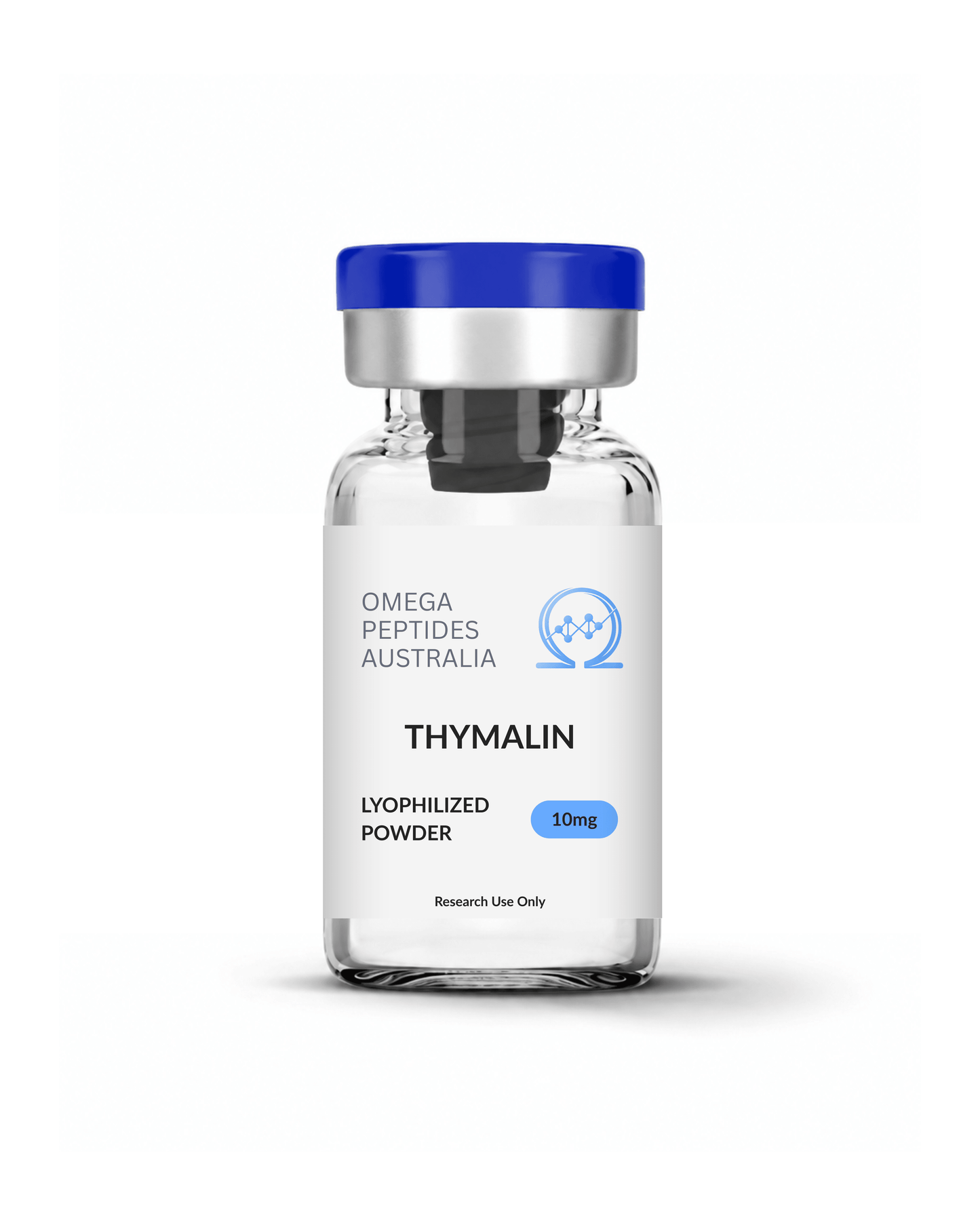
Thymalin (10mg) — Thymic Polypeptide Immune Research Compound
Thymalin (10mg) is supplied in Australia by Omega Peptides Australia from domestic stock, with same-day dispatch on orders placed before 12pm and an independent certificate of analysis for every batch. Commonly written as thymalin peptide, thymus peptide or thymic bioregulator, it is a thymic peptide bioregulator studied in immune and cellular-ageing research.
Thymalin is a polypeptide complex extracted from the thymus glands of young cattle. Rather than a single molecule, it is a standardised fraction of low-molecular-weight thymic peptides, generally described as a mixture of peptides up to about 10 kDa, developed in Leningrad in the 1970s by the Russian bioregulation research group led by Vladimir Khavinson and registered as an injectable medicine in the Soviet Union in 1982. The dipeptide Glu-Trp was later identified as one of its active components and developed separately as Thymogen. It is often written as thymalin peptide, thymalin 10mg or thymus polypeptide complex, and it should not be confused with thymulin, which is a distinct zinc-dependent nonapeptide.
Thymalin is studied as a thymic bioregulator in three main directions: restoration of T-cell function in immunodeficiency models, immune ageing and the long-term Russian studies of thymic peptides in elderly cohorts, and regulation of cytokine balance in inflammatory settings. The proposed mechanism is that its short peptides act on developing T lymphocytes to normalise the CD4 to CD8 ratio, promote differentiation of precursor cells and, according to the peptide bioregulation hypothesis, modulate gene expression in target cells.
Omega Peptides Australia supplies Thymalin as a high-purity (≥99% HPLC) COA-verified lyophilised powder in a sealed sterile 10mg vial. Orders placed before 12pm are dispatched the same day from within Australia, and the batch Certificate of Analysis for every lot is published in our COA library.
Key research areas
- T-cell restoration in immunodeficiency models Thymalin was originally characterised for its ability to restore impaired cellular immunity, and experimental work reports normalisation of T-lymphocyte counts, the ratio of helper to suppressor subsets and lymphocyte blast-transformation responses after thymectomy, irradiation or chemical immunosuppression. The proposed mechanism is peptide-driven maturation of thymocyte precursors.
- Immune ageing and thymic involution The thymus shrinks and its peptide output falls with age, and Thymalin has been used in Russian geroprotection research to test whether exogenous thymic peptides can partially offset that decline. Long-running observational programs in elderly cohorts, often alongside the pineal peptide preparation epithalamin, reported changes in immune indices and mortality that continue to be discussed in ageing research.
- Cytokine balance and inflammation Thymalin has been investigated for its effect on the balance between pro-inflammatory and regulatory cytokines, including work published during the COVID-19 pandemic that examined normalisation of cytokine synthesis in inflammatory lung disease. The research interest is in immune regulation rather than blunt stimulation.
- Phagocytosis and innate immunity Beyond lymphocytes, Thymalin is described in the Russian pharmacological literature as enhancing phagocytic activity of neutrophils and macrophages, and this innate-immune effect is one of the reasons it is studied alongside antimicrobial peptides such as LL-37.
- Peptide bioregulation and gene expression The Khavinson school proposes that short thymic peptides can enter cells, bind DNA and influence transcription of genes involved in cell differentiation. Thymalin serves as the parent extract for this line of work, which produced the synthetic dipeptides Thymogen (Glu-Trp) and Vilon (Lys-Glu) as defined analogues.
- Haematopoiesis and radioprotection Because thymic peptides support lymphoid recovery, Thymalin has been examined in models of bone-marrow suppression following radiation exposure or cytotoxic treatment, with research end points including leukocyte recovery time and survival in rodent studies.
How Thymalin works
Thymalin is a mixture, so its mechanism is described at the level of the biological response rather than a single receptor. The thymus is where T-cell precursors mature, and the peptides secreted by thymic epithelial cells act as differentiation signals. Thymalin is understood to supply a concentrated pool of those signals: in research models it increases the number and functional activity of T lymphocytes, restores the ratio of CD4+ helper to CD8+ suppressor cells, promotes maturation of precursor cells into functional T cells and enhances phagocytosis by cells of the innate immune system. The Glu-Trp dipeptide identified within the complex reproduces part of this activity on its own, which is how the synthetic analogue Thymogen was developed.
Because it is an extract, Thymalin has no single molecular weight, formula or amino-acid sequence, and its identity on a Certificate of Analysis is established by purity and peptide profile rather than by a single mass. This is the central difference from Thymosin Alpha-1, a chemically defined 28-amino-acid peptide with a known sequence, and from thymulin, a nine-residue peptide that requires zinc for activity. Detailed pharmacokinetic data for the mixture are limited in the accessible literature, so Omega Peptides Australia does not state a half-life for this compound.
Specifications
| Compound | Thymalin (thymus polypeptide complex) |
| Also known as | Thymalin peptide, thymalin 10mg, thymus polypeptide complex, thymic peptide bioregulator, thymus peptide, thymic bioregulator |
| CAS number | 79621-14-0 |
| Category | Immune research |
| Purity | ≥99% HPLC, batch COA supplied |
| Form | Lyophilised powder in a sealed sterile vial |
| Vial sizes available | 10mg — $89.99 |
| Storage (lyophilised) | 2–8°C short term or −20°C long term, protect from light and moisture, avoid repeated freeze-thaw |
| Storage (reconstituted) | 2–8°C, use within 28 days |
| Reconstitution | Bacteriostatic water (recommended) |
No molecular formula, molecular weight or sequence row is listed because Thymalin is a peptide mixture rather than a single defined molecule.
Available sizes and pricing
Thymalin is offered in a single 10mg vial. The per-milligram figure below allows a direct comparison with Thymosin Alpha-1, which is supplied in the same size at the same price.
- 10mg vial — $89.99 (about $9.00 per mg)
Multi-vial pricing: 2 vials $161.98 (10% off, $80.99 each), 3 vials $236.22 (12.5% off, $78.74 each), 4 vials $305.97 (15% off, $76.49 each). The discount is applied automatically in the cart.
There is no dedicated kit for Thymalin. A 10mL vial of bacteriostatic water is the usual companion purchase and will reconstitute several vials.
Quality and COA verification
Each batch of Thymalin supplied by Omega Peptides Australia is independently tested by Janoshik Analytical. HPLC is used to confirm purity of ≥99%, and mass spectrometry is used to characterise the peptide profile of the batch so that lot-to-lot consistency can be checked, which matters more for an extract than for a single-sequence peptide. A Certificate of Analysis is issued for every batch and published in our COA library, where the batch number on the vial label can be matched to its report. The compound is supplied lyophilised in a sealed sterile vial, since freeze-drying protects the peptide fraction from hydrolysis during storage and transit, and vials are packed in protective outer packaging for domestic delivery.
Frequently bought together
- Bacteriostatic Water (10mL) — $29.99, the diluent used to reconstitute lyophilised Thymalin.
- Thymosin Alpha-1 (10mg) — $89.99, the defined thymic peptide most often compared with Thymalin.
- Epitalon (10mg) — $79.99, the synthetic pineal tetrapeptide from the same bioregulation research lineage.
- LL-37 (5mg) — $119.99, the human antimicrobial peptide studied in innate immunity.
Research guides
- Peptide storage guide: how to store lyophilised peptides properly
- COA testing explained for research peptides in Australia
- Peptide reconstitution calculator
- Certificates of Analysis library
Frequently asked questions
What is Thymalin?
Thymalin is a polypeptide complex extracted from calf thymus, containing a range of low-molecular-weight thymic peptides up to about 10 kDa. It was developed by Russian bioregulation researchers in the 1970s and registered as a medicine in the Soviet Union in 1982. Omega Peptides Australia supplies it as a lyophilised research-grade powder in 10mg vials for in-vitro laboratory use, with an independent Certificate of Analysis for every batch.
What is Thymalin also known as?
It is also written as thymalin peptide, thymalin 10mg or thymus polypeptide complex, and it is sometimes described as a thymic bioregulator. It is the parent extract of the synthetic dipeptide Thymogen (Glu-Trp). It is not the same as thymulin, a zinc-dependent nonapeptide, and it is not Thymosin Alpha-1, which is a single defined 28-amino-acid peptide.
How does Thymalin work?
In research models Thymalin supplies thymic differentiation signals to developing T lymphocytes. It is reported to increase T-cell numbers and activity, normalise the ratio of CD4+ to CD8+ cells, promote maturation of precursor cells and enhance phagocytosis by innate immune cells. The bioregulation hypothesis proposes that its short peptides also modulate gene expression in target cells, and the Glu-Trp dipeptide reproduces part of the activity on its own.
What does the research show about Thymalin?
The research base is largely Russian and spans immunodeficiency models, radiation and chemotherapy recovery, long-term studies of thymic peptides in elderly cohorts and, more recently, work on cytokine regulation in inflammatory lung disease. Experimental studies report restoration of impaired cellular immunity, and animal work has examined lifespan and tumour incidence. Much of this literature predates modern trial standards, so results are best treated as a foundation for further research rather than settled findings.
Can I buy Thymalin at Chemist Warehouse or a pharmacy in Australia?
No. Thymalin is not a registered medicine in Australia and is not sold by Chemist Warehouse, Priceline or other retail pharmacies. It is registered as an injectable medicine in Russia and some neighbouring countries, but it is not on the Australian Register of Therapeutic Goods. The lyophilised research-grade compound sold here is supplied only for laboratory use and is not a pharmacy product.
Can Australian compounding pharmacies supply Thymalin?
Thymalin is not a compound that Australian compounding pharmacies routinely prepare, and any compounded peptide medicine would require an individual prescription under a pathway the TGA has placed under close scrutiny in its 2026 guidance on unapproved peptide products. Omega Peptides Australia is a research supplier: we supply the lyophilised compound for laboratory use and do not compound, prescribe or dispense medicines.
How do you reconstitute Thymalin?
Swab the stopper, then add bacteriostatic water slowly down the inside wall of the vial so the stream does not hit the powder directly. Swirl gently until dissolved; do not shake, because agitation can damage peptide chains and cause foaming. Label the vial with the date and concentration, refrigerate at 2–8°C and use within 28 days. Our reconstitution calculator works out the resulting concentration for any diluent volume.
How should Thymalin be stored?
Store the lyophilised vial at 2–8°C for short-term use or at −20°C for long-term storage, protected from light and moisture. The freeze-dried powder is stable for many months under these conditions. After reconstitution keep the solution at 2–8°C and use it within 28 days, and avoid repeated freeze-thaw cycles, which are more damaging to a peptide mixture than steady refrigeration.
Where can I buy Thymalin in Australia?
Omega Peptides Australia holds Thymalin in domestic stock, so orders placed before 12pm are dispatched the same day without international shipping delays or customs uncertainty. Every batch carries an independent Certificate of Analysis, and the compound sits within our research peptides collection alongside Thymosin Alpha-1, LL-37 and other immune research peptides.
What does Thymalin cost in Australia?
A 10mg vial of Thymalin costs $89.99 from Omega Peptides Australia, which is about $9.00 per mg. There is no bundle for this compound at present. Bacteriostatic water is available separately in 3mL and 10mL sizes for reconstitution. Pricing is expressed per vial and per milligram only, as the product is supplied for laboratory use.
How do I get Thymalin online in Australia?
Select the 10mg vial on this product page, add any bacteriostatic water or syringes you need, and complete checkout. Orders placed before 12pm are dispatched the same day from within Australia with tracked domestic shipping in plain, discreet packaging. A tracking number is emailed when the parcel is lodged, and most metropolitan addresses receive their order within a few business days.
Is Thymalin legal in Australia?
Omega Peptides Australia supplies Thymalin strictly for lawful in-vitro laboratory research. It is not approved by the TGA for human or veterinary use and is not sold as a medicine or supplement. Purchasers are responsible for ensuring their intended use complies with all applicable laws, including any state or territory requirements that apply to their laboratory.
What is the difference between Thymalin and Thymosin Alpha-1?
Thymalin is a natural extract containing many thymic peptides, so it has a CAS number but no single molecular weight, formula or sequence, and its Certificate of Analysis describes a peptide profile. Thymosin Alpha-1 is a single synthetic 28-amino-acid peptide with a defined sequence and a molecular weight of about 3,108 daltons, verified by mass spectrometry. Both are used in immune research, but they are different products and are not interchangeable.
⚠ For in-vitro research and laboratory use only. Not for human or veterinary use.
Share