Omega Peptides Australia
Couldn't load pickup availability
For laboratory research use only. Not for human or veterinary use, consumption, or therapeutic application. Not a drug, food, cosmetic, or dietary supplement. Handling restricted to qualified researchers in an appropriate setting.
Certificates of Analysis
Independent third-party testing for this product. Tap a report to view the data.


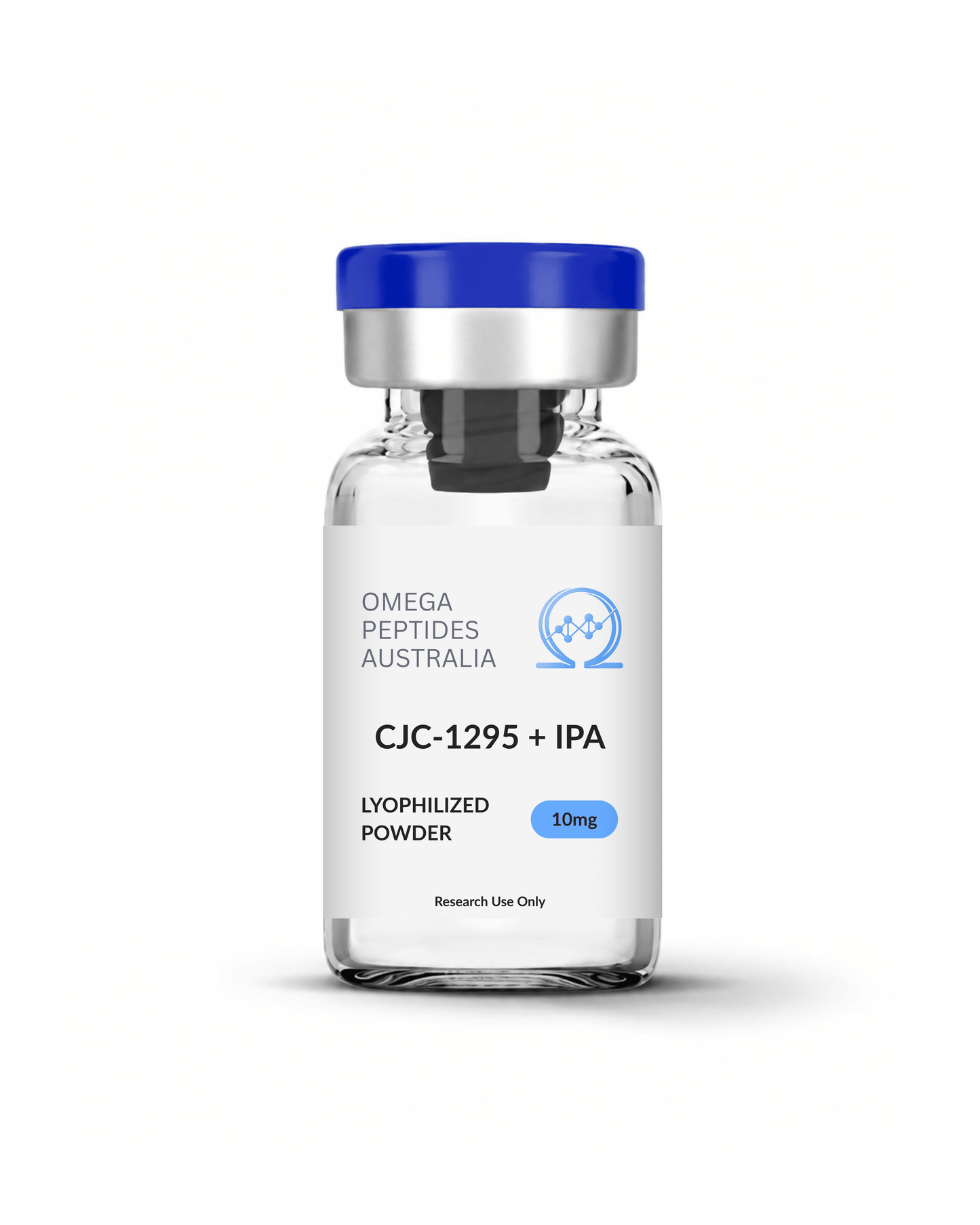
CJC-1295 No DAC + Ipamorelin Blend (10mg) — Dual Growth Hormone Secretagogue Research Compound
This blend combines two growth hormone secretagogues that act through different receptors in a single lyophilised vial containing 5mg of each. CJC-1295 No DAC, properly called Modified GRF (1-29), is a 29-amino-acid analogue of the active fragment of growth hormone-releasing hormone (GHRH) carrying four stabilising substitutions. Ipamorelin is a synthetic pentapeptide developed by Novo Nordisk as a selective agonist of the ghrelin receptor. The combination is often written as CJC 1295 Ipamorelin, cjc/ipa, Mod GRF 1-29 + Ipamorelin or cjc1295 ipamorelin blend.
The blend is studied for pulsatile growth hormone release, for the interaction between the GHRH and ghrelin pathways, and for downstream IGF-1 signalling in metabolic and recovery models. Modified GRF (1-29) binds the GHRH receptor on pituitary somatotrophs and raises cyclic AMP, which drives growth hormone synthesis and release, while ipamorelin binds the growth hormone secretagogue receptor GHS-R1a and signals through calcium mobilisation. Because the two receptors converge on the same cells, their combined effect on growth hormone output in research models is larger than either compound produces alone.
Omega Peptides Australia supplies the CJC-1295 No DAC and Ipamorelin blend as a high-purity (≥99% HPLC) COA-verified lyophilised powder in a 10mg vial, dispatched same day from within Australia on orders placed before 12pm. Every batch is independently tested and the certificate for your vial can be reviewed in our COA library before you order.
Key research areas
- Pulsatile growth hormone release The blend is the standard research model for dual-pathway secretagogue stimulation. Modified GRF (1-29) supplies a short GHRH-receptor signal and ipamorelin supplies a ghrelin-receptor signal, and studies examine how the two together shape the amplitude and timing of growth hormone pulses without the sustained elevation seen with long-acting analogues.
- GHRH and ghrelin pathway interaction Because the GHRH receptor works through cyclic AMP and the ghrelin receptor through phospholipase C and calcium, the two signals reinforce each other inside the somatotroph. The blend is used to study this synergy and the role of somatostatin suppression in amplifying release.
- IGF-1 and downstream signalling Growth hormone stimulates hepatic IGF-1 production, and the blend is used in models that follow IGF-1, IGF-binding proteins and hypothalamic feedback after repeated pulsatile stimulation.
- Body-composition and metabolic research Growth hormone influences lipolysis, protein synthesis and glucose handling, and dual secretagogue stimulation is examined in preclinical body-composition and recovery models.
- Selectivity and hormone-profile research Ipamorelin was selected in development because it stimulates growth hormone without meaningfully raising cortisol, ACTH or prolactin. The blend is used to study whether that selectivity is preserved when a GHRH analogue is added.
- Comparative secretagogue studies Researchers compare the No DAC blend with CJC-1295 DAC, sermorelin, tesamorelin, GHRP-2 and GHRP-6 to examine duration of action, receptor potency and hormone selectivity across the secretagogue family.
How the CJC-1295 No DAC + Ipamorelin blend works
Growth hormone is released from the pituitary in pulses that are driven by GHRH and restrained by somatostatin, with ghrelin acting as a third amplifying input. Modified GRF (1-29) reproduces the GHRH input. Native GHRH is degraded within minutes by dipeptidyl peptidase-IV, so the analogue carries D-alanine at position 2 to block that cleavage, glutamine at position 8 to prevent deamidation, alanine at position 15 to improve receptor binding and leucine at position 27 to prevent methionine oxidation. Its half-life is around thirty minutes, so it produces a discrete pulse rather than a plateau. Ipamorelin supplies the ghrelin input: it is a pentapeptide with the sequence Aib-His-D-2-Nal-D-Phe-Lys-NH2 that activates GHS-R1a on somatotrophs and in the hypothalamus, and its half-life is roughly two hours.
The value of the pairing lies in the two receptors sharing the same target cell but using different second messengers, cyclic AMP for GHRH and calcium for ghrelin, so their effects on growth hormone release multiply rather than simply add. Ghrelin-receptor agonists also reduce somatostatin tone, which removes the brake on GHRH action. The No DAC form is used in this blend rather than CJC-1295 DAC because the short-acting analogue preserves the natural pulsatile pattern, whereas the DAC version binds albumin and signals continuously for days. Ipamorelin is preferred over GHRP-2 and GHRP-6 because it does not stimulate cortisol and prolactin release in the way those older agonists do.
Specifications
| Compound | CJC-1295 No DAC (Modified GRF 1-29) 5mg + Ipamorelin 5mg, 10mg total per vial |
| Also known as | CJC 1295 Ipamorelin, cjc/ipa, Mod GRF 1-29 + Ipamorelin, cjc1295 ipamorelin blend |
| CAS number | Modified GRF (1-29): 863288-34-0; Ipamorelin: 170851-70-4 |
| Molecular formula | Modified GRF (1-29): C152H252N44O42; Ipamorelin: C38H49N9O5 |
| Molecular weight | Modified GRF (1-29): ~3367.9 g/mol; Ipamorelin: ~711.9 g/mol |
| Sequence | Ipamorelin: Aib-His-D-2-Nal-D-Phe-Lys-NH2; Modified GRF (1-29): 29-residue GHRH(1-29) analogue with D-Ala2, Gln8, Ala15 and Leu27 substitutions |
| Category | Growth hormone research |
| Purity | ≥99% HPLC, batch COA supplied |
| Form | Lyophilised powder blend in a sealed sterile vial |
| Vial sizes available | 10mg (5mg + 5mg) — $139.99 |
| Storage (lyophilised) | 2–8°C short term or −20°C long term, protect from light and moisture, avoid repeated freeze-thaw |
| Storage (reconstituted) | 2–8°C, use within 28 days |
| Reconstitution | Bacteriostatic water (recommended) |
Available sizes and pricing
The blend is supplied in a single 10mg vial containing 5mg of Modified GRF (1-29) and 5mg of ipamorelin in a fixed one-to-one ratio by mass, with one COA covering both components. Researchers who need the components individually can find ipamorelin on its own in a 10mg vial.
- 10mg vial (5mg CJC-1295 No DAC + 5mg Ipamorelin) — $139.99 (about $14.00 per mg)
Quality and COA verification
Every batch of the blend is independently tested by Janoshik Analytical. HPLC is used to confirm purity at or above 99% and mass spectrometry is used to confirm the identity of both components, so the certificate shows that the vial contains Modified GRF (1-29) rather than the DAC form, and ipamorelin rather than a related ghrelin agonist. A Certificate of Analysis is issued for every batch and published in our COA library, where it can be matched to the batch number on your vial. The blend is supplied as a lyophilised powder in a sealed sterile vial for stability in storage and transit, and each order is packed securely and discreetly for domestic delivery within Australia.
Frequently bought together
- CJC-1295 (DAC) (5mg) — $89.99, the long-acting albumin-bound GHRH analogue for DAC versus No DAC comparisons
- Ipamorelin (10mg) — $89.99, the selective ghrelin-receptor agonist on its own for single-pathway controls
- Tesamorelin (10mg) — $139.99, a full-length stabilised GHRH analogue for comparative GHRH-receptor work
- Bacteriostatic Water (10mL) — $29.99, the recommended diluent for reconstituting lyophilised peptides
Research guides
- CJC-1295 and Ipamorelin research guide
- CJC-1295 and Ipamorelin research overview
- Sermorelin research guide
- How to store lyophilised peptides
- COA testing explained
- Peptide reconstitution calculator
Frequently asked questions
What is the CJC-1295 No DAC + Ipamorelin blend?
It is a two-peptide research blend supplied in one lyophilised vial containing 5mg of Modified GRF (1-29), the No DAC form of CJC-1295, and 5mg of ipamorelin. The first is a short-acting GHRH-receptor agonist and the second is a selective ghrelin-receptor agonist, and together they are studied for pulsatile growth hormone release. Omega Peptides Australia supplies the blend COA-verified for in-vitro laboratory research only.
What is the CJC-1295 No DAC + Ipamorelin blend also known as?
The combination is commonly written as CJC 1295 Ipamorelin, cjc/ipa, CJC-1295/Ipamorelin, Mod GRF 1-29 + Ipamorelin or cjc1295 ipamorelin blend. The GHRH component is properly named Modified GRF (1-29), CAS 863288-34-0, and is sometimes called CJC-1295 without DAC. The ghrelin-receptor component is ipamorelin, CAS 170851-70-4, which also carries the development code NNC 26-0161.
How does the CJC-1295 No DAC + Ipamorelin blend work?
Modified GRF (1-29) activates the GHRH receptor on pituitary somatotrophs and raises cyclic AMP, stimulating growth hormone synthesis and release. Ipamorelin activates the ghrelin receptor GHS-R1a, which signals through calcium and also reduces the inhibitory effect of somatostatin. Because the two signals converge on the same cells through different second messengers, their combined effect on growth hormone output in research models is greater than the sum of the two alone.
What does the research show about the CJC-1295 No DAC + Ipamorelin blend?
Preclinical and early clinical pharmacology studies of the individual components established that GHRH analogues and ghrelin-receptor agonists each stimulate growth hormone release and that combined administration produces amplified pulses. Ipamorelin's development programme reported growth hormone release without notable effects on cortisol, ACTH or prolactin. The blend is used mainly in models of pulsatile GH release, the GH-IGF-1 axis and secretagogue selectivity.
Can I buy the CJC-1295 No DAC + Ipamorelin blend at Chemist Warehouse or a pharmacy in Australia?
No. Neither Modified GRF (1-29) nor ipamorelin is a registered medicine in Australia, and neither is stocked by Chemist Warehouse, Priceline or any other retail pharmacy. The blend supplied here is a research-grade lyophilised compound with an independent batch Certificate of Analysis, intended for laboratory use only.
Can Australian compounding pharmacies supply the CJC-1295 No DAC + Ipamorelin blend?
CJC-1295 and ipamorelin have in the past been among the peptides some Australian compounding pharmacies prepared on prescription. Compounding is only permitted for an individual patient on a valid prescription from a registered prescriber, within Pharmacy Board and TGA rules, and the TGA has stepped up compliance action on unapproved peptide products. Omega Peptides Australia is not a pharmacy. We supply the lyophilised research blend with a batch COA for in-vitro laboratory work only.
How do you reconstitute the CJC-1295 No DAC + Ipamorelin blend?
Use bacteriostatic water. Let the vial reach room temperature, then add the water slowly down the inside wall so it runs onto the powder without splashing. Swirl gently until both peptides have dissolved, do not shake. Because the vial contains 5mg of each peptide, the concentration of each component is half the total peptide concentration, which our reconstitution calculator can work out for you. Refrigerate at 2 to 8°C and use within 28 days.
How should the CJC-1295 No DAC + Ipamorelin blend be stored?
Keep sealed lyophilised vials at 2 to 8°C for short-term storage or at minus 20°C for long-term storage, protected from light and moisture, and avoid repeated freeze-thaw cycles. Both peptides are stable as a dry powder for extended periods under these conditions. After reconstitution, store the solution in the refrigerator at 2 to 8°C and use within 28 days.
Where can I buy the CJC-1295 No DAC + Ipamorelin blend in Australia?
The blend can be ordered directly from Omega Peptides Australia. Stock is held domestically, orders placed before 12pm are dispatched the same day with tracked shipping, and every batch has an independent Janoshik COA in our library. Related secretagogues are listed in our range of research peptides in Australia if you are ordering for a comparative study.
What does the CJC-1295 No DAC + Ipamorelin blend cost in Australia?
The blend is $139.99 for a 10mg vial containing 5mg of Modified GRF (1-29) and 5mg of ipamorelin, which works out at about $14.00 per mg of total peptide. The blend gives both peptides in one vial with a single COA, and it removes the step of combining two reconstituted solutions. Ipamorelin on its own is $89.99 for 10mg and CJC-1295 DAC is $89.99 for 5mg.
How do I get the CJC-1295 No DAC + Ipamorelin blend online in Australia?
Select the 10mg vial on this page, add it to your cart and complete checkout. Orders ship from our Australian stock with tracked domestic delivery in discreet packaging, and orders placed before 12pm on a business day are dispatched the same day. Shipping from within Australia means no customs clearance or import paperwork and short delivery times.
Is the CJC-1295 No DAC + Ipamorelin blend legal in Australia?
Omega Peptides Australia supplies the CJC-1295 No DAC + Ipamorelin blend strictly for lawful in-vitro laboratory research. It is not approved by the TGA for human or veterinary use and is not sold as a medicine or supplement. Purchasers are responsible for ensuring their intended use complies with all applicable laws.
What is the difference between the No DAC blend and CJC-1295 DAC?
Both contain the same modified GHRH(1-29) sequence. The No DAC form in this blend has no albumin-binding linker, so it acts for around thirty minutes and produces a discrete growth hormone pulse, and it is paired with ipamorelin to add a ghrelin-receptor signal. CJC-1295 DAC carries a maleimide linker that binds albumin, giving a half-life of days and a continuous GHRH signal. Researchers choose No DAC to preserve pulsatility and DAC for sustained stimulation.
⚠ For in-vitro research and laboratory use only. Not for human or veterinary use.