Omega Peptides Australia
Couldn't load pickup availability
For laboratory research use only. Not for human or veterinary use, consumption, or therapeutic application. Not a drug, food, cosmetic, or dietary supplement. Handling restricted to qualified researchers in an appropriate setting.
Dihexa (10mg) — Angiotensin IV-Derived HGF/c-Met Research Compound
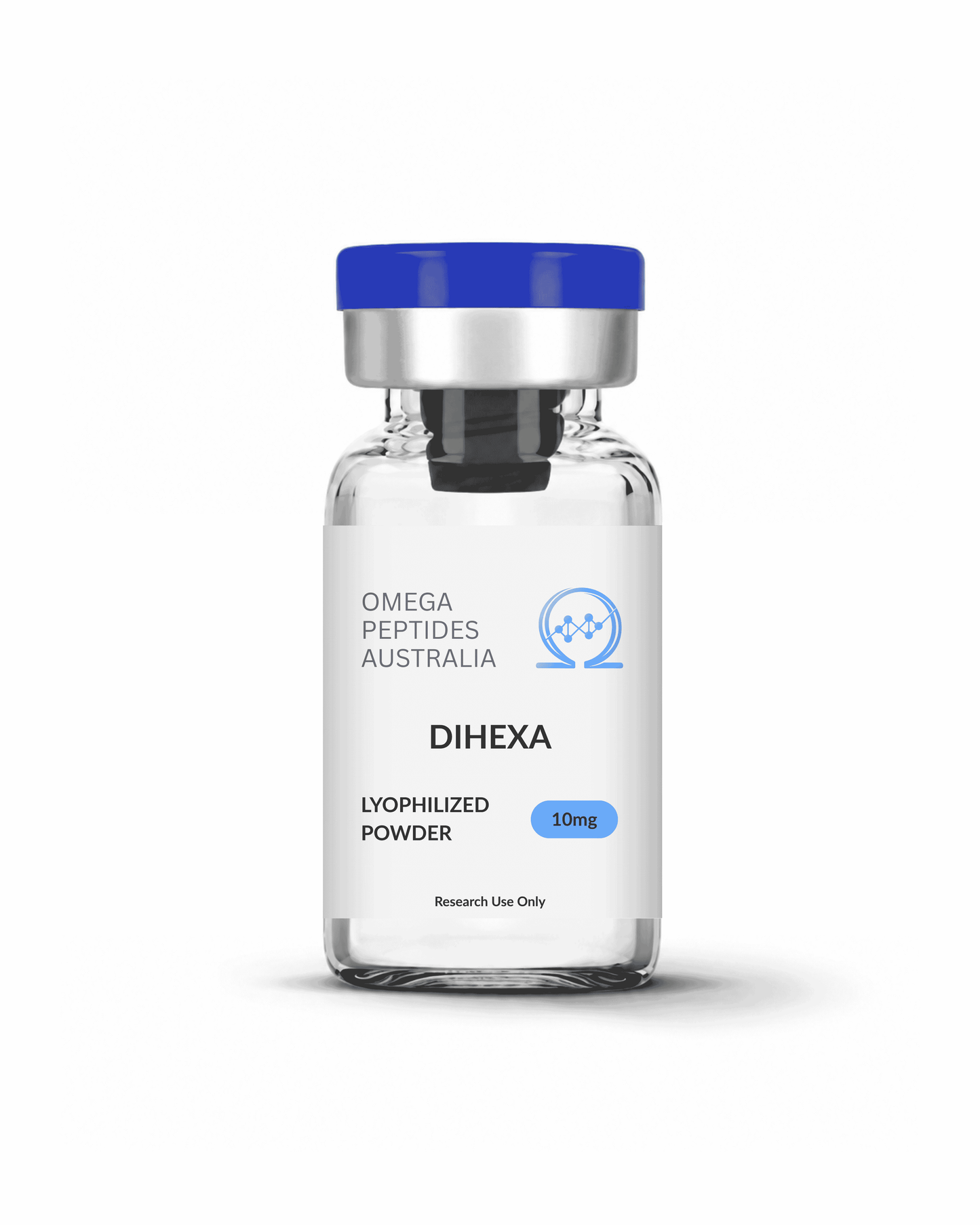
Dihexa (10mg) is supplied in Australia by Omega Peptides Australia from domestic stock, with same-day dispatch on orders placed before 12pm and an independent certificate of analysis for every batch. Commonly written as PNB-0408, dihexa peptide or HGF mimetic, it is an angiotensin IV-derived compound studied as a hepatocyte growth factor mimetic.
Dihexa is a small synthetic peptide-like compound developed in a United States university neuroscience programme as a metabolically stable derivative of angiotensin IV. Its full chemical name is N-hexanoic-Tyr-Ile-(6)-aminohexanoic amide: a hexanoyl fatty-acid cap on the N-terminus, the amino acids tyrosine and isoleucine, and a six-carbon aminohexanoic amide tail in place of the remaining angiotensin IV residues. Those modifications remove the cleavage sites that make the parent peptide short-lived and give Dihexa a lipophilic character unusual among research peptides. It was first reported under the development code PNB-0408 and is often written as dihexa peptide, dihexa nootropic or Hexanoyl-Tyr-Ile-Ahx-NH2.
Dihexa is studied principally for synaptogenesis and dendritic spine formation in cultured hippocampal neurons, for memory and learning in rodent models of induced cognitive deficit, and for neuroprotection in models of dopaminergic neuron loss. At the molecular level it is reported to bind hepatocyte growth factor (HGF) with picomolar affinity, promoting HGF dimerisation and activation of the c-Met receptor tyrosine kinase, a pathway that drives neuronal survival, growth and synaptic connectivity.
Omega Peptides Australia supplies Dihexa as a high-purity (≥99% HPLC) COA-verified lyophilised powder in a sealed sterile 10mg vial. Orders placed before 12pm are dispatched the same day from within Australia, and the certificate for each batch is published in our COA library. A capsule format is also available for laboratories running oral research models.
Key research areas
- Synaptogenesis and dendritic spine density In cultured rat hippocampal neurons, Dihexa has been reported to increase the number of dendritic spines and functional synapses at very low concentrations, with the developers describing its potency in spinogenesis assays as several orders of magnitude greater than BDNF. This work forms the core of the compound's research profile and is used to probe how HGF/c-Met signalling shapes synaptic architecture.
- Memory and learning in rodent models Dihexa has been examined in rats with scopolamine-induced cholinergic deficits and in aged animals using spatial tasks such as the Morris water maze, where it is associated with restored acquisition and recall. These studies established that the compound reaches the brain after peripheral or oral administration in animals, which distinguishes it from most peptide research tools.
- HGF/c-Met signalling Because Dihexa acts as an HGF mimetic rather than a direct receptor agonist, it is used to study how c-Met activation influences neuronal survival, neurite outgrowth and plasticity. Blocking experiments with c-Met inhibitors have been used to confirm that the synaptic effects depend on this pathway.
- Neurodegeneration and dopaminergic neuron models Dihexa has been studied in rodent models that mimic the loss of dopaminergic neurons seen in Parkinson's disease, with attention to neuronal survival and motor behaviour. Investigators are interested in whether c-Met activation can support damaged neurons and whether the effect is additive with other neurotrophic strategies.
- Angiotensin IV and the AT4/IRAP system Dihexa descends from research into angiotensin IV and its putative AT4 receptor, later identified as insulin-regulated aminopeptidase (IRAP). Comparative studies use Dihexa alongside Nle1-angiotensin IV to separate HGF/c-Met effects from those attributable to IRAP inhibition.
- Blood-brain barrier and metabolic stability The hexanoyl cap and aminohexanoic amide were designed to resist aminopeptidases and carboxypeptidases. Dihexa is therefore also studied as a model for engineering peptide-like drugs that survive oral absorption and cross the blood-brain barrier in rodent studies.
How Dihexa works
Hepatocyte growth factor is a large protein that must dimerise to activate its receptor, c-Met, a tyrosine kinase expressed on neurons and many other cell types. Dihexa is reported to bind HGF directly and stabilise the active dimer, effectively lowering the amount of HGF needed to trigger c-Met signalling. Once activated, c-Met recruits intracellular adaptors that switch on the PI3K/Akt and MAPK/ERK pathways, promoting cell survival, cytoskeletal remodelling and the formation of new synaptic contacts. In neuronal cultures this manifests as more dendritic spines and more functional synapses; in behavioural models it corresponds to improved learning performance in animals with induced deficits. Because the compound amplifies an endogenous ligand rather than replacing it, its activity depends on the presence of HGF in the tissue being studied.
Structurally, Dihexa is closer to a peptidomimetic than a conventional peptide. With a molecular weight of about 505 daltons and a fatty-acid cap, it is far more lipophilic than Semax or Selank and is described in rodent studies as orally active and able to cross the blood-brain barrier, properties that most short peptides lack. This same lipophilicity means it dissolves more slowly in water than typical lyophilised peptides. Compared with Semax, which acts through BDNF and melanocortin-related pathways, and Cerebrolysin, a mixture that mimics several neurotrophic factors at once, Dihexa is a single defined molecule with one well-characterised target, which makes it a clean tool for c-Met-focused experiments.
Specifications
| Compound | Dihexa |
| Also known as | PNB-0408, N-hexanoic-Tyr-Ile-(6)-aminohexanoic amide, Hexanoyl-Tyr-Ile-Ahx-NH2, dihexa peptide, dihexa nootropic, HGF mimetic |
| CAS number | 1401708-83-5 |
| Molecular formula | C27H44N4O5 |
| Molecular weight | 504.67 g/mol |
| Sequence | Hexanoyl-Tyr-Ile-Ahx-NH2 (N-hexanoyl-tyrosyl-isoleucyl-6-aminohexanamide) |
| Category | Nootropic research |
| Purity | ≥99% HPLC, batch COA supplied |
| Form | Lyophilised powder in a sealed sterile vial |
| Vial sizes available | 10mg — $169.99 |
| Storage (lyophilised) | 2–8°C short term or −20°C long term, protect from light and moisture, avoid repeated freeze-thaw |
| Storage (reconstituted) | 2–8°C, use within 28 days |
| Reconstitution | Bacteriostatic water (recommended); allow extra time to dissolve because of the compound's lipophilic structure |
Available sizes and pricing
Dihexa is supplied as a single 10mg lyophilised vial. Because the compound is active at very low concentrations in cell-culture work, a 10mg vial supports an extended series of in-vitro experiments. Laboratories running oral rodent models can choose the capsule format instead, which contains 600mg across 60 capsules and brings the per-milligram cost down considerably.
- 10mg vial — $169.99 (about $17.00 per mg)
See Dihexa Capsules (60 caps) at $399.99 for the oral research format.
Quality and COA verification
Every batch of Dihexa is tested independently by Janoshik Analytical. HPLC is used to quantify purity against the ≥99% specification and mass spectrometry confirms that the observed mass matches the expected 504.67 g/mol, ruling out truncated or mis-synthesised material. A Certificate of Analysis is issued for every lot and published in our COA library, where you can match the batch number on your vial to its report. The compound is lyophilised to prevent hydrolysis during storage, sealed in a sterile vial with a crimped cap, and packed with protective cushioning for domestic transit so it arrives in the same condition it left our facility.
Frequently bought together
- Dihexa Capsules (60 caps) — $399.99, the oral format for rodent feeding studies and long-duration protocols
- Semax (10mg) — $79.99, a BDNF-pathway nootropic peptide used as a mechanistic comparator
- Cerebrolysin (60mg) — $269.99, a neurotrophic peptide mixture often studied alongside single-target compounds
- Bacteriostatic Water (10mL) — $29.99, for reconstituting the lyophilised powder
Research guides
- Peptide storage guide: how to store lyophilised peptides properly
- COA testing explained
- Peptide reconstitution calculator
- Certificates of Analysis library
Frequently asked questions
What is Dihexa?
Dihexa is a synthetic angiotensin IV-derived compound, N-hexanoic-Tyr-Ile-(6)-aminohexanoic amide, developed as a metabolically stable molecule that activates the HGF/c-Met pathway. It has been studied in cultured neurons for synapse formation and in rodent models for memory and neuroprotection. It was first described under the code PNB-0408 and is supplied here as a lyophilised research powder for in-vitro and laboratory use only.
What is Dihexa also known as?
It is also written as dihexa peptide, dihexa nootropic or Dihexa PNB-0408, and appears in chemical catalogues as N-hexanoic-Tyr-Ile-(6)-aminohexanoic amide or Hexanoyl-Tyr-Ile-Ahx-NH2. Its CAS number is 1401708-83-5. It is sometimes described as an angiotensin IV analogue or an HGF mimetic, both of which refer to the same compound.
How does Dihexa work?
Dihexa binds hepatocyte growth factor and stabilises it in the dimeric form that activates the c-Met receptor tyrosine kinase. Activated c-Met signals through PI3K/Akt and MAPK/ERK to support neuronal survival, neurite growth and the formation of new dendritic spines and synapses. Because it amplifies an endogenous ligand, its effect in a given model depends on local HGF availability, and c-Met inhibitors have been used in research to block its activity.
What does the research show about Dihexa?
Published preclinical work reports that Dihexa increases dendritic spine density and functional synapses in cultured hippocampal neurons at picomolar to nanomolar concentrations, and improves spatial learning in rats with scopolamine-induced deficits and in aged animals. Further rodent studies have examined dopaminergic neuron models. There are no published human clinical trials, so all findings to date come from in-vitro and animal research.
Can I buy Dihexa at Chemist Warehouse or a pharmacy in Australia?
No. Dihexa is not a registered medicine anywhere in the world, is not listed on the Australian Register of Therapeutic Goods, and is not stocked by Chemist Warehouse, Priceline or any other retail pharmacy. In Australia it is available only as a research-grade compound from laboratory suppliers, supplied in lyophilised or capsule form for in-vitro and laboratory use.
Can Australian compounding pharmacies supply Dihexa?
Australian compounding pharmacies may only prepare medicines for an individual patient on prescription, and the TGA has warned of significant uncertainties around compounded unapproved peptides whose ingredients are not described in recognised compounding references. Dihexa has no such reference, no pharmacopoeial monograph and no clinical data, so it is not a compounding product. Research suppliers such as Omega Peptides Australia supply the lyophilised research compound for laboratory use.
How do you reconstitute Dihexa?
Use bacteriostatic water. Add it slowly down the inside wall of the vial rather than onto the powder, then swirl gently; do not shake. Dihexa is more lipophilic than typical peptides, so it can take longer to disperse fully and some laboratories select a co-solvent according to their own validated method. Once in solution, refrigerate the vial at 2–8°C and use within 28 days.
How should Dihexa be stored?
Store the sealed lyophilised vial at 2–8°C for short-term use or at −20°C for long-term storage, protected from light and moisture, and avoid repeated freeze-thaw cycles. After reconstitution, keep the solution refrigerated at 2–8°C and use it within 28 days. The lyophilised form is stable for extended periods when kept cold and dry, which is why we ship it as a powder rather than a solution.
Where can I buy Dihexa in Australia?
Omega Peptides Australia holds Dihexa in domestic stock, dispatches orders placed before 12pm the same day, and provides a batch Certificate of Analysis for every vial. Buying from an Australian supplier avoids international shipping delays and customs uncertainty. You can also browse the full research peptides Australia collection for related neuropeptides.
What does Dihexa cost in Australia?
The 10mg lyophilised vial is $169.99, or about $17.00 per mg. The capsule format, 60 capsules of 10mg each, is $399.99, which works out to about $0.67 per mg and suits laboratories that need larger quantities for oral rodent studies. All prices are in Australian dollars and include third-party batch testing.
How do I get Dihexa online in Australia?
Choose the 10mg vial on this page, add it to your cart and complete checkout. Orders are shipped with tracked domestic delivery in discreet packaging that carries no reference to the contents. Orders placed before 12pm on a business day are dispatched the same day; later orders leave the following business day, and tracking details are emailed when the parcel is lodged.
Is Dihexa legal in Australia?
Omega Peptides Australia supplies Dihexa strictly for lawful in-vitro laboratory research. It is not approved by the TGA for human or veterinary use and is not sold as a medicine or supplement. Purchasers are responsible for ensuring their intended use complies with all applicable laws.
Dihexa vial vs Dihexa capsules: which format is used for which research?
The lyophilised vial is the format for cell-culture and in-vitro work, where the compound is dissolved and applied at defined concentrations, and for any study that requires a precisely prepared solution. Dihexa Capsules contain 10mg per capsule and are chosen for oral rodent models and long-duration protocols where reconstitution is impractical and a larger total quantity is needed. Both formats are tested to the same purity specification.
⚠ For in-vitro research and laboratory use only. Not for human or veterinary use.
Share