Omega Peptides Australia
Couldn't load pickup availability
Disclaimer
By viewing this page I acknowledge this is for lab research use only. It is not for human or veterinary use, consumption, or therapeutic application. It is not a drug, food, cosmetic, or dietary supplement, and must only be handled by qualified researchers in an appropriate setting.
Cerebrolysin (60mg) — Neurotrophic Peptide Mixture Research Compound
Omega Peptides Australia supplies Cerebrolysin (60mg) in Australia from domestic stock, dispatching same day on orders placed before 12pm with a certificate of analysis published for every batch. Often written cerebrolysin peptide or neuropeptide preparation, it is a porcine-derived neuropeptide preparation studied for neurotrophic signalling.
Cerebrolysin is a standardised mixture of low-molecular-weight peptides and free amino acids produced by enzymatic hydrolysis of purified porcine brain proteins. Unlike a single synthetic peptide, it has no one sequence: roughly a quarter of its mass is made up of short peptides below 10 kDa and the remainder is free amino acids, and the preparation is defined by its manufacturing process and analytical profile rather than a molecular formula. It is often written as cerebrolysin peptide or cerebrolysin 60mg, and is variously described as a porcine brain-derived peptide preparation, a brain peptide hydrolysate or a neurotrophic peptide complex.
Cerebrolysin has been investigated for decades in ischaemic stroke recovery, traumatic brain injury and dementia of both Alzheimer and vascular type, making it one of the most extensively studied neuropeptide preparations in the literature. Its proposed mechanism is neurotrophic factor mimicry: the peptide fraction is reported to engage signalling normally driven by nerve growth factor, BDNF, GDNF and CNTF, activating Trk receptors and downstream survival pathways while reducing calpain and caspase activation in stressed neurons.
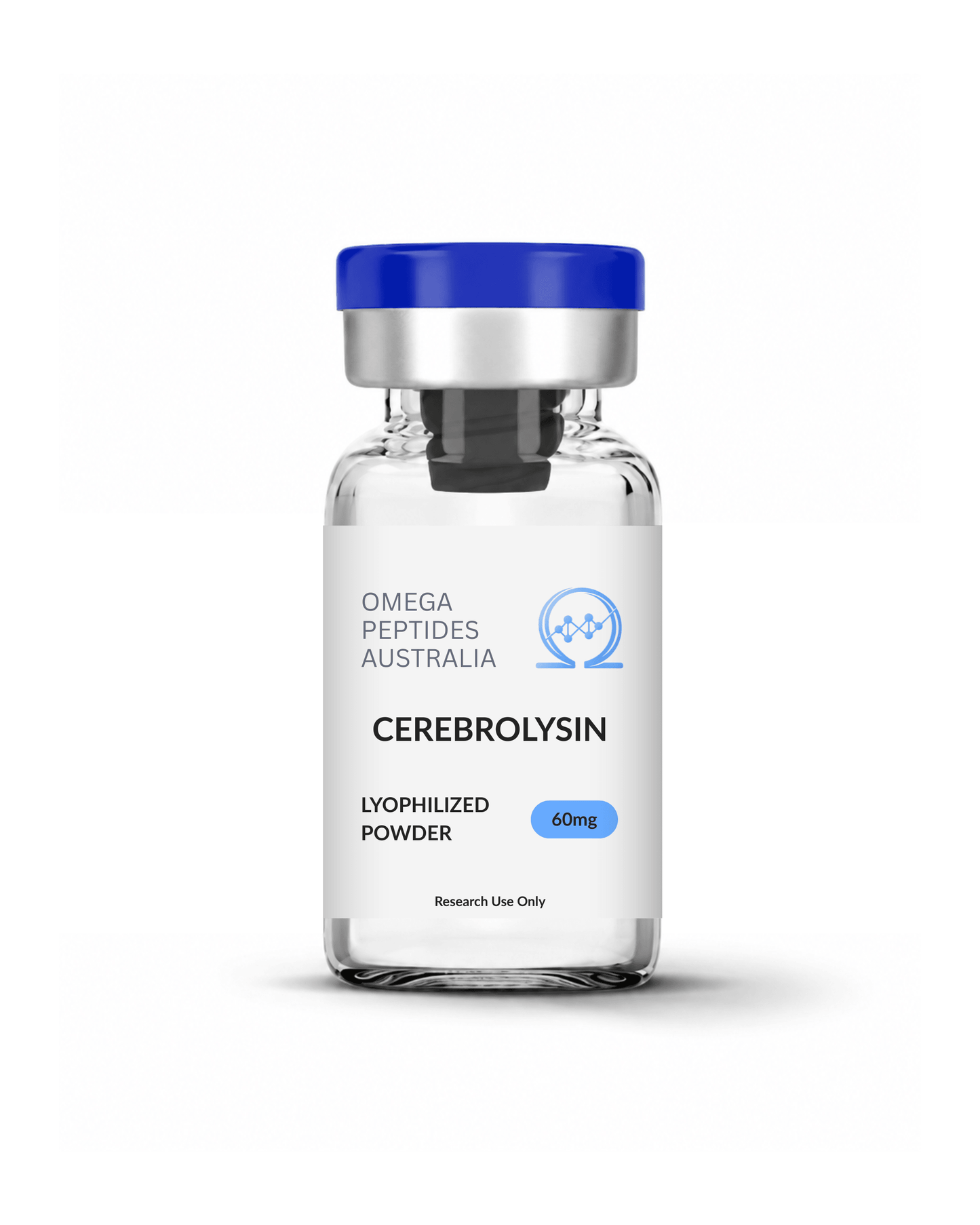
Omega Peptides Australia supplies Cerebrolysin as a high-purity (≥99% HPLC) COA-verified lyophilised powder in a sealed sterile 60mg vial, prepared for laboratory research rather than as a pharmaceutical presentation. Orders placed before 12pm are dispatched the same day from within Australia, and the certificate for every batch is published in our COA library.
Key research areas
- Ischaemic stroke recovery Cerebrolysin has been studied in rodent models of middle cerebral artery occlusion and in clinical programmes in countries where it is registered, with outcomes including infarct volume, neurological scoring and functional recovery. The proposed mechanism combines protection of neurons in the penumbra during the acute phase with support for neurogenesis and angiogenesis during recovery.
- Traumatic brain injury In experimental head-injury models the preparation is investigated for its influence on secondary injury processes such as excitotoxicity, oxidative stress and inflammation, as well as on longer-term recovery of motor and cognitive function. Research focuses on whether neurotrophic support in the days after injury changes the trajectory of repair.
- Alzheimer-type and vascular dementia models Cerebrolysin has been examined in transgenic mouse models of amyloid pathology, where it is associated with altered processing of amyloid precursor protein, reduced amyloid burden and modulation of the kinases GSK-3 beta and CDK5 that hyperphosphorylate tau. Clinical studies in dementia have been conducted in registered markets with mixed conclusions.
- Neurotrophic factor signalling A central research question is how a mixture of small peptides can reproduce actions of large growth factors. Studies examine activation of TrkA and TrkB receptors, PI3K/Akt and MAPK signalling, and expression of neurotrophins themselves, using cultured neurons and rodent brain tissue.
- Neurogenesis and synaptic plasticity Cerebrolysin is reported to increase proliferation and survival of new neurons in the subventricular zone and hippocampal dentate gyrus of rodents and to promote dendritic branching and synapse formation, with Sonic hedgehog signalling among the pathways proposed to mediate the effect.
- Excitotoxicity and apoptosis In-vitro work uses glutamate, hypoxia or oxidative insults to study whether Cerebrolysin limits NMDA-driven calcium overload, calpain activation and caspase-3 cleavage, mechanisms that link acute neuronal injury to delayed cell death.
How Cerebrolysin works
Cerebrolysin does not act through a single receptor. Its peptide fraction is thought to contain fragments that mimic the active regions of endogenous neurotrophic factors, so that it can engage several receptor systems at once: Trk receptors normally activated by NGF and BDNF, the GDNF and CNTF receptor families, and downstream cascades such as PI3K/Akt and MAPK/ERK that promote neuronal survival, neurite growth and synaptic remodelling. In parallel it is reported to dampen the machinery of neuronal death, reducing NMDA-mediated calcium influx, calpain activation and caspase-3 cleavage, and to shift amyloid precursor protein processing away from amyloid-beta production. The free amino acid fraction is generally regarded as nutritionally inert in research models, with the biological activity attributed to the peptides.
Because it is a mixture, the pharmacokinetics of Cerebrolysin cannot be described by a single half-life; the constituent peptides are small, cross the blood-brain barrier to differing degrees and are cleared by peptidases over minutes to hours. This is the key distinction from single nootropic peptides such as Semax, which acts through a defined BDNF-linked mechanism, and Dihexa, which targets HGF/c-Met specifically. Cerebrolysin is registered as a medicine in around 44 countries but not in Australia, the United States or under the EU central procedure, and independent systematic reviews, including a Cochrane review of its use in acute ischaemic stroke, have concluded that evidence of improved functional outcomes is uncertain or probably absent. Researchers therefore treat it as a well-characterised but still debated neurotrophic tool.
Specifications
| Compound | Cerebrolysin (porcine brain-derived peptide mixture: low-molecular-weight peptides below 10 kDa plus free amino acids) |
| Also known as | cerebrolysin peptide, cerebrolysin 60mg, porcine brain-derived peptide preparation, brain peptide hydrolysate, neurotrophic peptide complex, neuropeptide preparation |
| Category | Nootropic and neuroprotection research |
| Purity | ≥99% HPLC, batch COA supplied |
| Form | Lyophilised powder in a sealed sterile vial |
| Vial sizes available | 60mg — $269.99 |
| Storage (lyophilised) | 2–8°C short term or −20°C long term, protect from light and moisture, avoid repeated freeze-thaw |
| Storage (reconstituted) | 2–8°C, use within 28 days |
| Reconstitution | Bacteriostatic water (recommended) |
Available sizes and pricing
Cerebrolysin is supplied in a single 60mg lyophilised vial, a larger quantity than our single-peptide nootropics because research models of a mixture typically require more material per experiment than a potent single-target peptide.
- 60mg vial — $269.99 (about $4.50 per mg)
Multi-vial pricing: 2 vials $485.98 (10% off, $242.99 each), 3 vials $708.72 (12.5% off, $236.24 each), 4 vials $917.97 (15% off, $229.49 each). The discount is applied automatically in the cart.
Laboratories comparing it with single-target compounds can find Semax, Dihexa and N-Acetyl Selank in the same neuropeptide range.
Quality and COA verification
Every batch of Cerebrolysin is tested independently by Janoshik Analytical. For a peptide mixture, HPLC establishes purity and the characteristic elution profile of the peptide fraction, and mass spectrometry confirms identity by matching the mass distribution of the constituents to the reference profile, so that adulterated or degraded material can be identified. A Certificate of Analysis is issued for every lot and published in our COA library, where the batch number on your vial can be matched to its report. The preparation is lyophilised to protect the peptide fraction from hydrolysis, sealed in a sterile vial under an inert environment, and packed with cushioning for domestic transit so it arrives ready for laboratory use.
Frequently bought together
- Semax (10mg) — $79.99, a single-sequence nootropic peptide used as a mechanistic comparator
- Dihexa (10mg) — $169.99, an HGF/c-Met research compound often studied alongside neurotrophic mixtures
- N-Acetyl Selank (10mg) — $129.99, an anxiolytic-type research peptide for stress and cognition panels
- Bacteriostatic Water (10mL) — $29.99, for reconstituting the lyophilised powder
Research guides
- Peptide storage guide: how to store lyophilised peptides properly
- COA testing explained
- Peptide reconstitution calculator
- Certificates of Analysis library
Frequently asked questions
What is Cerebrolysin?
Cerebrolysin is a standardised mixture of low-molecular-weight peptides and free amino acids obtained by enzymatic breakdown of purified porcine brain proteins. It has been studied for decades in stroke, traumatic brain injury and dementia research, and is proposed to act by mimicking endogenous neurotrophic factors. It is supplied here as a 60mg lyophilised powder strictly for in-vitro research and laboratory use, not as a pharmaceutical product.
What is Cerebrolysin also known as?
It is also written as cerebrolysin peptide or cerebrolysin 60mg, and is described as a porcine brain-derived peptide preparation, a brain peptide hydrolysate or a neurotrophic peptide complex. Because it is a mixture rather than a single molecule, it has no sequence, CAS number or molecular weight of its own, and is identified by its manufacturing process and analytical profile.
How does Cerebrolysin work?
The peptide fraction is thought to contain fragments that mimic active regions of nerve growth factor, BDNF, GDNF and CNTF, engaging Trk and related receptors and activating PI3K/Akt and MAPK survival signalling. It is also reported to reduce NMDA-driven calcium overload, calpain activation and caspase-3 cleavage, and to shift amyloid precursor protein processing away from amyloid-beta. No single receptor accounts for its activity, which is why it is described as a multimodal neurotrophic preparation.
What does the research show about Cerebrolysin?
Preclinical studies in rodent stroke, head-injury and amyloid models report reduced neuronal loss, increased neurogenesis and improved behavioural recovery. Clinical programmes in countries where it is registered have produced mixed results, and independent systematic reviews, including a Cochrane review in acute ischaemic stroke, concluded that evidence of improved functional outcomes is uncertain or probably absent. Researchers therefore regard it as a useful but debated neurotrophic tool rather than an established therapy.
Can I buy Cerebrolysin at Chemist Warehouse or a pharmacy in Australia?
No. Although Cerebrolysin is registered as a medicine in around 44 countries, mainly in Eastern Europe and Asia, it is not on the Australian Register of Therapeutic Goods and is not stocked by Chemist Warehouse, Priceline or any other Australian pharmacy. The research-grade lyophilised preparation sold here is a laboratory product for in-vitro use and is not the pharmaceutical ampoule sold overseas.
Can Australian compounding pharmacies supply Cerebrolysin?
Compounding pharmacies in Australia may only prepare a medicine for an individual patient on prescription, and the TGA has warned of significant uncertainties with compounded unapproved peptides whose ingredients are not described in recognised compounding references. Cerebrolysin is a proprietary porcine-derived mixture with no such reference and cannot be compounded from a defined active ingredient. Research suppliers such as Omega Peptides Australia supply the lyophilised research preparation for laboratory use only.
How do you reconstitute Cerebrolysin?
Use bacteriostatic water. Add it slowly down the inside wall of the vial rather than directly onto the powder, then swirl gently until dissolved; never shake, because agitation can denature the peptide fraction. A 60mg vial dissolves readily, and the resulting solution should be clear to faintly straw-coloured. Refrigerate the reconstituted vial at 2–8°C and use within 28 days, discarding any solution that becomes cloudy.
How should Cerebrolysin be stored?
Keep the sealed lyophilised vial at 2–8°C for short-term storage or at −20°C for long-term storage, protected from light and moisture, and avoid repeated freeze-thaw cycles. Once reconstituted, store at 2–8°C and use within 28 days. Because the preparation contains many different peptides, degradation is easier to miss than with a single compound, so consistent cold storage is particularly important for reproducible results.
Where can I buy Cerebrolysin in Australia?
Omega Peptides Australia holds Cerebrolysin in domestic stock, dispatches orders placed before 12pm the same day, and publishes a batch Certificate of Analysis for every vial. Buying domestically avoids the customs and temperature risks of importing a peptide preparation. You can browse it alongside our other neuropeptides in the research peptides Australia collection.
What does Cerebrolysin cost in Australia?
The 60mg lyophilised vial is $269.99, which is about $4.50 per mg, one of the lowest per-milligram prices in our neuropeptide range because of the larger vial size. All prices are in Australian dollars and include third-party HPLC and mass spectrometry testing of the batch, with the report available in our COA library.
How do I get Cerebrolysin online in Australia?
Add the 60mg vial to your cart on this page and complete checkout. Orders are shipped with tracked domestic delivery in discreet packaging with no reference to the contents. Orders placed before 12pm on a business day are dispatched the same day; later orders leave the following business day, and tracking details are emailed once the parcel is lodged.
Is Cerebrolysin legal in Australia?
Omega Peptides Australia supplies Cerebrolysin strictly for lawful in-vitro laboratory research. It is not approved by the TGA for human or veterinary use and is not sold as a medicine or supplement. Purchasers are responsible for ensuring their intended use complies with all applicable laws.
Cerebrolysin vs Semax and Dihexa: how does a peptide mixture differ from single nootropic peptides?
Semax and Dihexa are single defined molecules with one primary mechanism each, Semax through BDNF-linked signalling and Dihexa through HGF/c-Met activation, which makes them precise tools for pathway-specific experiments. Cerebrolysin is a mixture of many peptides that engages several neurotrophic receptor systems at once, giving broader but less specific activity. Researchers often use the single peptides to dissect mechanisms and the mixture to study combined neurotrophic support in injury models.
⚠ For in-vitro research and laboratory use only. Not for human or veterinary use.
Share