Omega Peptides Australia
Couldn't load pickup availability
For laboratory research use only. Not for human or veterinary use, consumption, or therapeutic application. Not a drug, food, cosmetic, or dietary supplement. Handling restricted to qualified researchers in an appropriate setting.
N-Acetyl Semax (10mg) — Acetylated ACTH(4-10) Analogue Nootropic Research Peptide
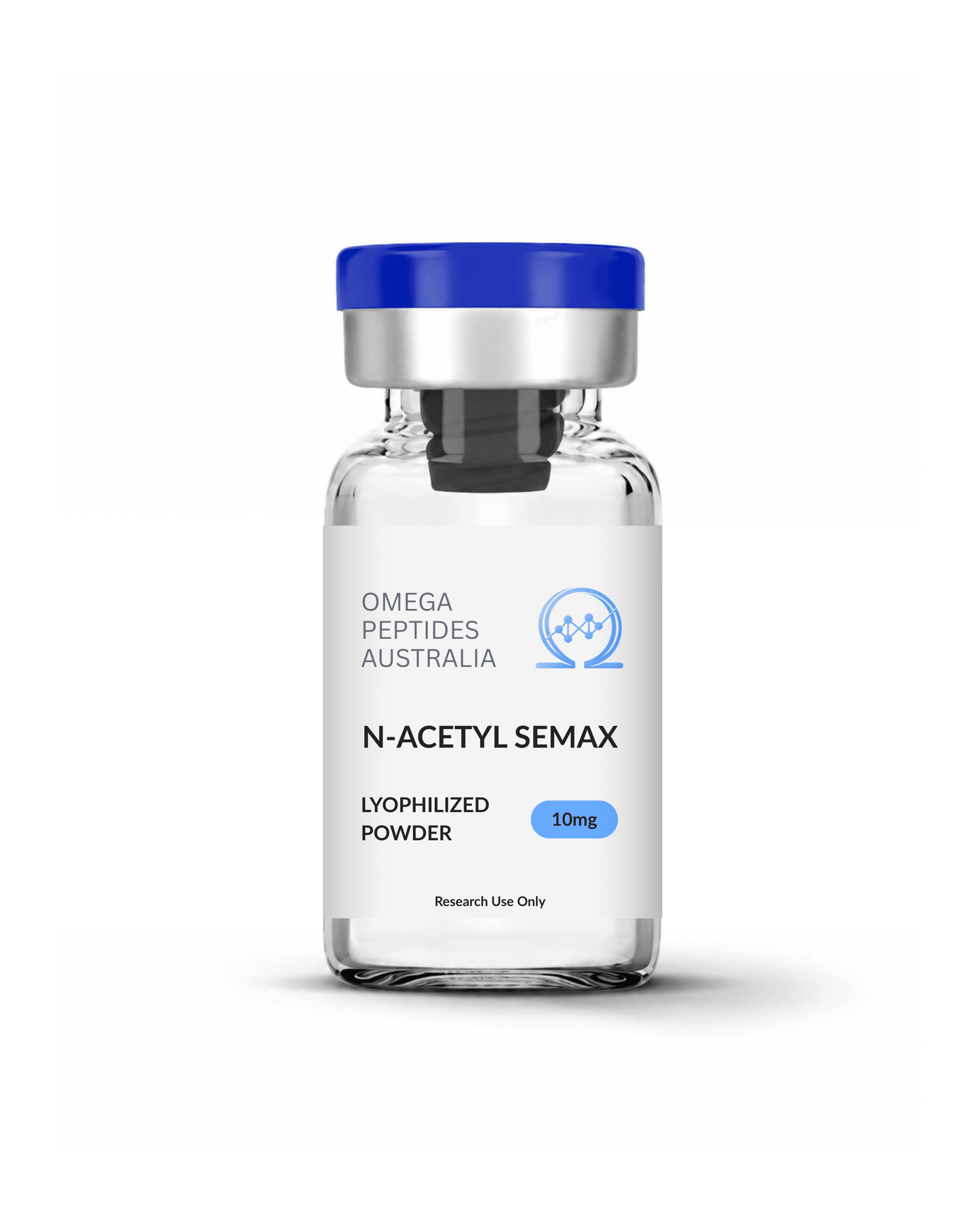
N-Acetyl Semax (10mg) is supplied in Australia by Omega Peptides Australia from domestic stock, with same-day dispatch on orders placed before 12pm and an independent certificate of analysis for every batch. Commonly written as NA-Semax, NA Semax or acetyl semax, it is the N-terminally acetylated analogue of Semax studied for extended neuroprotective activity.
N-Acetyl Semax is the N-terminally acetylated derivative of Semax, the ACTH(4-10) analogue heptapeptide developed at the Institute of Molecular Genetics of the Russian Academy of Sciences. It keeps the Met-Glu-His-Phe-Pro-Gly-Pro backbone of the parent peptide, in which the 4 to 7 fragment of adrenocorticotropic hormone is joined to a Pro-Gly-Pro tail, but an acetyl group caps the free amine of the N-terminal methionine. The form used in research supply generally also carries a C-terminal amide, which is why the compound is commonly listed as N-Acetyl Semax amidate. It is written as NA-Semax, NA Semax, acetyl semax or n acetyl semax.
The compound is studied in the same directions as Semax: cognition and memory, neuroprotection in cerebral ischaemia models, and stress and attention research, with the added question of how the acetyl cap changes stability and tissue persistence. Mechanistically it acts through the Semax pathways, raising BDNF and TrkB expression in the hippocampus, interacting with melanocortin receptors and inhibiting enkephalin-degrading enzymes, rather than through any new target introduced by the modification.
Omega Peptides Australia supplies N-Acetyl Semax as a high-purity (≥99% HPLC) COA-verified lyophilised powder in a sealed 10mg vial. Orders placed before 12pm are dispatched the same day from within Australia, and the batch Certificate of Analysis for every lot is published in our COA library.
Key research areas
- Peptide stability and degradation The acetyl modification itself is a research subject. Unmodified Semax is trimmed from the N-terminus by aminopeptidases in serum and tissue, and N-Acetyl Semax is used to examine how blocking that first cleavage changes the persistence of the intact peptide and the fragments produced.
- Neurotrophin signalling Semax increases BDNF protein and TrkB receptor expression in the rodent hippocampus within hours of administration. N-Acetyl Semax is investigated in models that extend this finding, on the premise that a longer-lived peptide may sustain the same neurotrophic signal for longer.
- Cerebral ischaemia and neuroprotection Rat models of focal ischaemia have been used to study Semax for effects on neuronal survival and on the expression of inflammatory and vascular genes in the affected tissue. The acetylated analogue is examined in similar preparations where sustained exposure is of interest.
- Attention, learning and memory The ACTH(4-10) core of the sequence was originally identified for its effects on attention and retention in animal behavioural tasks. N-Acetyl Semax preserves that core and is studied in passive-avoidance and maze paradigms alongside the parent compound.
- Monoamine neurotransmission Semax has been reported to alter dopamine and serotonin turnover in the striatum and hypothalamus of rodents. The acetylated form is used in comparable neurochemical work relating monoamine metabolism to behaviour.
- Enkephalin and stress systems Semax and Selank both inhibit enkephalin-degrading enzymes in human serum in vitro, a mechanism proposed to underlie their anxiolytic-like effects in animal models. N-Acetyl Semax retains the sequence responsible and is studied in stress-response models on the same basis.
How N-Acetyl Semax works
N-Acetyl Semax acts through the pathways described for Semax. The Met-Glu-His-Phe segment is the ACTH(4-10) core recognised by melanocortin receptors, where Semax has been reported to competitively antagonise alpha-melanocyte-stimulating hormone at MC4 and MC5 rather than act as a classical agonist, with no influence on cortisol production. Downstream, the peptide family increases BDNF and TrkB expression in the hippocampus, shifts dopamine and serotonin turnover, and inhibits the enzymes that break down enkephalins. Because the acetyl group sits on the terminal amine rather than on a side chain involved in receptor contact, it is not expected to change which targets are engaged, only how long the peptide survives.
That survival is the point of the chemistry. Aminopeptidases remove residues from the free N-terminus of a peptide, and in Semax this progressively yields shorter fragments such as Glu-His-Phe-Pro-Gly-Pro. Acetylation removes the free amine those enzymes require, and the C-terminal amide present in the amidate form removes the free carboxyl group that carboxypeptidases act on, so the acetylated and amidated peptide is more resistant to degradation from both ends. It is the same principle that separates N-Acetyl Selank from Selank. The trade-off is that most primary literature was generated with unmodified Semax, so findings for the acetylated form are extrapolated from that base rather than from an equally large body of its own studies.
Specifications
| Compound | N-Acetyl Semax |
| Also known as | NA-Semax, N-Acetyl Semax amidate, acetyl semax, Ac-Semax, NA Semax |
| CAS number | 2920938-90-3 (N-Acetyl Semax amidate) |
| Molecular formula | C₃₉H₅₄N₁₀O₁₀S (amidate form) |
| Molecular weight | 855.0 g/mol (amidate form) |
| Sequence | Ac-Met-Glu-His-Phe-Pro-Gly-Pro-NH₂ (Ac-MEHFPGP-NH₂) |
| Category | Nootropic research |
| Purity | ≥99% HPLC, batch COA supplied |
| Form | Lyophilised powder in a sealed sterile vial |
| Vial sizes available | 10mg — $129.99 |
| Storage (lyophilised) | 2–8°C short term or −20°C long term, protect from light and moisture, avoid repeated freeze-thaw |
| Storage (reconstituted) | 2–8°C, use within 28 days |
| Reconstitution | Bacteriostatic water (recommended) |
Available sizes and pricing
N-Acetyl Semax is supplied in a single 10mg vial. The unmodified parent peptide, Semax, is available separately at a lower per-mg cost, and the two are often purchased together for direct comparison work.
- 10mg vial — $129.99 (about $13.00 per mg)
Quality and COA verification
Every batch of N-Acetyl Semax is tested independently by Janoshik Analytical. HPLC quantifies purity, and mass spectrometry confirms that the measured molecular mass matches the acetylated sequence rather than unmodified Semax, the check that matters most for a derivative differing from its parent by a single acetyl group. A Certificate of Analysis is issued for each batch and published in our COA library, so a vial's lot number can be matched to its own report before it is opened. The peptide is supplied as a lyophilised powder in a sealed sterile vial, which protects it from hydrolysis and oxidation, and every order is packed with protective cushioning for domestic transit within Australia.
Frequently bought together
- Bacteriostatic Water (10mL) — $29.99, the recommended diluent for reconstituting lyophilised N-Acetyl Semax
- Semax (10mg) — $79.99, the unmodified parent peptide for side-by-side stability and activity comparisons
- N-Acetyl Selank (10mg) — $129.99, the acetylated tuftsin analogue studied alongside it in anxiety and cognition models
- Selank (10mg) — $79.99, the unmodified companion peptide sharing the Pro-Gly-Pro tail
Research guides
- Semax Australia research guide
- Peptide storage guide: how to store lyophilised peptides properly
- COA testing explained for research peptides
- Peptide reconstitution calculator
Frequently asked questions
What is NA-Semax?
NA-Semax is the common shorthand for N-Acetyl Semax, the acetylated derivative of the Russian nootropic peptide Semax. The "NA" stands for N-acetyl, describing the acetyl group attached to the N-terminal methionine. When a supplier lists NA-Semax amidate, the name also indicates a C-terminal amide. All of these refer to the same research compound supplied here as a lyophilised 10mg vial for in-vitro laboratory use only.
What is N-Acetyl Semax?
N-Acetyl Semax is a synthetic heptapeptide with the sequence Ac-Met-Glu-His-Phe-Pro-Gly-Pro, an acetylated form of Semax, which is itself an analogue of the ACTH(4-10) fragment with a Pro-Gly-Pro tail. The acetyl cap makes the peptide more resistant to enzymatic breakdown. It is studied as a nootropic and neuroprotective research compound in models of memory, attention and cerebral ischaemia, and it is supplied strictly for laboratory research.
What is N-Acetyl Semax also known as?
It is written as NA-Semax, NA Semax, acetyl semax, n acetyl semax or Ac-Semax, and research catalogues frequently list it as N-Acetyl Semax amidate or NA-Semax amidate to indicate the C-terminal amide. The CAS number registered for the amidate form is 2920938-90-3. It should not be confused with plain Semax, which has a different CAS number, molecular weight and degradation profile.
How does N-Acetyl Semax work?
It acts through the pathways described for Semax: interaction with melanocortin receptors, increased BDNF and TrkB expression in the hippocampus, changes in dopamine and serotonin turnover, and inhibition of enkephalin-degrading enzymes. The acetyl group does not add a new target; it blocks aminopeptidases at the N-terminus so the intact peptide persists longer in tissue and serum. The amidated C-terminus of the amidate form adds protection against carboxypeptidases as well.
What does the research show about N-Acetyl Semax?
The published evidence base belongs largely to unmodified Semax, which in rodent models has shown increased hippocampal BDNF, improved acquisition and retention in learning tasks, reduced neuronal loss in ischaemia models and anxiolytic-like behaviour under stress. N-Acetyl Semax is used in research that builds on those findings where a more stable analogue is wanted, and stability comparisons between the two forms are a study area in their own right. The acetylated form has no clinical registration anywhere.
Can I buy N-Acetyl Semax at Chemist Warehouse or a pharmacy in Australia?
No. N-Acetyl Semax is not registered on the Australian Register of Therapeutic Goods, so it is not stocked by Chemist Warehouse, Priceline or any other retail pharmacy, and no Australian medicine contains it. Unlike Semax, which has a registered nasal product in Russia, the acetylated derivative has no pharmaceutical registration in any country. The lyophilised compound supplied here is a research-grade chemical for laboratory use, not a medicine.
Can Australian compounding pharmacies supply N-Acetyl Semax?
Compounding pharmacies in Australia may only prepare a medicine for a named patient against a valid prescription, and the TGA has issued specific guidance warning pharmacists about compounding and supplying unapproved peptide products. N-Acetyl Semax is not an approved medicine, so it is not a routine compounding item. Research suppliers such as Omega Peptides Australia provide the lyophilised research compound, which is a different product intended for in-vitro work rather than for dispensing to patients.
How do you reconstitute N-Acetyl Semax?
Let the vial reach room temperature, then add bacteriostatic water slowly down the inside wall of the vial so the stream does not hit the powder directly. Swirl gently until the solution is clear and do not shake, since agitation can damage the peptide. The volume of diluent depends on the concentration the research design calls for; our reconstitution calculator can help. Refrigerate the solution at 2–8°C and use it within 28 days.
How should N-Acetyl Semax be stored?
Store the sealed lyophilised powder at 2–8°C for short-term use or at −20°C for long-term storage, protected from light and moisture, and avoid repeated freeze-thaw cycles. Once reconstituted, keep the solution refrigerated at 2–8°C and use it within 28 days. The methionine residue can oxidise, so limiting exposure to air and light is worthwhile even though the acetyl cap improves resistance to enzymatic degradation.
Where can I buy N-Acetyl Semax in Australia?
N-Acetyl Semax 10mg is available directly from Omega Peptides Australia. Stock is held domestically, orders placed before 12pm are dispatched the same day, and every batch is supported by an independent Certificate of Analysis you can review before ordering. The peptide is listed in our research peptides collection alongside Semax, Selank and N-Acetyl Selank.
What does N-Acetyl Semax cost in Australia?
N-Acetyl Semax is $129.99 for a 10mg vial from Omega Peptides Australia, which is about $13.00 per mg. The higher price relative to Semax at $79.99 reflects the additional synthesis steps of the acetylated form. There is currently no bundle containing N-Acetyl Semax; the Semax and Selank Bundle uses the unmodified peptides. Prices are in Australian dollars, with domestic tracked shipping calculated at checkout.
How do I get N-Acetyl Semax online in Australia?
Open the N-Acetyl Semax product page, select the 10mg vial, add it to your cart and complete checkout. Orders ship with tracked domestic delivery in discreet, unbranded packaging that gives no indication of the contents. Orders placed before 12pm on a business day leave the same day, and later orders are dispatched the next business day. Tracking details are emailed once the parcel is lodged.
Is N-Acetyl Semax legal in Australia?
Omega Peptides Australia supplies N-Acetyl Semax strictly for lawful in-vitro laboratory research. It is not approved by the TGA for human or veterinary use and is not sold as a medicine or supplement. Purchasers are responsible for ensuring their intended use complies with all applicable laws. This research-only condition applies to every compound in our catalogue and is stated on each product page and on the COA documentation.
N-Acetyl Semax vs Semax: what is the difference?
Both share the Met-Glu-His-Phe-Pro-Gly-Pro sequence and the same receptor and neurotrophin targets. The difference is chemical: N-Acetyl Semax has an acetyl cap on the N-terminus (and, in the amidate form, an amide on the C-terminus) that blocks the enzymes responsible for trimming Semax, so it degrades more slowly. Semax has the larger published evidence base and the lower price; the acetylated form suits work needing a longer-lived peptide. See the Semax page for its specifications.
⚠ For in-vitro research and laboratory use only. Not for human or veterinary use.
Share