Omega Peptides Australia
Couldn't load pickup availability
For laboratory research use only. Not for human or veterinary use, consumption, or therapeutic application. Not a drug, food, cosmetic, or dietary supplement. Handling restricted to qualified researchers in an appropriate setting.
Certificates of Analysis
Independent third-party testing for this product. Tap a report to view the data.


MOTS-c 10mg — Mitochondrial-Derived Metabolic Research Peptide
MOTS-C (10mg) is stocked in Australia by Omega Peptides Australia and dispatched the same business day on orders before 12pm, each batch backed by an independent certificate of analysis. Also searched as MOTS C, MOTSC, MOT C or mitochondrial-derived peptide, it is a mitochondrial-derived peptide studied for metabolic regulation and AMPK signalling.
MOTS-c is a 16-amino-acid peptide encoded not in the nuclear genome but in a small open reading frame within the 12S ribosomal RNA gene of mitochondrial DNA, which is where its name comes from: mitochondrial open reading frame of the 12S rRNA type-c. First described in 2015, it belongs to a small family of mitochondrial-derived peptides that also includes humanin and the SHLP series. Its sequence, Met-Arg-Trp-Gln-Glu-Met-Gly-Tyr-Ile-Phe-Tyr-Pro-Arg-Lys-Leu-Arg, is synthesised for research as the free peptide. It is written as MOTS-c, MOTS c, MOTS-C or mots c peptide, and simply called MOTS in laboratory shorthand.
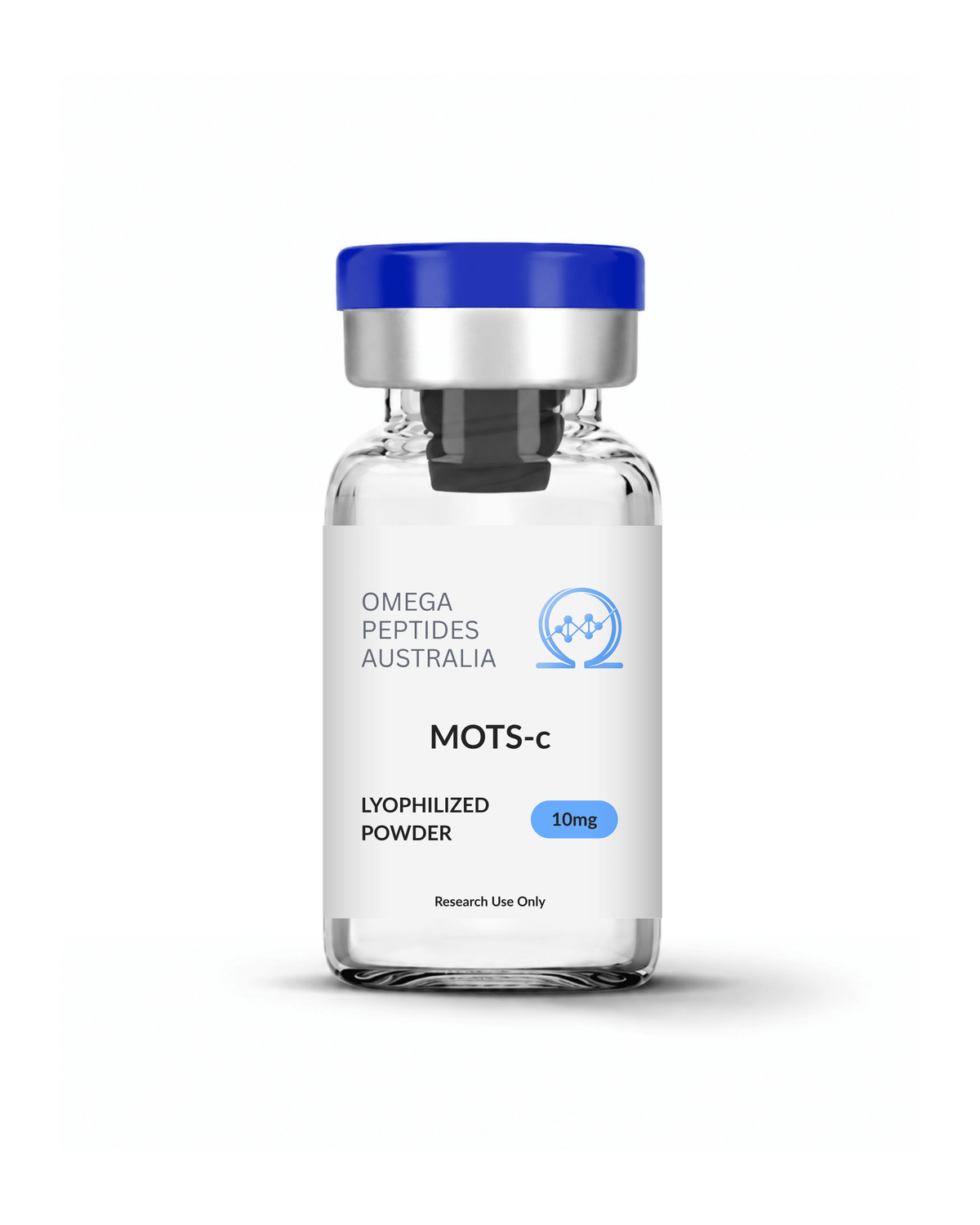
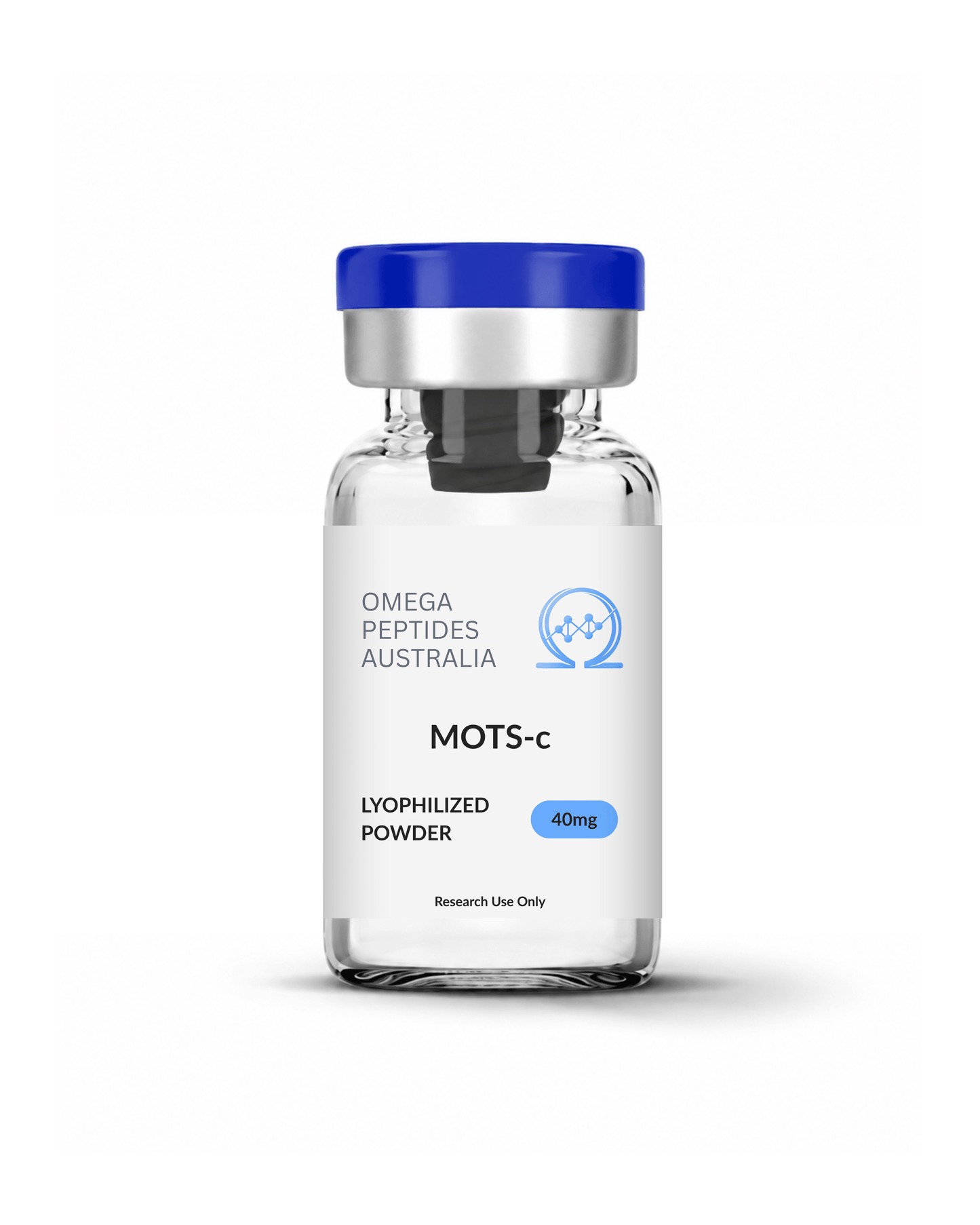
This page is the 10mg vial, the standard entry size for pilot experiments and single-model studies. If your protocol needs more material per batch, the 40mg vial brings the per-mg cost down by roughly a third.
MOTS-c is studied for its role in skeletal muscle glucose uptake and insulin sensitivity, in the metabolic response to exercise and diet-induced obesity, and in the cellular stress response during ageing. At the pathway level it inhibits the folate-methionine cycle, which causes the AMP analogue AICAR to accumulate and activates AMP-activated protein kinase (AMPK), the central energy sensor of the cell. Under metabolic stress it also translocates to the nucleus and regulates gene expression through antioxidant response elements.
Omega Peptides Australia supplies this MOTS-c 10mg vial as a high-purity (≥99% HPLC), COA-verified lyophilised powder. Orders placed before 12pm are dispatched the same day from within Australia, and the certificate for every batch is published in our COA library.
Key research areas
- Insulin sensitivity and glucose handling. In rodent models MOTS-c has been studied for its effect on skeletal muscle glucose uptake, with AMPK activation increasing GLUT4 translocation to the cell surface. Work in diet-induced obese mice examined insulin resistance, hepatic lipid accumulation and weight gain during MOTS-c administration.
- Exercise physiology. Circulating MOTS-c rises during and after exercise in humans, and exercise-mimetic effects have been reported in mice, including improved treadmill endurance in young, middle-aged and old animals. Researchers investigate whether MOTS-c signals from the mitochondria to coordinate the systemic adaptation to physical stress.
- Ageing and the nuclear stress response. Under glucose restriction or oxidative stress, MOTS-c moves from the cytoplasm into the nucleus and binds chromatin regions containing antioxidant response elements, working alongside the transcription factor NRF2. This mitochondrial-to-nuclear signalling is studied as a mechanism of cellular adaptation that declines with age.
- Mitochondrial genetics and longevity. A naturally occurring variant of the MOTS-c gene, in which lysine 14 is replaced by glutamine, has been associated in population studies with exceptional longevity in East Asian cohorts and with altered diabetes risk, making the peptide a subject of mitochondrial genetics research.
- Bone and muscle biology. Preclinical studies have examined MOTS-c in osteoblast and osteoclast models, in muscle atrophy models and in the balance of oxidative fibre types, exploring whether AMPK activation in these tissues changes remodelling and turnover.
- Metabolic disease analogues. A MOTS-c analogue has been evaluated in an early-phase clinical program for fatty liver disease and obesity, which supports interest in the native peptide as a research tool for metabolic disease pathways.
MOTS-C in Australia
Because MOTS-C is not listed on the Australian Register of Therapeutic Goods, it cannot be bought from a pharmacy in Australia; retail chains do not carry it. The route in Australia is a domestic research supplier holding the compound as a research-grade lyophilised vial. Omega Peptides Australia keeps MOTS-C in Australian stock and ships it the same business day for orders before 12pm, on tracked delivery, which removes the transit and customs delay of ordering from overseas. The batch certificate is published in the COA library so identity and purity can be checked before the order is placed.
MOTS-C is stocked in Australia in two sizes: this 10mg vial and a 40mg vial for extended protocols at a lower cost per milligram. Researchers working on mitochondrial function often run it alongside SS-31 or NAD+, both held domestically.
How MOTS-c works
MOTS-c acts primarily on cellular metabolism. Inside the cell it inhibits the folate cycle at the level of 5-methyltetrahydrofolate, which slows de novo purine synthesis and causes the intermediate AICAR to build up. AICAR mimics AMP, so AMPK is switched on. Activated AMPK increases glucose uptake and fatty acid oxidation, reduces lipogenesis and improves the efficiency of energy use in skeletal muscle and liver. Because the signal begins in the mitochondria and ends in the nucleus and cytosol, MOTS-c is described as a retrograde signalling molecule: a message sent from the organelle to the rest of the cell.
Circulating MOTS-c levels decline with age in skeletal muscle and plasma, and rise transiently in response to exercise. The peptide is small and hydrophilic and, like most unmodified peptides, has a short plasma half-life, so research protocols usually rely on repeated administration or on continuous exposure in cell culture. MOTS-c is often compared with SS-31 because both are mitochondrial research peptides, but they act very differently: SS-31 binds cardiolipin in the inner membrane to stabilise the electron transport chain, whereas MOTS-c is a signalling peptide that alters gene expression and AMPK-dependent metabolism.
Specifications
| Compound | MOTS-c |
| Also known as | Mitochondrial open reading frame of the 12S rRNA type-c, MOTS c, MOTS-C, MOTS-c peptide, mots c peptide, MOTS, MOTSC, MOT C, mitochondrial-derived peptide |
| CAS number | 1627580-64-6 |
| Molecular formula | C101H152N28O22S2 |
| Molecular weight | Approximately 2174.6 g/mol |
| Sequence | MRWQEMGYIFYPRKLR (Met-Arg-Trp-Gln-Glu-Met-Gly-Tyr-Ile-Phe-Tyr-Pro-Arg-Lys-Leu-Arg) |
| Category | Metabolic research |
| Purity | ≥99% HPLC, batch COA supplied |
| Form | Lyophilised powder in a sealed sterile vial |
| This vial | 10mg — $99.99 (also available as a 40mg vial — $269.99) |
| Storage (lyophilised) | 2–8°C short term or −20°C long term, protect from light and moisture, avoid repeated freeze-thaw |
| Storage (reconstituted) | 2–8°C, use within 28 days |
| Reconstitution | Bacteriostatic water (recommended) |
10mg vial: pricing and who it suits
The 10mg vial is $99.99, about $10.00 per mg, and is the right starting point for a single research model, a pilot run, or any protocol where you want to confirm a result before committing to a larger batch. It comes from the same COA-verified production batches as the 40mg vial, so purity and identity are identical between sizes; the only difference is how much peptide is in the vial.
If your protocol runs multiple parallel arms, repeats over several weeks, or you've already validated the model and want a lower cost per mg, the 40mg vial is worth comparing: it brings the per-mg price down to about $6.75, a saving of roughly a third over buying two 10mg vials.
Quality and COA verification
Every batch of MOTS-c is independently tested by Janoshik Analytical. HPLC confirms purity of 99 percent or higher and mass spectrometry confirms that the measured mass matches the expected molecular weight of the 16-residue sequence, so the identity of the peptide, not just its purity, is verified. A Certificate of Analysis is issued for every batch and published in our COA library, where the batch number on the vial can be matched to its report. Vials are filled and sealed under sterile conditions and the peptide is lyophilised, because MOTS-c contains two methionine residues that are prone to oxidation in solution. Orders are packed for domestic transit and shipped from Australian stock, which keeps transit time short.
Frequently bought together
- Bacteriostatic Water (10mL) — $29.99, the standard diluent for reconstituting lyophilised peptides.
- SS-31 (10mg) — $79.99, a cardiolipin-binding mitochondrial peptide often studied alongside MOTS-c.
- NAD+ (500mg) — $139.99, the coenzyme at the centre of mitochondrial redox research.
- 5-Amino-1MQ (5mg) — $89.99, a small-molecule NNMT inhibitor used in adjacent metabolic models.
Research guides
Frequently asked questions
What is MOTS?
MOTS is the shorthand for MOTS-c, the mitochondrial-derived peptide encoded in the 12S ribosomal RNA gene of mitochondrial DNA. Searches for MOTS peptide, MOTS c or MOTS-C all refer to the same 16-amino-acid research compound. Omega Peptides Australia supplies it as a lyophilised research peptide in 10mg and 40mg vials for laboratory use only.
What is MOTS-c?
MOTS-c is a 16-amino-acid peptide produced from a short open reading frame inside the mitochondrial genome rather than the nuclear genome. It was identified in 2015 and is studied as a signalling molecule that links mitochondrial activity to whole-cell metabolism. Research models examine its effects on insulin sensitivity, exercise capacity, the stress response of ageing cells and metabolic disease pathways.
What is MOTS-c also known as?
The full name is mitochondrial open reading frame of the 12S rRNA type-c. It is written as MOTS-c, MOTS c, MOTS-C or MOTSc, described as MOTS-c peptide or mots c peptide, and shortened to MOTS. It belongs to the family of mitochondrial-derived peptides, which also includes humanin and the small humanin-like peptides.
How does MOTS-c work?
MOTS-c inhibits the folate cycle, which reduces de novo purine synthesis and causes AICAR to accumulate. AICAR activates AMPK, the cellular energy sensor, which increases glucose uptake and fatty acid oxidation in muscle and liver. Under metabolic stress MOTS-c also moves into the nucleus and regulates genes that contain antioxidant response elements, acting as a retrograde signal from the mitochondria to the nucleus.
What does the research show about MOTS-c?
Preclinical rodent studies have reported improved insulin sensitivity, reduced weight gain on a high-fat diet and enhanced treadmill endurance during MOTS-c administration. Human observational work shows that circulating MOTS-c rises with exercise and falls with age, and a lysine-to-glutamine variant of the gene has been associated with longevity in East Asian populations. An analogue has been assessed in an early-phase clinical program for metabolic liver disease.
Should I choose the 10mg or 40mg vial?
The 10mg vial suits a first run, a single research model, or any protocol you want to validate before scaling up. The 40mg vial is better value once you know the model works, since it lowers the cost per mg by about a third and reduces how often you need to reorder for longer or multi-arm protocols. Both sizes are drawn from the same COA-verified batches, so switching sizes doesn't change purity or identity.
Can I buy MOTS-c at Chemist Warehouse or a pharmacy in Australia?
No. MOTS-c is not a registered medicine in Australia and is not listed on the Australian Register of Therapeutic Goods, so it is not stocked by Chemist Warehouse, Priceline or other retail pharmacies. There is no approved MOTS-c medicine anywhere in the world. Omega Peptides Australia supplies MOTS-c only as a research-grade lyophilised compound for in-vitro laboratory work, which is a different category of product from a pharmacy medicine.
Can Australian compounding pharmacies supply MOTS-c?
Compounding pharmacies in Australia may only prepare a medicine for an individual patient on a prescription from a registered practitioner, and the TGA has warned about the uncertainties of compounded unapproved peptide products. MOTS-c is not an approved ingredient and is not a routine compounded product. Research suppliers such as Omega Peptides Australia supply the lyophilised research compound for laboratory use, which is separate from any pharmacy pathway.
How do you reconstitute MOTS-c?
Add bacteriostatic water slowly down the inside wall of the vial so that it runs onto the powder gently, then swirl until the solution is clear. Do not shake the vial. The reconstitution calculator gives the volume needed for a chosen concentration. Once reconstituted, keep the vial refrigerated at 2–8°C and use it within 28 days.
How should MOTS-c be stored?
Store the sealed lyophilised powder at 2–8°C for short-term use or at −20°C for long-term storage, protected from light and moisture. Avoid repeated freeze-thaw cycles. Because the sequence contains two methionine residues that can oxidise, minimising time in solution matters more for MOTS-c than for many peptides. After reconstitution, refrigerate at 2–8°C and use within 28 days.
Where can I buy MOTS-c in Australia?
Omega Peptides Australia holds MOTS-c in domestic stock and dispatches orders placed before 12pm on the same business day. Every batch is COA-verified by an independent laboratory and the certificates are published online. Order the 10mg vial on this page, or the 40mg vial for a lower cost per mg, or browse the full range of research peptides in Australia.
What does this 10mg vial of MOTS-c cost in Australia?
This 10mg vial is $99.99, which works out to about $10.00 per mg. The 40mg vial is $269.99, about $6.75 per mg, so it's the better per-mg value once a protocol is validated and you're ordering repeatedly. Bacteriostatic water for reconstitution is sold separately in 3mL and 10mL sizes.
How do I get MOTS-c online in Australia?
Add this 10mg vial to your cart and complete checkout. Orders are shipped with tracked domestic delivery in discreet, unbranded packaging. Orders placed before 12pm are dispatched the same business day from within Australia, and a tracking number is emailed once the parcel is lodged with the carrier.
Is MOTS-c legal in Australia?
Omega Peptides Australia supplies MOTS-c strictly for lawful in-vitro laboratory research. It is not approved by the TGA for human or veterinary use and is not sold as a medicine or supplement. Purchasers are responsible for ensuring their intended use complies with all applicable laws.
How does MOTS-c differ from SS-31?
Both are mitochondrial research peptides, but they work in different ways. MOTS-c is encoded by mitochondrial DNA and acts as a signalling molecule, activating AMPK and regulating nuclear gene expression. SS-31 is a synthetic tetrapeptide that concentrates in the inner mitochondrial membrane, binds cardiolipin and stabilises the electron transport chain to limit oxidative damage. Researchers often study them side by side to separate metabolic signalling from membrane protection.
Is MOTS-C available in Australia?
Yes, as a research-grade lyophilised peptide from domestic suppliers. Omega Peptides Australia holds MOTS-C in 10mg and 40mg vials in Australian stock, COA verified, with same-day dispatch before 12pm.
Can you get MOTS-C in Australia?
Yes, from an Australian research peptide supplier with domestic stock. Omega Peptides Australia dispatches MOTS-C from within Australia on tracked delivery.
⚠ For in-vitro research and laboratory use only. Not for human or veterinary use.