Omega Peptides Australia
Couldn't load pickup availability
For laboratory research use only. Not for human or veterinary use, consumption, or therapeutic application. Not a drug, food, cosmetic, or dietary supplement. Handling restricted to qualified researchers in an appropriate setting.
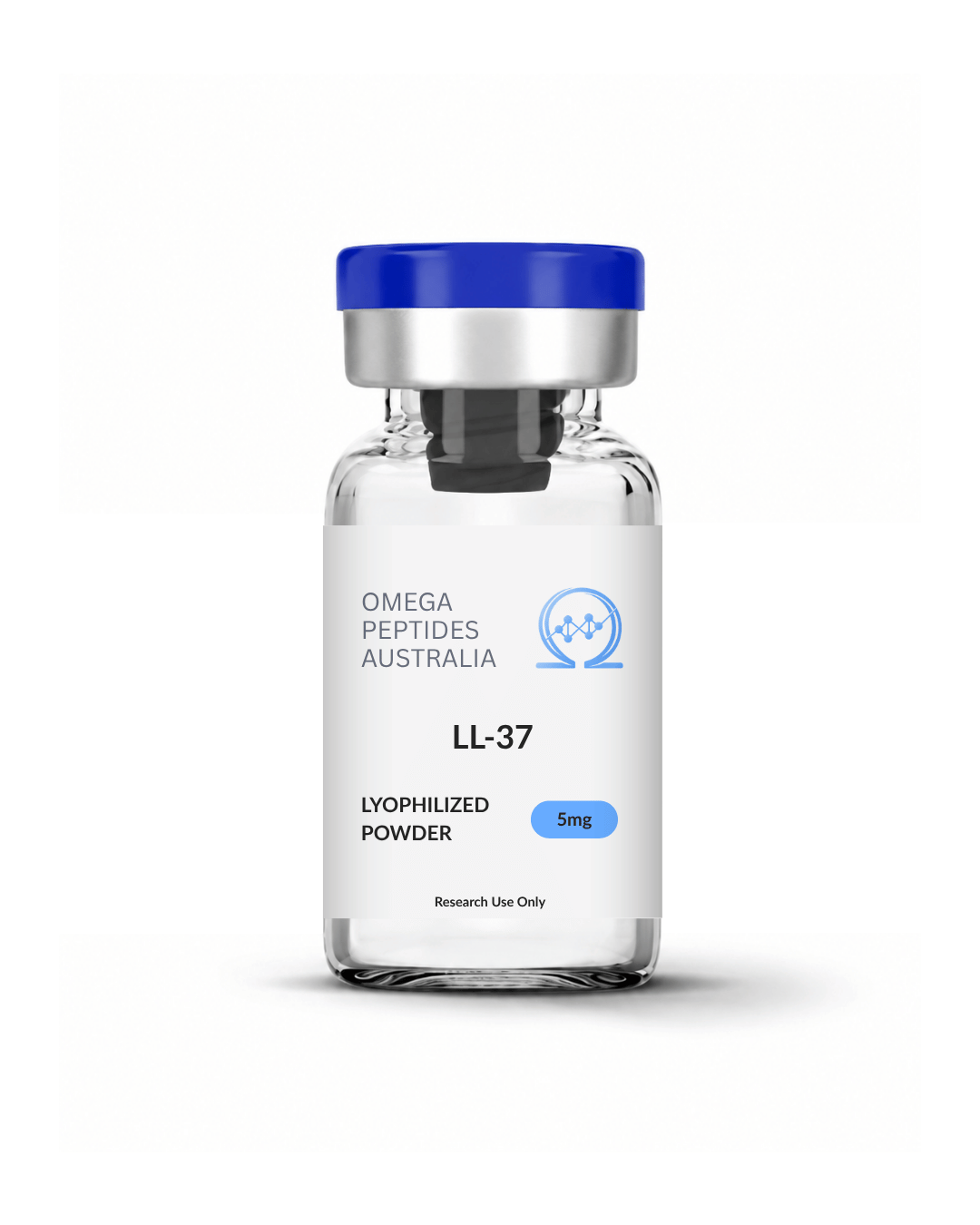
LL-37 (5mg) — Cathelicidin Antimicrobial Peptide Research Compound
Omega Peptides Australia supplies LL-37 (5mg) in Australia from domestic stock, dispatching same day on orders placed before 12pm with a certificate of analysis published for every batch. Often written cathelicidin, LL37 or CAP-18 fragment, it is the human cathelicidin antimicrobial peptide studied for innate immunity.
LL-37 is the only cathelicidin-family antimicrobial peptide found in humans. It is a 37-amino-acid fragment released from the C-terminus of the precursor protein hCAP-18 (human cationic antimicrobial protein of 18 kDa, encoded by the CAMP gene) when the protein is cleaved by proteinase 3 in neutrophils. Its name comes from the two leucine residues that begin the sequence and its length of 37 residues. The peptide is strongly cationic, carrying a net charge of about +6, and folds into an amphipathic alpha helix in the presence of membranes. It is often written as LL37, ll 37 or cathelicidin LL-37, and older papers describe it as the CAP-18 fragment or FALL-39.
LL-37 is studied in three overlapping areas: direct antimicrobial and antibiofilm activity against bacteria, fungi and enveloped viruses; innate immune signalling, where it acts as a chemoattractant and modulator of inflammation; and tissue repair, including re-epithelialisation and angiogenesis in wound models. Its antimicrobial action comes from electrostatic binding to negatively charged microbial membranes followed by membrane disruption, while its signalling effects are mediated through host receptors such as formyl peptide receptor 2, the P2X7 receptor and transactivation of the epidermal growth factor receptor.
Omega Peptides Australia supplies LL-37 as a high-purity (≥99% HPLC) COA-verified lyophilised powder in a sealed sterile 5mg vial. Orders placed before 12pm are dispatched the same day from within Australia, and the batch Certificate of Analysis for every lot is published in our COA library.
Key research areas
- Broad-spectrum antimicrobial activity LL-37 has been tested against Gram-positive and Gram-negative bacteria, fungi such as Candida, and enveloped viruses in in-vitro models. Its positively charged helix binds the anionic lipids of microbial membranes and inserts into the bilayer, causing leakage and cell death, a physical mechanism that is much harder for microbes to evade than an enzyme-targeting antibiotic.
- Biofilm disruption At concentrations below those needed to kill bacteria, LL-37 has been shown in laboratory models to inhibit biofilm formation by Pseudomonas aeruginosa and Staphylococcus aureus and to disperse established biofilms. The proposed mechanism involves interference with quorum-sensing systems and the genes that control attachment and twitching motility.
- Innate immune signalling LL-37 recruits neutrophils, monocytes and T cells through formyl peptide receptor 2 and modulates the response of immune cells to bacterial products. It binds and neutralises lipopolysaccharide, reducing the inflammatory response to endotoxin in cell models, while separately promoting cytokine release through the P2X7 receptor, which is why it is described as an immune modulator rather than simply anti-inflammatory.
- Wound repair and angiogenesis In skin and epithelial models LL-37 promotes keratinocyte migration and proliferation through EGFR transactivation, and it stimulates endothelial cells to form new vessels. Its expression rises sharply in the margin of healing wounds, and reduced LL-37 has been documented in chronic non-healing ulcers, which drives research interest in topical and matrix-based delivery.
- Vitamin D and cathelicidin expression The CAMP gene carries a vitamin D response element, and active vitamin D strongly induces LL-37 production in macrophages and epithelial cells. This link is studied in models of tuberculosis, respiratory infection and skin disease, and it is one of the reasons LL-37 is examined alongside other immune research peptides.
- Autoimmune and inflammatory skin models LL-37 forms complexes with self-DNA and self-RNA that activate plasmacytoid dendritic cells through TLR9 and TLR7, a pathway implicated in psoriasis and rosacea models. Understanding when the peptide protects and when it drives inflammation is an active area of research.
How LL-37 works
LL-37 has two distinct modes of action. The first is direct: in solution it is largely unstructured, but on contact with a negatively charged membrane it adopts an amphipathic alpha helix in which hydrophobic residues line one face and cationic lysine and arginine residues line the other. The peptide accumulates on the microbial surface, inserts into the bilayer and disrupts it through carpet-like and toroidal-pore mechanisms, leading to loss of membrane integrity. Because mammalian membranes are rich in zwitterionic lipids and cholesterol, they are far less susceptible than bacterial membranes at the same concentrations. The second mode is receptor-mediated: LL-37 signals to host cells through formyl peptide receptor 2 (chemotaxis), the P2X7 purinergic receptor (cytokine processing) and transactivation of EGFR (epithelial migration), and it binds lipopolysaccharide and lipoteichoic acid to dampen endotoxin-driven inflammation.
In biological fluids LL-37 is rapidly degraded by host and bacterial proteases and is partly inactivated by high salt and by binding to serum proteins, so its activity in vitro depends heavily on the assay medium. This short functional lifetime is one reason researchers examine fragments, D-amino-acid analogues and matrix-bound formulations. LL-37 differs from KPV, a three-residue alpha-MSH fragment with anti-inflammatory but no direct antimicrobial activity, and from Thymosin Alpha-1, which acts on adaptive immunity through dendritic cell maturation rather than on microbes directly.
Specifications
| Compound | LL-37 (human cathelicidin antimicrobial peptide) |
| Also known as | LL37, ll 37, cathelicidin LL-37, CAP-18 fragment, LL37 peptide, human cathelicidin |
| CAS number | 154947-66-7 |
| Molecular formula | C205H340N60O53 |
| Molecular weight | 4493.3 g/mol |
| Sequence | LLGDFFRKSKEKIGKEFKRIVQRIKDFLRNLVPRTES (37 residues) |
| Category | Immune research |
| Purity | ≥99% HPLC, batch COA supplied |
| Form | Lyophilised powder in a sealed sterile vial |
| Vial sizes available | 5mg — $119.99 |
| Storage (lyophilised) | 2–8°C short term or −20°C long term, protect from light and moisture, avoid repeated freeze-thaw |
| Storage (reconstituted) | 2–8°C, use within 28 days |
| Reconstitution | Bacteriostatic water (recommended) |
Available sizes and pricing
LL-37 is offered in a single 5mg vial. The per-milligram figure is higher than for shorter peptides because a 37-residue sequence is considerably more demanding to synthesise and purify to ≥99%.
- 5mg vial — $119.99 (about $24.00 per mg)
There is no dedicated kit for LL-37. A vial of bacteriostatic water is the usual companion purchase for reconstitution.
Quality and COA verification
Every batch of LL-37 sold by Omega Peptides Australia is independently tested by Janoshik Analytical. HPLC confirms purity of ≥99%, and mass spectrometry confirms that the measured mass matches the expected 4493 daltons of the full 37-residue sequence, which rules out truncated or mis-synthesised chains. A Certificate of Analysis is issued for every batch and published in our COA library, where the batch number on the vial can be matched to its report. The peptide is supplied lyophilised in a sealed sterile vial because the freeze-dried form is stable for months, whereas LL-37 in solution is vulnerable to oxidation and proteolytic degradation. Vials are packed in protective outer packaging for domestic transit.
Frequently bought together
- Bacteriostatic Water (10mL) — $29.99, the diluent used to reconstitute lyophilised LL-37.
- Thymosin Alpha-1 (10mg) — $89.99, the thymic peptide studied for adaptive immune regulation.
- KPV (10mg) — $79.99, the alpha-MSH tripeptide studied in inflammation models.
- BPC-157 (10mg) — $99.99, the pentadecapeptide used in tissue-repair research.
Research guides
- Peptide storage guide: how to store lyophilised peptides properly
- COA testing explained for research peptides in Australia
- Peptide reconstitution calculator
- Certificates of Analysis library
Frequently asked questions
What is LL-37?
LL-37 is the human cathelicidin antimicrobial peptide, a 37-amino-acid cationic peptide cleaved from the precursor protein hCAP-18 and produced by neutrophils, macrophages and epithelial cells as part of innate immunity. It has a molecular weight of about 4,493 daltons and forms an amphipathic alpha helix on membranes. Omega Peptides Australia supplies it as a lyophilised research-grade powder in 5mg vials for in-vitro laboratory use.
What is LL-37 also known as?
It is also written as LL37, ll 37 or LL-37 peptide, and is often called cathelicidin LL-37 or human cathelicidin. Because it is cut from the precursor hCAP-18, it is sometimes labelled the CAP-18 fragment, and an early 39-residue form was named FALL-39. All of these names refer to the same human antimicrobial peptide.
How does LL-37 work?
In research models LL-37 binds negatively charged microbial membranes, folds into an alpha helix and disrupts the bilayer, killing bacteria and fungi and inactivating enveloped viruses. It also signals to host cells through formyl peptide receptor 2, the P2X7 receptor and EGFR, recruiting immune cells and promoting epithelial migration, and it neutralises lipopolysaccharide. This combination of direct killing and immune modulation is what distinguishes it from conventional antibiotics.
What does the research show about LL-37?
In-vitro studies show broad antimicrobial and antibiofilm activity, including against antibiotic-resistant strains, and cell and animal models report faster re-epithelialisation and angiogenesis in wounds. Research also links low cathelicidin levels to chronic ulcers and respiratory infection, and shows that vitamin D induces its expression. At the same time, LL-37 complexes with self-nucleic acids can drive inflammation in psoriasis models, so research focuses on context and concentration.
Can I buy LL-37 at Chemist Warehouse or a pharmacy in Australia?
No. LL-37 is not a registered medicine in Australia and is not stocked by Chemist Warehouse, Priceline or other retail pharmacies. There is no approved LL-37 medicine anywhere in the world; the peptide remains at the preclinical and early clinical stage. The lyophilised research-grade compound sold here is supplied strictly for laboratory use and is not a pharmacy product.
Can Australian compounding pharmacies supply LL-37?
LL-37 is not a compound that Australian compounding pharmacies routinely prepare, and any compounded peptide product would require an individual prescription under a pathway the TGA has placed under close scrutiny in its 2026 guidance on unapproved peptide products. Omega Peptides Australia is a research supplier: we supply the lyophilised compound for laboratory use and do not compound, prescribe or dispense medicines.
How do you reconstitute LL-37?
Swab the stopper and add bacteriostatic water slowly down the inside wall of the vial so the stream does not hit the powder directly. Swirl gently until the solution is clear; do not shake, because a long cationic peptide can aggregate or foam when agitated. Label the vial with the date and concentration, refrigerate at 2–8°C and use within 28 days. Our reconstitution calculator gives the concentration for any diluent volume.
How should LL-37 be stored?
Keep the lyophilised vial at 2–8°C for short-term use or at −20°C for long-term storage, protected from light and moisture. The freeze-dried powder is stable for many months under these conditions. Once reconstituted, store the solution at 2–8°C and use it within 28 days, and avoid repeated freeze-thaw cycles, which promote aggregation and hydrolysis of the long peptide chain.
Where can I buy LL-37 in Australia?
Omega Peptides Australia holds LL-37 in domestic stock, so orders placed before 12pm are dispatched the same day without international shipping delays or customs uncertainty. Every batch carries an independent Certificate of Analysis, and the compound sits within our research peptides collection alongside Thymosin Alpha-1, KPV and other immune research peptides.
What does LL-37 cost in Australia?
A 5mg vial of LL-37 costs $119.99 from Omega Peptides Australia, which is about $24.00 per mg. The higher per-milligram cost reflects the length and purification demands of a 37-residue peptide. There is no bundle for this compound at present, and bacteriostatic water is available separately in 3mL and 10mL sizes. Pricing is per vial and per milligram only.
How do I get LL-37 online in Australia?
Select the 5mg vial on this product page, add any bacteriostatic water or syringes you need, and complete checkout. Orders placed before 12pm are dispatched the same day from within Australia with tracked domestic shipping in plain, discreet packaging. A tracking number is emailed when the parcel is lodged, and most metropolitan addresses receive their order within a few business days.
Is LL-37 legal in Australia?
Omega Peptides Australia supplies LL-37 strictly for lawful in-vitro laboratory research. It is not approved by the TGA for human or veterinary use and is not sold as a medicine or supplement. Purchasers are responsible for ensuring their intended use complies with all applicable laws, including any state or territory requirements that apply to their laboratory.
How do LL-37, KPV and Thymosin Alpha-1 compare as immune research peptides?
They act on different arms of immunity. LL-37 is an innate antimicrobial peptide that kills microbes directly and signals to immune cells. KPV is a three-residue alpha-MSH fragment studied for anti-inflammatory signalling through melanocortin pathways and NF-kB inhibition, with no direct antimicrobial effect. Thymosin Alpha-1 is a thymic peptide that acts on adaptive immunity through dendritic cell and T-cell maturation. Researchers choose between them by the pathway under study.
⚠ For in-vitro research and laboratory use only. Not for human or veterinary use.
Share