Omega Peptides Australia
Couldn't load pickup availability
For laboratory research use only. Not for human or veterinary use, consumption, or therapeutic application. Not a drug, food, cosmetic, or dietary supplement. Handling restricted to qualified researchers in an appropriate setting.
GHRP-2 (10mg) — Synthetic Hexapeptide Growth Hormone Secretagogue Research Peptide
Omega Peptides Australia supplies GHRP-2 (10mg) in Australia from domestic stock, dispatching same day on orders placed before 12pm with a certificate of analysis published for every batch. Often written pralmorelin, GHRP 2 or GHRP2, it is a hexapeptide growth hormone secretagogue studied for ghrelin receptor research.
GHRP-2 is a synthetic six-amino-acid growth hormone releasing peptide with the sequence D-Ala-D-2-Nal-Ala-Trp-D-Phe-Lys and a C-terminal amide, where 2-Nal is the unnatural amino acid 3-(2-naphthyl)-D-alanine. It belongs to the second generation of GHRPs developed after GHRP-6 and was the first compound in its class to reach clinical use, being marketed in Japan as a single-dose diagnostic agent for growth hormone deficiency under the code KP-102. Its international non-proprietary name is pralmorelin, and it is also written as GHRP2, GHRP 2 or growth hormone releasing peptide-2.
GHRP-2 is studied in three main directions: as a potent ghrelin-receptor agonist for probing pituitary growth hormone secretion, as a tool for investigating appetite and energy-balance signalling in feeding models, and as a diagnostic-style stimulus whose response is used to characterise the somatotroph axis. At the receptor level it activates the growth hormone secretagogue receptor type 1a (GHS-R1a), the same G-protein-coupled receptor used by ghrelin, and this raises intracellular calcium in somatotroph cells so that stored growth hormone is released in a pulse.
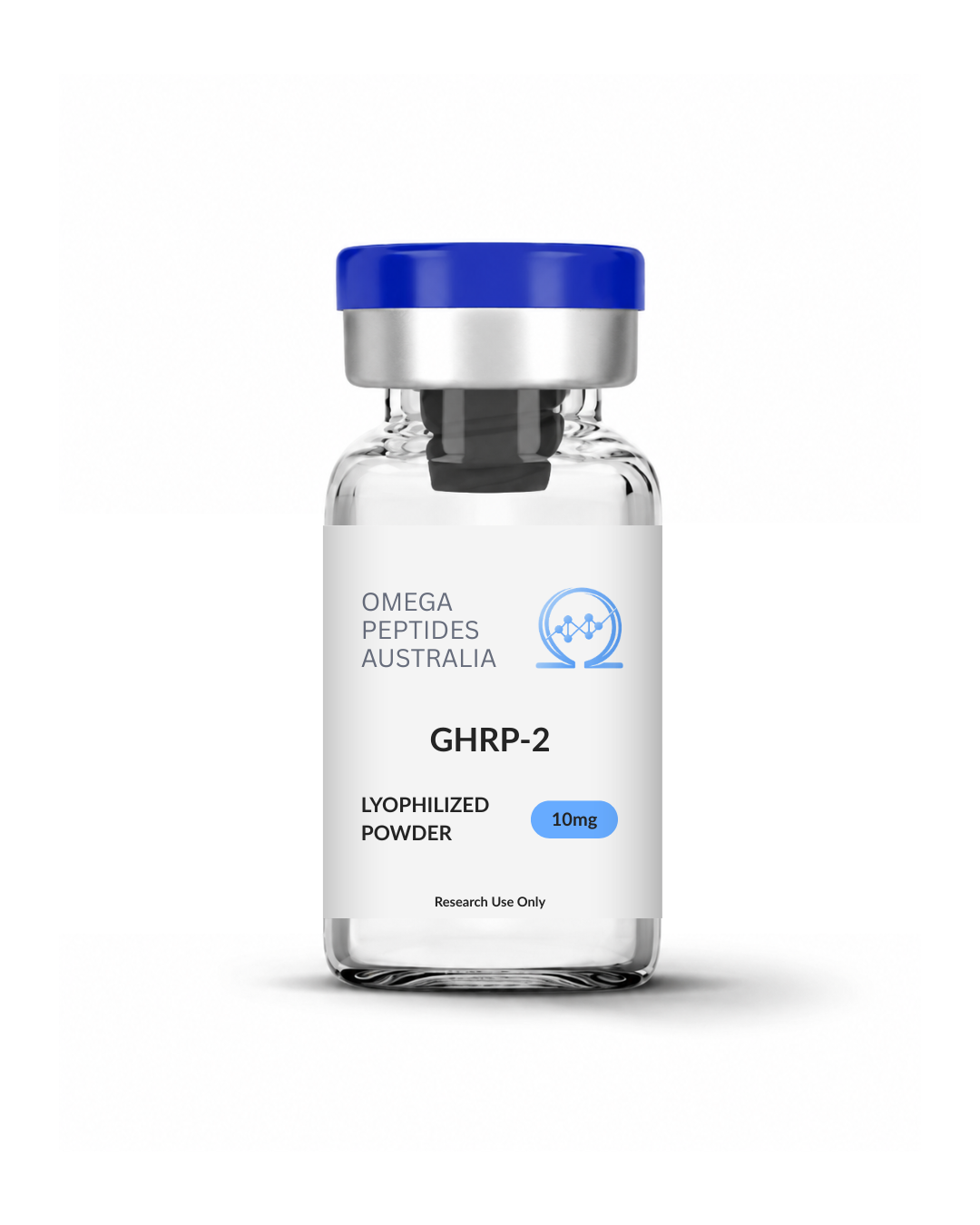
Omega Peptides Australia supplies GHRP-2 as a high-purity (≥99% HPLC) COA-verified lyophilised powder in a sealed 10mg vial. Orders placed before 12pm are dispatched the same day from stock held within Australia, and the batch Certificate of Analysis for every lot is published in our COA library so the purity and identity of the vial you receive can be checked against the batch number on the label.
Key research areas
- Pituitary growth hormone release. GHRP-2 produces a robust, dose-dependent GH pulse in cell and animal models and is one of the most widely characterised secretagogues in the literature. Its consistent response has made it a standard positive control when new GHS-R1a ligands are screened for GH-releasing activity.
- Diagnostic stimulation testing. The clinical history of GHRP-2 as a single-dose diagnostic in Japan means there is a substantial body of data on the size and timing of the GH response it evokes. Researchers use that reference profile when designing stimulation protocols in animal models of growth hormone deficiency.
- Appetite and energy balance. As a ghrelin mimetic, GHRP-2 engages the hypothalamic circuits that drive feeding. It is used in energy-balance research to separate the orexigenic actions of the ghrelin receptor from its endocrine actions, often alongside GHRP-6, which has a stronger appetite effect, and ipamorelin, which has almost none.
- Synergy with GHRH analogues. Because GHRP-2 acts on GHS-R1a while sermorelin, CJC-1295 and tesamorelin act on the GHRH receptor, the two classes are additive when combined. This pairing is a standard design in secretagogue research and the basis of many blended GH-axis compounds.
- Receptor desensitisation. Repeated exposure to GHRP-2 in animal models leads to a measurable attenuation of the GH response over several days. This makes it a useful compound for studying receptor downregulation, internalisation and recovery, and for comparing the desensitisation profiles of different GHS-R1a agonists.
- Pituitary and hypothalamic hormone cross-talk. GHRP-2 produces transient increases in cortisol and prolactin alongside GH in the models studied. Mapping those responses against selective agonists such as ipamorelin helps identify which parts of the GHS-R1a cascade are shared between somatotrophs, corticotrophs and lactotrophs.
How GHRP-2 works
GHRP-2 is an agonist of the growth hormone secretagogue receptor type 1a, a Gq-coupled receptor expressed on pituitary somatotrophs and in the arcuate nucleus of the hypothalamus. Receptor activation stimulates phospholipase C, which generates inositol trisphosphate and diacylglycerol; the inositol trisphosphate releases calcium from intracellular stores, and the resulting calcium surge triggers exocytosis of growth hormone granules. In the hypothalamus the same receptor increases the firing of GHRH neurons and reduces somatostatin release, so the pituitary receives more stimulation and less inhibition at the same time. This two-site action is why GHRPs produce a larger pulse than GHRH analogues alone and why the two classes are additive when combined.
GHRP-2 is a short-acting peptide, with a reported plasma half-life of roughly 30 minutes in the published pharmacology, longer than GHRP-6 at about 20 minutes but shorter than hexarelin at about 50 minutes. The naphthylalanine residue at position two replaces the tryptophan of GHRP-6 and is the main structural reason for its higher potency. Compared with GHRP-6, GHRP-2 is a stronger GH releaser with a milder appetite effect; compared with ipamorelin, it is more potent but less selective, producing transient rises in cortisol and prolactin that ipamorelin largely avoids. Compared with hexarelin, it lacks affinity for the CD36 receptor that gives hexarelin its cardiovascular research profile.
Specifications
| Compound | GHRP-2 (pralmorelin) |
| Also known as | Pralmorelin, GHRP2, growth hormone releasing peptide-2, KP-102, GPA-748, GHRP 2 |
| CAS number | 158861-67-7 |
| Molecular formula | C45H55N9O6 |
| Molecular weight | 817.99 g/mol (free peptide) |
| Sequence | D-Ala-D-2-Nal-Ala-Trp-D-Phe-Lys-NH2 (six residues) |
| Category | Growth hormone research |
| Purity | ≥99% HPLC, batch COA supplied |
| Form | Lyophilised powder in a sealed sterile vial |
| Vial sizes available | 10mg — $79.99 |
| Storage (lyophilised) | 2–8°C short term or −20°C long term, protect from light and moisture, avoid repeated freeze-thaw |
| Storage (reconstituted) | 2–8°C, use within 28 days |
| Reconstitution | Bacteriostatic water (recommended) |
Available sizes and pricing
GHRP-2 is supplied in a single 10mg vial. As a hexapeptide with a molecular weight just under 820 g/mol, 10mg represents a high molar quantity of peptide. The price is per vial, with the per-milligram figure shown so it can be compared directly against hexarelin, GHRP-6 and ipamorelin. Laboratories that need reconstitution supplies can add the Research Starter Kit, which bundles bacteriostatic water, syringes and alcohol swabs.
- 10mg vial — $79.99 (about $8.00 per mg)
Quality and COA verification
Every batch of GHRP-2 is tested independently by Janoshik Analytical before it is released. The HPLC purity assay quantifies the intact hexapeptide against any deletion sequences, diastereomers or oxidation products, and mass spectrometry confirms the molecular mass matches the expected value for the six-residue sequence including its naphthylalanine residue. A Certificate of Analysis is issued for every lot and published in our COA library, where it can be matched to the batch number on the vial label. The peptide is lyophilised for long-term stability, sealed in a sterile glass vial with a crimped cap, and packed with cushioning for domestic transit so the powder arrives dry and intact. Keeping the vial lyophilised until use gives the longest shelf life.
Frequently bought together
- Bacteriostatic Water (10mL) — $29.99, the recommended diluent for reconstituting lyophilised GHRP-2.
- GHRP-6 (10mg) — $79.99, the first-generation GHRP for direct potency and appetite comparisons.
- Hexarelin (5mg) — $89.99, the stabilised high-potency GHRP for side-by-side receptor studies.
- Ipamorelin (10mg) — $89.99, the selective secretagogue used as the specificity comparator to GHRP-2.
Research guides
- CJC-1295 and Ipamorelin research guide
- CJC-1295 and Ipamorelin research overview
- Peptide storage guide
- COA testing explained
- Peptide reconstitution calculator
- Certificates of Analysis library
Frequently asked questions
What is GHRP-2?
GHRP-2 is a synthetic six-residue growth hormone releasing peptide, known by the non-proprietary name pralmorelin. It was developed as a second-generation GHRP and became the first compound in the class to reach clinical use, as a diagnostic agent in Japan. In research it is used as a potent ghrelin-receptor agonist for studying growth hormone secretion. It is supplied here as a lyophilised, COA-verified powder for in-vitro research only.
What is GHRP-2 also known as?
It is also written as GHRP2, GHRP 2 or ghrp-2, and its full name is growth hormone releasing peptide-2. The pharmacological name is pralmorelin, sometimes given as pralmorelin hydrochloride or dihydrochloride when the salt is specified, and the development codes KP-102 and GPA-748 appear in older literature. Common misspellings such as ghrp2 peptide and grhp-2 all refer to the same hexapeptide.
How does GHRP-2 work?
GHRP-2 binds the growth hormone secretagogue receptor type 1a, the receptor ghrelin uses, on pituitary somatotrophs and in the hypothalamus. Activation raises intracellular calcium through the Gq and phospholipase C pathway, triggering release of stored growth hormone. In the hypothalamus it also increases GHRH neuron activity and reduces somatostatin tone, so the pituitary receives a stronger signal. Its naphthylalanine residue gives it higher potency than GHRP-6.
What does the research show about GHRP-2?
Published cell, animal and clinical-diagnostic data show that GHRP-2 reliably produces a large, dose-dependent growth hormone pulse, that the response attenuates with repeated exposure over several days, and that it transiently raises cortisol and prolactin and increases food intake in the models studied. Its reference profile is widely used when characterising new secretagogues. All of this describes laboratory and preclinical research and does not relate to any use outside that setting.
Can I buy GHRP-2 at Chemist Warehouse or a pharmacy in Australia?
No. GHRP-2 is not registered on the Australian Register of Therapeutic Goods and is not stocked by Chemist Warehouse, Priceline or any other retail pharmacy. Its only marketed form was a single-dose diagnostic product in Japan, which was never registered in Australia. The lyophilised research-grade GHRP-2 supplied here is a laboratory reagent for research use and is not a pharmacy product or a substitute for any registered medicine.
Can Australian compounding pharmacies supply GHRP-2?
An Australian compounding pharmacy may only prepare a medicine for a named patient on a practitioner's prescription and cannot sell peptides to the general public. Research suppliers such as Omega Peptides Australia supply the lyophilised research compound for in-vitro laboratory use, which is a separate product on a separate pathway from anything a pharmacy prepares.
How do you reconstitute GHRP-2?
Use bacteriostatic water. Draw the required volume into a sterile syringe and add it slowly down the inside wall of the vial so the stream does not strike the lyophilised cake directly. Swirl gently until the solution is clear and do not shake, as agitation can degrade the peptide. Refrigerate the reconstituted vial at 2–8°C and use it within 28 days. Our reconstitution calculator will convert vial size and diluent volume into a working concentration.
How should GHRP-2 be stored?
Keep the unopened lyophilised vial at 2–8°C for short-term storage or at −20°C for long-term storage, protected from light and moisture and away from repeated freeze-thaw cycles. After reconstitution, store the solution at 2–8°C and use it within 28 days. GHRP-2 is a comparatively robust hexapeptide, but its tryptophan residue is sensitive to light and oxidation, so keep the vial in its box and limit time at room temperature.
Where can I buy GHRP-2 in Australia?
Omega Peptides Australia holds GHRP-2 in domestic stock and dispatches orders placed before 12pm on the same business day with tracked shipping within Australia. Each batch is backed by an independent Certificate of Analysis that you can review in the COA library before ordering. GHRP-2 is listed alongside GHRP-6, hexarelin and ipamorelin in our research peptides range so related secretagogues can be compared on one page.
What does GHRP-2 cost in Australia?
GHRP-2 is supplied in a 10mg vial at $79.99, which is about $8.00 per milligram, making it one of the most economical secretagogues in the range on a per-milligram basis. There is currently no larger vial or bundle for this compound. Bacteriostatic water is sold separately at $29.99 for 10mL or $14.99 for 3mL, and the Research Starter Kit adds syringes and alcohol swabs for laboratories setting up for the first time.
How do I get GHRP-2 online in Australia?
Open the GHRP-2 product page, select the 10mg vial, add it to the cart and complete checkout. Orders placed before 12pm are dispatched the same business day from our Australian stock and later orders leave on the next business day. Parcels travel by tracked domestic courier in plain, discreet packaging with no product description on the outside, and a tracking number is emailed as soon as the order ships.
Is GHRP-2 legal in Australia?
Omega Peptides Australia supplies GHRP-2 strictly for lawful in-vitro laboratory research. It is not approved by the TGA for human or veterinary use and is not sold as a medicine or supplement. Purchasers are responsible for ensuring their intended use complies with all applicable laws, including any state or territory requirements that apply to research chemicals.
GHRP-2 vs GHRP-6: what is the difference?
Both are six-residue GHS-R1a agonists that differ at position two, where GHRP-2 carries a naphthylalanine and GHRP-6 a D-tryptophan. That change makes GHRP-2 the more potent growth hormone releaser with a somewhat longer half-life of about 30 minutes against 20 for GHRP-6. GHRP-6 produces a much stronger appetite response, which is why it is preferred in feeding studies, while GHRP-2 is chosen when a strong GH pulse with a milder orexigenic effect is the goal.
⚠ For in-vitro research and laboratory use only. Not for human or veterinary use.
Share