Omega Peptides Australia
Couldn't load pickup availability
For laboratory research use only. Not for human or veterinary use, consumption, or therapeutic application. Not a drug, food, cosmetic, or dietary supplement. Handling restricted to qualified researchers in an appropriate setting.
AOD-9604 — Modified hGH Fragment 176-191 Metabolic Research Peptide
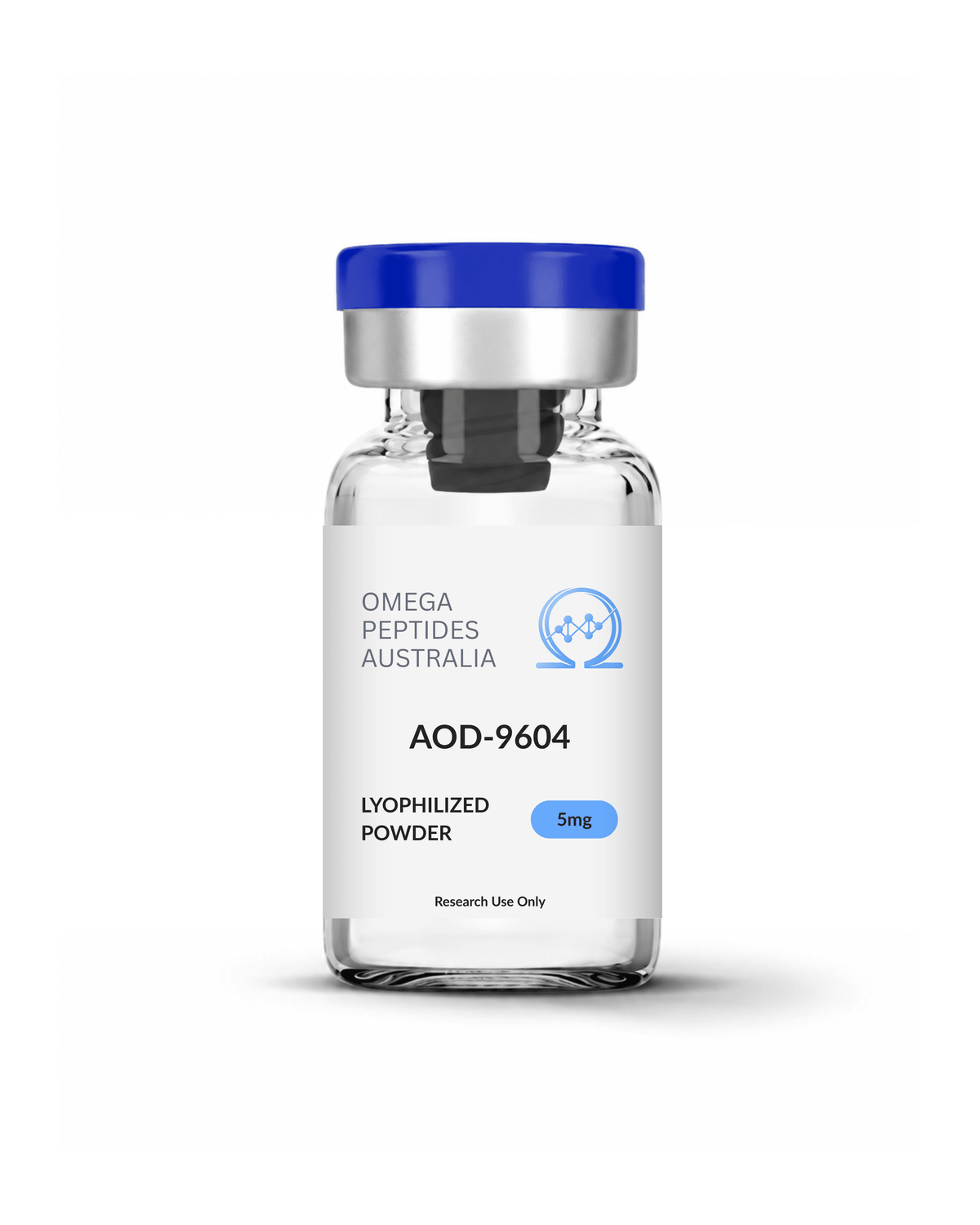
Omega Peptides Australia supplies AOD-9604 (5mg) in Australia from domestic stock, dispatching same day on orders placed before 12pm with a certificate of analysis published for every batch. Often written AOD 9604, AOD9604, HGH fragment 176-191 or fragment 176-191, it is a modified fragment of human growth hormone studied for lipolytic signalling.
AOD-9604 is a synthetic 16-amino-acid peptide derived from the C-terminal region of human growth hormone. It reproduces residues 177 to 191 of the hormone, its lipolytic domain, with an additional tyrosine at the N-terminus to stabilise the molecule, and it retains the cysteine-to-cysteine disulfide bridge of the native loop. The compound was discovered at Monash University in Melbourne and developed in Australia by Metabolic Pharmaceuticals, and its name is the development code "anti-obesity drug 9604". It is written as AOD9604, AOD 9604 or aod-9604 and is often described as hGH fragment 176-191.
AOD-9604 is studied in three main directions: adipose tissue lipid metabolism, where it was designed to reproduce the fat-metabolising activity of growth hormone without the hormone's other effects; joint cartilage models, where it has been examined in preclinical osteoarthritis research; and comparative metabolic pharmacology, as a non-hormonal, non-incretin reference against the GLP-1-class compounds. Mechanistically it does not bind the growth hormone receptor. In rodent adipose tissue it increased lipolysis and reduced lipogenesis, with evidence that the beta-3 adrenergic receptor pathway is involved, and it did not raise IGF-1 in the studies reported.
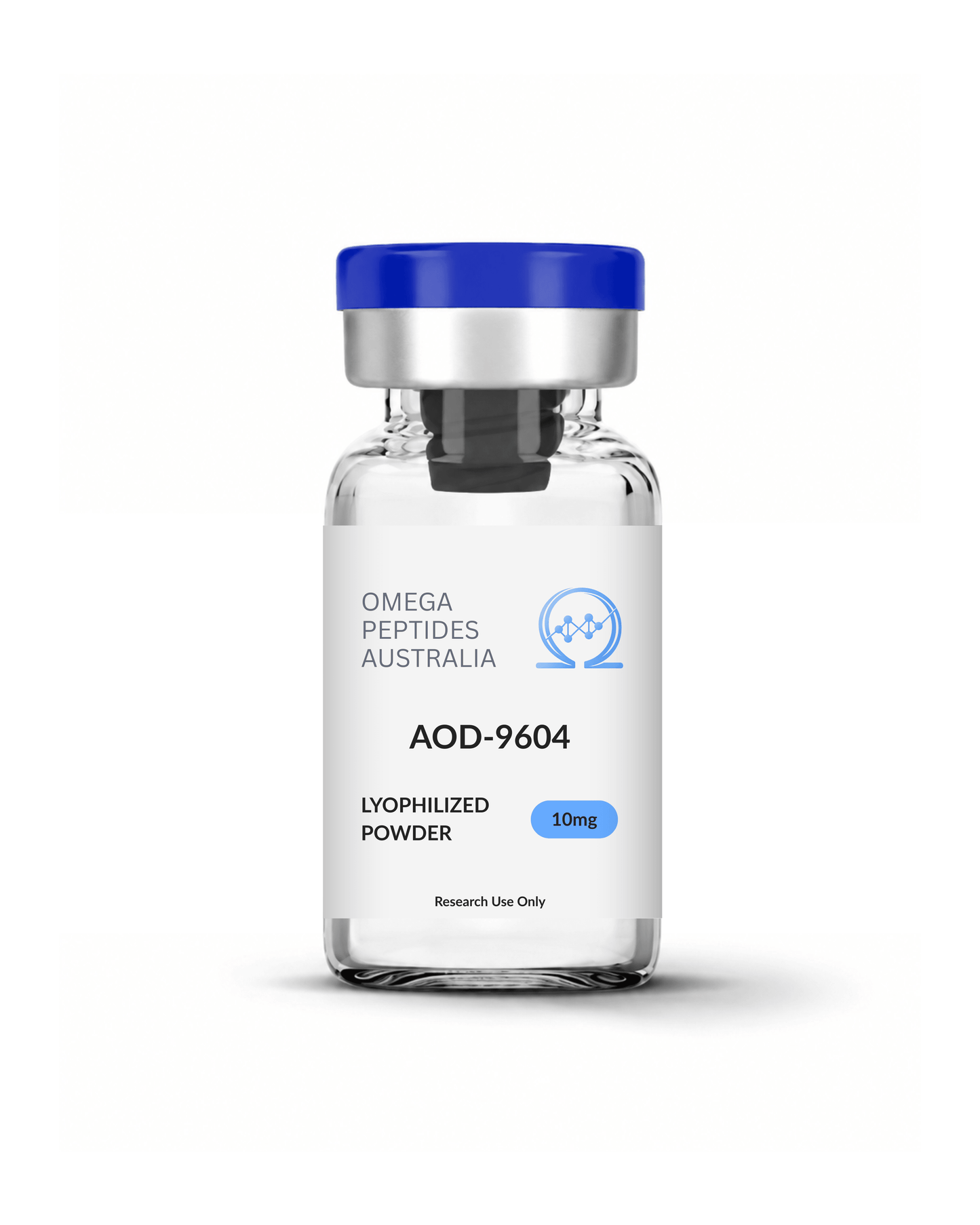
Omega Peptides Australia supplies AOD-9604 as a high-purity (≥99% HPLC) COA-verified lyophilised powder in sealed 5mg and 10mg vials. Orders placed before 12pm are dispatched the same day from stock held within Australia, and the batch Certificate of Analysis for every lot is published in our COA library so the purity and identity of the vial you receive can be checked against the batch number on the label.
Key research areas
- Adipose lipolysis and lipogenesis. Rodent work in obese mouse and rat models showed that the C-terminal fragment of growth hormone increased fat breakdown and reduced new fat synthesis in adipose tissue. AOD-9604 is the stabilised form of that fragment used to study this GH-receptor-independent lipid effect.
- Beta-3 adrenergic receptor signalling. Studies in beta-3 adrenergic receptor knockout mice found that the lipid-metabolic response to the fragment was diminished, pointing to that receptor pathway as a mediator. AOD-9604 is used in adipocyte and rodent models to probe how peptide and adrenergic signalling interact in fat tissue.
- Separation of GH activities. Because AOD-9604 does not bind the growth hormone receptor, it lets researchers study the lipid-metabolic domain of GH in isolation from its effects on IGF-1, glucose handling and cell growth.
- Clinical development history. AOD-9604 progressed through a programme of six human trials in the 2000s, including two Phase 2b studies in several hundred adults each, in which it was reported to be safe and well tolerated. The programme did not lead to registration as a medicine.
- Cartilage and joint models. Preclinical work in a rabbit osteoarthritis model examined intra-articular AOD-9604, alone and with hyaluronic acid, for effects on cartilage structure.
- Comparative metabolic pharmacology. As a peptide with no action on incretin receptors, AOD-9604 is used as a mechanistic contrast to GLP-1 and multi-agonist compounds such as tirzepatide in laboratories mapping how peptides influence energy balance.
AOD-9604 in Australia
AOD-9604 is supplied in Australia strictly as a research-grade lyophilised vial; it is not a registered medicine and is not available through Chemist Warehouse, Priceline or compounding pharmacies. Omega Peptides Australia holds it in domestic stock, dispatches same day on orders before 12pm, and ships on tracked delivery within Australia, so there is no international transit or customs hold. Each batch carries an independent certificate in the COA library matched to the number printed on the vial.
AOD-9604 is stocked in Australia in 5mg and 10mg vials from the same batch. Metabolic-research protocols frequently run it alongside 5-Amino-1MQ or Tesamorelin, both held domestically.
How AOD-9604 works
Growth hormone is a 191-residue protein whose activities map to distinct regions of its structure. The C-terminal tail, residues 176 to 191, was identified as the part responsible for the hormone's effect on fat metabolism, and synthetic copies of it reproduced the lipolytic activity in rodent adipose tissue without engaging the growth hormone receptor. AOD-9604 is the refined version of that fragment: the additional N-terminal tyrosine improves stability, and the cysteine-to-cysteine disulfide bridge preserves the loop conformation of the native sequence. Because the receptor for growth hormone is not involved, the fragment does not trigger the IGF-1 release or the changes in glucose handling that whole growth hormone produces.
The proposed mechanism in adipose tissue involves increased expression and activity of the beta-3 adrenergic receptor, which stimulates lipolysis and thermogenesis in fat cells, together with a reduction in lipogenic enzyme activity. Pharmacokinetic data from the clinical programme describe a short-acting, rapidly cleared peptide. AOD-9604 differs from tirzepatide and retatrutide, which act on GIP, GLP-1 and glucagon receptors to alter appetite, gastric emptying and insulin secretion, and from MOTS-c, a mitochondrial-derived peptide acting through AMPK. Its niche is a targeted adipose-tissue mechanism that bypasses both the incretin system and the growth hormone receptor.
Specifications
| Compound | AOD-9604 (Tyr-hGH 177-191) |
| Also known as | AOD9604, AOD 9604, hGH fragment 176-191, anti-obesity drug 9604, growth hormone fragment |
| CAS number | 221231-10-3 |
| Molecular formula | C78H123N23O23S2 |
| Molecular weight | 1815.1 g/mol |
| Sequence | Tyr-Leu-Arg-Ile-Val-Gln-Cys-Arg-Ser-Val-Glu-Gly-Ser-Cys-Gly-Phe (16 residues, disulfide bridge Cys7 to Cys15) |
| Category | Metabolic research |
| Purity | ≥99% HPLC, batch COA supplied |
| Form | Lyophilised powder in a sealed sterile vial |
| Vial sizes available | 5mg — $89.99; 10mg — $139.99 |
| Storage (lyophilised) | 2–8°C short term or −20°C long term, protect from light and moisture, avoid repeated freeze-thaw |
| Storage (reconstituted) | 2–8°C, use within 28 days |
| Reconstitution | Bacteriostatic water (recommended) |
Available sizes and pricing
AOD-9604 is supplied in two vial sizes. The 10mg vial lowers the per-milligram cost by around 22 percent compared with the 5mg vial, so laboratories running extended assay series will find the larger size more economical. Prices are per vial, with the per-milligram figure for comparison. Laboratories that need reconstitution supplies can add the Research Starter Kit, which bundles bacteriostatic water, syringes and alcohol swabs.
- 5mg vial — $89.99 (about $18.00 per mg)
- 10mg vial — $139.99 (about $14.00 per mg)
Quality and COA verification
Every batch of AOD-9604 is tested independently by Janoshik Analytical before it is released. The HPLC purity assay quantifies the intact 16-residue peptide against any deletion sequences, open-chain (reduced) forms or oxidation products, and mass spectrometry confirms the measured mass matches the disulfide-bridged sequence. A Certificate of Analysis is issued for every lot and published in our COA library, where it can be matched to the batch number on the vial label. The peptide is lyophilised for long-term stability, sealed in a sterile glass vial with a crimped cap, and packed with cushioning for domestic transit so the powder arrives dry and intact. Keeping the vial lyophilised until use protects the disulfide bridge, the most chemically sensitive feature of the molecule.
Frequently bought together
- Bacteriostatic Water (10mL) — $29.99, the recommended diluent for reconstituting lyophilised AOD-9604.
- Tirzepatide (10mg) — $119.99, the dual GIP and GLP-1 receptor agonist used as the incretin-pathway comparator in metabolic models.
- MOTS-C (10mg) — $99.99, a mitochondrial-derived peptide studied for AMPK-mediated metabolic regulation.
- 5-amino-1-MQ (5mg) — $89.99, a small-molecule NNMT inhibitor studied in adipocyte metabolism research.
Research guides
- Tirzepatide research guide
- Retatrutide vs tirzepatide
- MOTS-c research guide
- Peptide storage guide
- COA testing explained
- Peptide reconstitution calculator
- Certificates of Analysis library
Frequently asked questions
What is AOD-9604?
AOD-9604 is a synthetic 16-residue peptide copied from the C-terminal region of human growth hormone, residues 177 to 191, with an extra tyrosine at the N-terminus for stability. It was discovered at Monash University and developed in Australia as a metabolic research compound that reproduces the lipid-metabolising activity of growth hormone without binding the growth hormone receptor. It is supplied here as a lyophilised, COA-verified powder for in-vitro research only.
What is AOD-9604 also known as?
It is also written as AOD9604, AOD 9604 or aod-9604, and the letters stand for "anti-obesity drug", its development code at Metabolic Pharmaceuticals. It is often called hGH fragment 176-191, growth hormone fragment 176-191 or simply the GH fragment, although strictly it is Tyr-hGH 177-191. Misspellings such as aod 9640, aod-9406 and adp-9604 all refer to the same peptide.
How does AOD-9604 work?
AOD-9604 reproduces the lipolytic domain of growth hormone. In rodent adipose tissue it increased fat breakdown and reduced new fat synthesis, and studies in beta-3 adrenergic receptor knockout mice suggest that receptor pathway carries much of the effect. It does not bind the growth hormone receptor, so it does not trigger IGF-1 release or the changes in glucose handling associated with whole growth hormone, which is what makes it a selective research tool.
What does the research show about AOD-9604?
Preclinical work in obese rodent models showed increased lipolysis and reduced lipogenesis in adipose tissue with no effect on IGF-1. A clinical programme of six trials, including two Phase 2b studies, reported the compound to be safe and well tolerated but did not produce results that led to registration. Separate preclinical work has examined it in a rabbit osteoarthritis model. All of this describes laboratory and clinical research and does not relate to any use outside that setting.
Can I buy AOD-9604 at Chemist Warehouse or a pharmacy in Australia?
No. Although AOD-9604 was developed in Australia and went through clinical trials here, it was never registered on the Australian Register of Therapeutic Goods, so it is not stocked by Chemist Warehouse, Priceline or any other retail pharmacy. There is no registered AOD-9604 medicine in Australia or elsewhere. The lyophilised research-grade AOD-9604 sold here is a laboratory reagent for research use and is not a pharmacy product.
Can Australian compounding pharmacies supply AOD-9604?
A compounding pharmacy may only prepare a medicine for a named patient on a practitioner's prescription and cannot sell peptides to the general public. AOD-9604 has appeared on some Australian compounding formularies under that framework, which is a clinical pathway with its own rules and is entirely separate from research supply. Omega Peptides Australia supplies the lyophilised research compound for in-vitro laboratory use only and does not offer any compounded or clinical product.
How do you reconstitute AOD-9604?
Use bacteriostatic water. Draw the required volume into a sterile syringe and add it slowly down the inside wall of the vial so the stream does not strike the lyophilised cake directly. Swirl gently until the solution is clear and do not shake, as agitation can degrade the peptide. Refrigerate the reconstituted vial at 2–8°C and use it within 28 days. Our reconstitution calculator will convert vial size and diluent volume into a working concentration.
How should AOD-9604 be stored?
Keep the unopened lyophilised vial at 2–8°C for short-term storage or at −20°C for long-term storage, protected from light and moisture and away from repeated freeze-thaw cycles. After reconstitution, store the solution at 2–8°C and use it within 28 days. The disulfide bridge in AOD-9604 is sensitive to oxidation and reduction, so keeping the vial sealed, cold and out of light preserves the intact cyclic structure that the COA verifies.
Where can I buy AOD-9604 in Australia?
Omega Peptides Australia holds AOD-9604 in domestic stock in both 5mg and 10mg vials and dispatches orders placed before 12pm on the same business day with tracked shipping within Australia. Each batch is backed by an independent Certificate of Analysis that you can review in the COA library before ordering. AOD-9604 is listed with tirzepatide, MOTS-c and the other metabolic compounds in our research peptides range.
What does AOD-9604 cost in Australia?
AOD-9604 is supplied in a 5mg vial at $89.99, about $18.00 per milligram, and in a 10mg vial at $139.99, about $14.00 per milligram. The larger vial reduces the per-milligram cost by roughly 22 percent and suits laboratories running extended assay series. There is currently no bundle for this compound. Bacteriostatic water is sold separately at $29.99 for 10mL or $14.99 for 3mL, and the Research Starter Kit adds syringes and alcohol swabs.
How do I get AOD-9604 online in Australia?
Open the AOD-9604 product page, choose the 5mg or 10mg vial, add it to the cart and complete checkout. Orders placed before 12pm are dispatched the same business day from our Australian stock and later orders leave on the next business day. Parcels travel by tracked domestic courier in plain, discreet packaging with no product description on the outside, and a tracking number is emailed as soon as the order ships.
Is AOD-9604 legal in Australia?
Omega Peptides Australia supplies AOD-9604 strictly for lawful in-vitro laboratory research. It is not approved by the TGA for human or veterinary use and is not sold as a medicine or supplement. Purchasers are responsible for ensuring their intended use complies with all applicable laws, including any state or territory requirements that apply to research chemicals.
AOD-9604 vs tirzepatide and retatrutide: how do they differ as metabolic research compounds?
They act through completely different mechanisms. Tirzepatide is a dual GIP and GLP-1 receptor agonist and retatrutide adds glucagon receptor activity; both are long-acting incretin-class peptides that act on appetite, gastric emptying and insulin secretion in research models. AOD-9604 is a short-acting growth hormone fragment with no incretin activity that acts directly on adipose lipid metabolism. Researchers use them as contrasting tools for separating central appetite pathways from peripheral fat-tissue pathways.
Is AOD-9604 available in Australia?
Yes, as a research-grade lyophilised peptide from domestic suppliers. Omega Peptides Australia holds AOD-9604 in 5mg and 10mg vials in Australian stock, COA verified, with same-day dispatch before 12pm.
Where can I buy AOD 9604 in Australia?
From an Australian research peptide supplier holding domestic stock. Omega Peptides Australia ships AOD-9604 from within Australia on tracked delivery.
⚠ For in-vitro research and laboratory use only. Not for human or veterinary use.
Share