Omega Peptides Australia
Couldn't load pickup availability
For laboratory research use only. Not for human or veterinary use, consumption, or therapeutic application. Not a drug, food, cosmetic, or dietary supplement. Handling restricted to qualified researchers in an appropriate setting.
Certificates of Analysis
Independent third-party testing for this product. Tap a report to view the data.


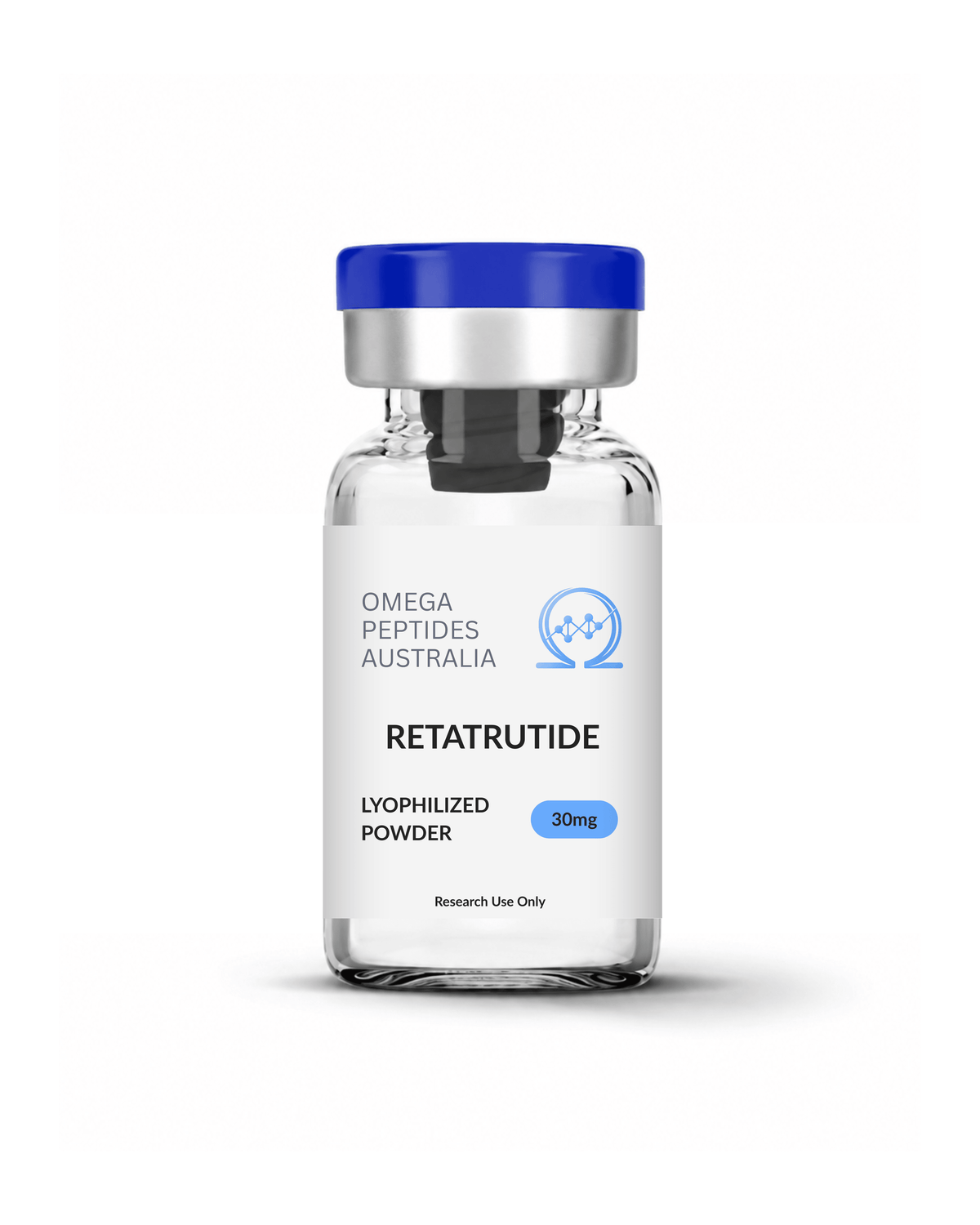
Retatrutide 30mg — the reta peptide in a single 30mg vial
Retatrutide, known in research shorthand simply as reta or the reta peptide, is Eli Lilly's investigational compound LY3437943. This listing is the 30mg vial at $359.99, or $12.00 per mg, which is 25 percent below the per-mg cost of a 10mg vial.
30mg is the size most laboratories settle on once a retatrutide protocol is established. It carries enough material for an extended or multi-arm study from a single uniform solution, at a per-mg cost low enough that the arithmetic stops being the deciding factor. Everything below is specific to this vial: what 30mg divides into, the reconstitution volumes for a 30mg fill, and where it sits against every other size.
Supplied as a lyophilised powder at ≥99% HPLC purity with a batch certificate. Every size is selectable from one listing on the main Retatrutide page.
What is reta?
Reta is the shorthand researchers use for retatrutide. The terms reta, reta peptide, reta peptides and retatrutide peptide all refer to the same compound: a 39-amino-acid peptide developed under the code name LY3437943 (also written LY-3437943). It is frequently mistyped as retarutide, retatritide, reda peptide or reta.peptide, and all of these describe this same molecule.
What makes reta distinct from every other peptide in its class is that it is a unimolecular triple agonist. One backbone activates three receptors at once: GLP-1, GIP and glucagon. Semaglutide is a GLP-1 agonist only. Tirzepatide is a GLP-1/GIP dual agonist. Retatrutide adds the glucagon receptor to both, which is the entire basis of research interest in it, because glucagon receptor signalling in the liver raises fatty acid oxidation and resting energy expenditure through a pathway the other two do not touch.
A fatty diacid side chain attached via a linker to a lysine residue binds the peptide reversibly to circulating albumin. That slows renal clearance and extends plasma half-life far enough to support once-weekly administration in research protocols, rather than the daily schedules earlier incretin peptides required.
What the retatrutide peptide is studied for
- Triple receptor agonism. Reta is the first clinical-stage peptide to activate GLP-1R, GIPR and GCGR together, so it is used as the reference compound when isolating which receptor pathway drives a given metabolic outcome.
- Energy expenditure. The glucagon arm raises hepatic energy expenditure and lipolysis through a mechanism independent of appetite signalling, which is absent in GLP-1-only and GLP-1/GIP dual agonists.
- TRIUMPH Phase 3 data. Retatrutide progressed through Eli Lilly's TRIUMPH program, including TRIUMPH-1 and TRIUMPH-3, which reached primary completion in April 2026, with published reductions in the order of 15 to 24 percent over 48 to 72 weeks.
- Glycaemic research. Insulin secretion, fed-state glucagon suppression and glucose-dependent insulinotropic activity, with comparatively low reported hypoglycaemia risk in trial data.
- Comparator work. Reta, tirzepatide and semaglutide activate overlapping but distinct receptor sets, so all three are commonly run together as comparator arms.
- Tolerability. Gastrointestinal findings dominate the reported adverse profile, consistent with the incretin class, and are studied alongside dose-escalation designs.
The mechanism, trial data and comparative pharmacology are set out in full in the retatrutide research guide and the retatrutide vs tirzepatide comparison.
What a 30mg vial actually yields
Thirty milligrams divides evenly across every common aliquot size, which is part of why this vial is the default for established protocols.
- Thirty 1mg aliquots from one vial.
- Fifteen 2mg aliquots, exact.
- Ten 3mg aliquots, exact.
- Six 5mg aliquots, exact.
The number that actually constrains the vial is not how many aliquots it holds but how many you will draw in 28 days, the refrigerated window for reconstituted peptide. Fifteen 2mg aliquots at weekly intervals would run fifteen weeks, so a 30mg vial suits work consuming roughly 7mg or more per week, or several arms drawing from one solution. Below that rate the Box of 10 x 10mg gives similar per-mg pricing across ten separately sealed vials.
Reconstituting a 30mg retatrutide vial
Volumes calculated for 30mg specifically. Run the bacteriostatic water down the inside wall of the vial onto the powder rather than directly onto it, then swirl until clear. Do not shake.
| Bacteriostatic water added | Final concentration | 1mg aliquot (U100 units) | 2mg aliquot (U100 units) |
| 1.5 mL | 20 mg/mL | 5 units | 10 units |
| 3.0 mL | 10 mg/mL | 10 units | 20 units |
| 6.0 mL | 5 mg/mL | 20 units | 40 units |
3.0 mL at 10 mg/mL is the standard fill for a 30mg vial and the one most protocols assume. 1.5 mL gives a concentrated 20 mg/mL that keeps volumes small but makes sub-milligram measurement difficult on a U100 syringe. 6.0 mL is a large volume for a single vial, so check it against the fill line first.
One 10mL bottle of bacteriostatic water reconstitutes three 30mg vials at 3.0 mL each. The reconstitution calculator will work out any other target concentration.
Retatrutide 30mg price and cost per mg
$359.99 for 30mg works out to $12.00 per mg. Three separate 10mg vials would cost $479.97 for the same quantity, so the single vial saves $119.98.
| Vial | Price | Cost per mg | |
| 5mg | $99.99 | $20.00 per mg | |
| 10mg | $159.99 | $16.00 per mg | |
| 20mg | $269.99 | $13.50 per mg | |
| 30mg | $359.99 | $12.00 per mg | This page |
| 60mg | $589.99 | $9.83 per mg | |
| Box (10 x 10mg) | $1,099.99 | $11.00 per mg |
30mg sits in the middle of the bulk tier: $1.50 per mg below 20mg, $2.17 per mg above 60mg. The Box of 10 x 10mg is cheaper again at $11.00 per mg and splits into ten sealed vials, so for studies running past a month the box is usually the better structure. The single 30mg vial is the right call when the material needs to come from one uniform solution.
Storing a 30mg vial
Sealed, the lyophilised powder holds at 2–8°C for short-term use or −20°C for long-term, protected from light and moisture, without repeated freeze-thaw. Unopened, a 30mg vial keeps as well as any other size in the range.
The difference appears at reconstitution. All 30mg becomes a single solution with one 28 day refrigerated window, and there is no practical way to re-dry the remainder once it is in solution. Decide before opening whether the protocol will draw 30mg inside four weeks. If it will not, holding the same quantity as separate sealed vials preserves the unopened material at full stability until each one is needed.
Label the vial with the reconstitution date as soon as it goes into solution. On a vial this size the window is long enough that it is easy to lose track of, and a 30mg vial discarded at day 35 is $359.99 of material gone.
Choosing 30mg over the alternatives
The 30mg vial is the right choice in three situations, and the wrong one in a fourth, which is worth setting out before ordering.
- A validated protocol with known throughput. Once consumption is predictable and above roughly 7mg a week, 30mg in one vial removes the reordering overhead and drops the per-mg cost 25 percent below the 10mg vial.
- Several arms from one solution. Where comparability between arms matters, drawing every aliquot from a single reconstituted vial removes preparation variance as a confounder.
- Bulk pricing without going to 60mg. The 60mg vial is cheaper per mg but doubles the quantity tied to one expiry window. 30mg is the compromise.
- Not for slow protocols. If consumption is under about 7mg a week, part of the vial will expire. The Box of 10 x 10mg is cheaper per mg than this vial anyway and splits into ten sealed units, so for slower work it is strictly the better buy.
Specifications
| Compound | Retatrutide |
| Also known as | LY3437943, LY-3437943, reta, reta peptide, retatrutide peptide |
| CAS number | 2381089-83-2 |
| Molecular weight | 4731.33 g/mol |
| Purity | ≥99% HPLC, batch COA supplied |
| Form | Lyophilised powder in a sealed sterile vial |
| This vial | 30mg — $359.99 ($12.00 per mg) |
| Aliquots per vial | 30 × 1mg, 15 × 2mg, or 10 × 3mg |
| Typical reconstitution | 3.0 mL bacteriostatic water for 10 mg/mL |
| Saving vs 10mg | 25% lower cost per mg |
| Storage (lyophilised) | 2–8°C short term, −20°C long term |
| Storage (reconstituted) | 2–8°C, use within 28 days |
Batch testing and COA
Janoshik Analytical tests every batch independently. HPLC establishes purity at 99 percent or above and mass spectrometry confirms the measured mass against the expected molecular weight of the 39-residue backbone, which verifies identity rather than purity alone. Certificates are published in the COA library indexed by the batch number printed on the vial. Orders placed before 12pm dispatch the same business day from Australian stock.
Other retatrutide sizes
Every retatrutide size Omega Peptides Australia stocks, with the per-mg cost of each. All sizes can also be selected from a single listing on the main Retatrutide page.
- Retatrutide 5mg — smallest vial, $20.00 per mg, $99.99
- Retatrutide 10mg — the standard single vial, $16.00 per mg, $159.99
- Retatrutide 20mg — first bulk tier, $13.50 per mg, $269.99
- Retatrutide 30mg — this page, the established-protocol size, $359.99
- Retatrutide 60mg — lowest cost per mg, $9.83 per mg, $589.99
- Retatrutide Box (10 x 10mg) — ten sealed vials, $11.00 per mg, $1,099.99
Background on the compound itself sits on the Retatrutide product page and in the retatrutide research guide, rather than being repeated on each size page.
Ordered with a 30mg vial
- Bacteriostatic water — one 10mL bottle covers three 30mg vials at the standard 3.0 mL fill.
- Tirzepatide — the GLP-1/GIP dual agonist run as the standard comparator against reta's triple agonism.
- Retatrutide Premium Kit — vials, diluent and consumables together.
Frequently asked questions
What is reta?
Reta is the shorthand for retatrutide, a 39-amino-acid peptide developed by Eli Lilly under the code name LY3437943. Reta, reta peptide, reta peptides and retatrutide peptide all refer to the same compound. It is also commonly mistyped as retarutide, retatritide or reda peptide.
What is the reta peptide used for in research?
Reta is studied as the first clinical-stage unimolecular triple agonist, activating the GLP-1, GIP and glucagon receptors from one backbone. Research focuses on energy expenditure, glycaemic control and comparative incretin pharmacology against dual and single agonists such as tirzepatide and semaglutide.
How is retatrutide different from tirzepatide and semaglutide?
Semaglutide activates the GLP-1 receptor alone. Tirzepatide activates GLP-1 and GIP. Retatrutide activates both of those plus the glucagon receptor, which raises hepatic fatty acid oxidation and resting energy expenditure through a pathway neither of the others reaches.
How many doses are in a 30mg retatrutide vial?
Thirty 1mg aliquots, fifteen 2mg, ten 3mg or six 5mg, all exact divisions. The practical limit is the 28 day refrigerated window after reconstitution, not the vial contents.
How much bacteriostatic water do I add to a 30mg vial?
3.0 mL is standard and gives 10 mg/mL, so a 2mg aliquot reads 20 units on a U100 syringe. 1.5 mL gives 20 mg/mL and 6.0 mL gives 5 mg/mL, though 6.0 mL is a large volume for one vial.
How much does retatrutide 30mg cost in Australia?
$359.99 for the 30mg vial, which is $12.00 per mg and 25 percent below the 10mg vial. Three 10mg vials would be $479.97 for the same quantity.
Is the 30mg vial the same material as other retatrutide sizes?
Yes. All sizes are filled from the same COA-verified production batches, so purity and identity are identical across the range. Only the quantity per vial differs.
Does the 30mg reta vial ship the same day in Australia?
Orders placed before 12pm on a business day are dispatched the same day from Australian stock, with tracked domestic delivery in discreet unbranded packaging.
⚠ For in-vitro research and laboratory use only. Not for human or veterinary use.