Omega Peptides Australia
Couldn't load pickup availability
For laboratory research use only. Not for human or veterinary use, consumption, or therapeutic application. Not a drug, food, cosmetic, or dietary supplement. Handling restricted to qualified researchers in an appropriate setting.
Certificates of Analysis
Independent third-party testing for this product. Tap a report to view the data.


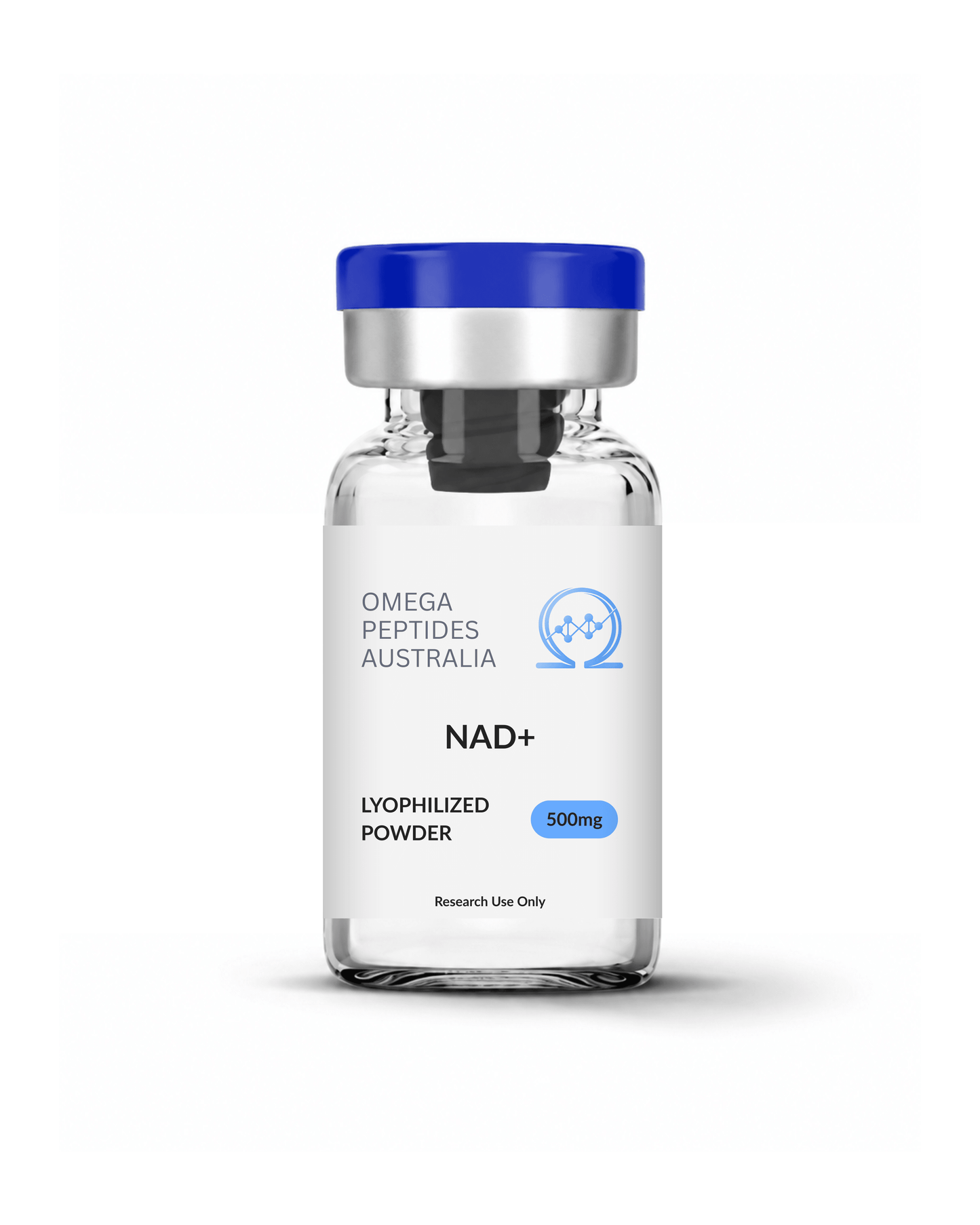
NAD+ (500mg) — Coenzyme and Cellular Energy Research Compound
NAD+ (500mg) is stocked in Australia by Omega Peptides Australia and dispatched the same business day on orders before 12pm, each batch backed by an independent certificate of analysis. Also searched as NAD plus, NAD peptide or nicotinamide adenine dinucleotide, it is the coenzyme central to cellular energy metabolism and sirtuin signalling.
NAD+ is nicotinamide adenine dinucleotide in its oxidised form, a coenzyme found in every living cell. It is not a peptide but a dinucleotide: a nicotinamide riboside unit joined through a pyrophosphate bridge to adenosine monophosphate. The nicotinamide ring accepts and donates a hydride ion, which is what allows NAD+ to shuttle electrons through glycolysis, the citric acid cycle and the mitochondrial electron transport chain. It is written as NAD+, NAD plus or NAD, sometimes as nicotinamide adenine dinucleotide, and informally, though incorrectly, as NAD+ peptide.
NAD+ is studied for its decline with age and the consequences for mitochondrial function, for its role as a substrate of the sirtuin and PARP enzyme families that regulate gene expression and DNA repair, and for its part in neuronal survival and immune signalling. Beyond redox chemistry, NAD+ is consumed by sirtuins, PARPs, CD38 and SARM1, which cleave it to release nicotinamide, so the size of the cellular NAD+ pool sets the activity of these enzymes and links energy status to cell signalling.
Omega Peptides Australia supplies NAD+ as a high-purity (≥99% HPLC), COA-verified lyophilised powder in a 500mg research vial. Orders placed before 12pm are dispatched the same day from within Australia, and the certificate for every batch is published in our COA library.
Key research areas
- Ageing and NAD+ decline. Tissue NAD+ levels fall with age in rodents and humans, partly through increased consumption by CD38 and PARPs and reduced synthesis through the salvage enzyme NAMPT. Research models examine whether restoring the NAD+ pool changes mitochondrial output, senescence markers and healthspan endpoints.
- Sirtuin signalling. Sirtuins are NAD+-dependent deacylases. SIRT1 in the nucleus and SIRT3 in the mitochondria regulate PGC-1 alpha, FOXO transcription factors and mitochondrial biogenesis. NAD+ availability is studied as the switch that couples nutrient status to these longevity-associated pathways.
- DNA repair and PARP activity. PARP1 consumes large amounts of NAD+ when it responds to DNA strand breaks. Laboratory work investigates how genotoxic stress depletes NAD+, how this limits sirtuin activity, and whether replenishing the coenzyme supports repair capacity in cultured cells.
- Neuronal survival. Axon degeneration after injury is driven by SARM1, an enzyme that destroys NAD+ once activated, while the NAD+-synthesising enzyme NMNAT2 protects axons. NAD+ metabolism is therefore central to models of neuropathy, Wallerian degeneration and neurodegenerative disease.
- Metabolic and mitochondrial function. The NAD+/NADH ratio governs the flux of glycolysis and oxidative phosphorylation. Cell and animal models study NAD+ supplementation and precursor loading in obesity, insulin resistance, fatty liver and exercise adaptation.
- Immune and inflammatory signalling. CD38 on immune cells is a major NAD+ consumer and produces calcium-mobilising second messengers. Research examines how inflammation drives NAD+ depletion and how the NAD+ pool shapes macrophage and T-cell function.
NAD+ in Australia
Because NAD+ is not listed on the Australian Register of Therapeutic Goods, it cannot be bought from a pharmacy in Australia; retail chains do not carry it. The route in Australia is a domestic research supplier holding the compound as a research-grade lyophilised vial. Omega Peptides Australia keeps NAD+ in Australian stock and ships it the same business day for orders before 12pm, on tracked delivery, which removes the transit and customs delay of ordering from overseas. The batch certificate is published in the COA library so identity and purity can be checked before the order is placed.
NAD+ is stocked in Australia as a 500mg research-grade vial. It is commonly paired in mitochondrial designs with MOTS-C or SS-31, both held domestically.
How NAD+ works
NAD+ has two distinct jobs. The first is redox chemistry: as a coenzyme it accepts two electrons and a proton from substrates during glycolysis, fatty acid oxidation and the citric acid cycle, becoming NADH, then hands those electrons to complex I of the electron transport chain so that ATP can be made. In this role NAD+ is recycled rather than consumed, and the NAD+/NADH ratio is a real-time readout of how oxidised or reduced the cell is. The second job is as a substrate: sirtuins, PARPs, CD38 and SARM1 cleave NAD+ at the glycosidic bond, using the ADP-ribose portion for signalling or protein modification and releasing nicotinamide.
Because these consuming enzymes destroy NAD+, the cell must constantly remake it. Most NAD+ is rebuilt through the salvage pathway, in which NAMPT converts nicotinamide to NMN and NMNAT enzymes convert NMN to NAD+. Smaller amounts come from tryptophan through the de novo pathway and from nicotinic acid through the Preiss-Handler route. In solution NAD+ is unstable, hydrolysing faster at neutral-to-alkaline pH and at warm temperatures, which is why the research compound is supplied lyophilised and why reconstituted solutions should be kept cold and used promptly.
Specifications
| Compound | NAD+ (nicotinamide adenine dinucleotide, oxidised form, free acid) |
| Also known as | NAD, NAD plus, beta-nicotinamide adenine dinucleotide, diphosphopyridine nucleotide (DPN), coenzyme I, NAD peptide |
| CAS number | 53-84-9 |
| Molecular formula | C21H27N7O14P2 |
| Molecular weight | Approximately 663.4 g/mol |
| Category | Metabolic research |
| Purity | ≥99% HPLC, batch COA supplied |
| Form | Lyophilised powder in a sealed sterile vial |
| Vial sizes available | 500mg — $139.99 |
| Storage (lyophilised) | 2–8°C short term or −20°C long term, protect from light and moisture, avoid repeated freeze-thaw |
| Storage (reconstituted) | 2–8°C, use within 28 days |
| Reconstitution | Bacteriostatic water (recommended) |
Available sizes and pricing
NAD+ is supplied in a single 500mg research vial, a much larger quantity than a typical peptide vial because NAD+ is used at milligram rather than microgram scale in most assays. At $139.99 the per-mg cost is well under a dollar, and the vial contains enough material for a full series of cell-culture or biochemical experiments.
- 500mg vial — $139.99 (about $0.28 per mg)
Quality and COA verification
Every batch of NAD+ is independently tested by Janoshik Analytical. HPLC confirms purity of 99 percent or higher, and mass spectrometry confirms the identity of the compound against its expected molecular weight, which distinguishes NAD+ from its reduced form NADH and from precursors such as NMN. A Certificate of Analysis is issued for every batch and published in our COA library, where the batch number on the vial can be matched to its report. The powder is filled into sterile vials and sealed, and it is lyophilised because NAD+ hydrolyses readily in solution and the dry form is far more stable. Orders are packed to protect the vial from light and impact during domestic transit and shipped from Australian stock.
Frequently bought together
- Bacteriostatic Water (10mL) — $29.99, for reconstituting the 500mg vial to a working stock.
- MOTS-C (10mg) — $99.99, a mitochondrial-derived peptide studied in the same metabolic pathways.
- SS-31 (10mg) — $79.99, a cardiolipin-binding peptide for mitochondrial function models.
- Epitalon (10mg) — $79.99, a tetrapeptide studied in ageing and telomerase research.
Research guides
- Peptide storage guide
- COA testing explained
- Peptide reconstitution calculator
- Ordering and shipping FAQs
Frequently asked questions
What is NAD?
NAD is the short form of nicotinamide adenine dinucleotide, the coenzyme that carries electrons in cellular metabolism. The plus sign in NAD+ marks the oxidised form; NADH is the reduced form that has accepted electrons. When people search for NAD Australia or NAD research compound they almost always mean NAD+. Omega Peptides Australia supplies NAD+ as a 500mg lyophilised research compound for laboratory use only.
What is NAD+?
NAD+ is nicotinamide adenine dinucleotide, a molecule made of nicotinamide, two ribose sugars, two phosphates and adenine. It is present in every cell, where it moves electrons between metabolic reactions and serves as the substrate for sirtuins, PARPs and CD38. It is studied in research models of ageing, mitochondrial function, DNA repair and neuronal survival. It is a small molecule coenzyme, not a peptide.
What is NAD+ also known as?
NAD+ is written as NAD plus, NAD or NAD+, and its full chemical name is beta-nicotinamide adenine dinucleotide. Older literature calls it diphosphopyridine nucleotide, DPN or coenzyme I. It is sometimes described online as an NAD+ peptide, but that is a misnomer because it contains no amino acids. Its reduced form is NADH, and its phosphorylated relatives are NADP+ and NADPH.
How does NAD+ work?
NAD+ works as a redox coenzyme, accepting electrons from substrates to become NADH and delivering them to the mitochondrial electron transport chain for ATP production. It also works as a signalling substrate: sirtuins, PARPs, CD38 and SARM1 break NAD+ apart to regulate gene expression, repair DNA and control calcium signalling. Cells rebuild it mainly through the salvage pathway using the enzymes NAMPT and NMNAT.
What does the research show about NAD+?
Rodent and human studies show that tissue NAD+ falls with age and under metabolic stress. Preclinical work with NAD+ and its precursors NMN and NR has reported improvements in mitochondrial function, insulin sensitivity, muscle endurance and markers of DNA repair in aged or diseased animals. Human clinical studies of precursors have shown that blood NAD+ can be raised, but effects on functional outcomes remain an active area of research.
Can I buy NAD+ at Chemist Warehouse or a pharmacy in Australia?
Not as NAD+ itself. NAD+ is not a registered medicine on the Australian Register of Therapeutic Goods, so Chemist Warehouse and other retail pharmacies do not sell it. Pharmacies do sell precursor supplements such as NMN, and the TGA has issued guidance restricting the use of NAD terms in listed-medicine names. Clinics offer NAD+ infusions as compounded preparations. The lyophilised research-grade NAD+ supplied here is a different product for laboratory use only.
Can Australian compounding pharmacies supply NAD+?
Some Australian compounding pharmacies prepare NAD+ injections, infusions or nasal sprays on an individual prescription from a registered practitioner. These are unapproved compounded preparations, and the TGA has published safety alerts about NAD, NADH and NMN products sold in Australia. Research suppliers such as Omega Peptides Australia supply the lyophilised research compound for in-vitro laboratory work, which is separate from any compounding or clinical pathway.
How do you reconstitute NAD+?
Add bacteriostatic water slowly down the inside wall of the vial and swirl gently until the powder dissolves; do not shake. NAD+ dissolves readily, and the reconstitution calculator gives the volume for a chosen concentration. Because NAD+ hydrolyses in solution, prepare only what is needed, refrigerate the vial at 2–8°C and use it within 28 days.
How should NAD+ be stored?
Keep the sealed lyophilised powder at 2–8°C for short-term storage or at −20°C for long-term storage, protected from light and moisture, and avoid repeated freeze-thaw cycles. NAD+ is hygroscopic, so allow a cold vial to reach room temperature before opening to prevent condensation. Reconstituted solutions should be refrigerated at 2–8°C and used within 28 days, and frozen aliquots preserve activity better for longer holds.
Where can I buy NAD+ in Australia?
Omega Peptides Australia holds NAD+ in domestic stock and dispatches orders placed before 12pm on the same business day. Every batch is COA-verified by an independent laboratory and the certificates are published online. Order the 500mg vial from this page, or browse the full range of research peptides in Australia for related mitochondrial and metabolic compounds.
What does NAD+ cost in Australia?
Research-grade NAD+ from Omega Peptides Australia costs $139.99 for a 500mg vial, which works out to about $0.28 per mg. The large vial format means one purchase covers an extended series of biochemical or cell-culture experiments. Bacteriostatic water for reconstitution is sold separately in 3mL and 10mL sizes.
How do I get NAD+ online in Australia?
Add the 500mg vial to your cart on this product page and complete checkout. Orders are shipped with tracked domestic delivery in discreet, unbranded packaging. Orders placed before 12pm are dispatched the same business day from within Australia, and a tracking number is emailed once the parcel is lodged with the carrier.
Is NAD+ legal in Australia?
Omega Peptides Australia supplies NAD+ strictly for lawful in-vitro laboratory research. It is not approved by the TGA for human or veterinary use and is not sold as a medicine or supplement. Purchasers are responsible for ensuring their intended use complies with all applicable laws.
How does research-grade NAD+ differ from NAD+ supplements and IV clinics?
Retail supplements usually contain precursors such as NMN or nicotinamide riboside rather than NAD+ itself, and are formulated as capsules for oral use. IV clinics and compounding pharmacies prepare NAD+ solutions for administration on prescription. The product sold here is pure lyophilised NAD+ with a batch COA, supplied as a raw research compound for laboratory assays and cell-culture work, not as a formulated or sterile-for-injection product.
Is NAD+ available in Australia?
Yes, as a research-grade lyophilised compound from domestic suppliers. Omega Peptides Australia holds NAD+ 500mg in Australian stock, COA verified, with same-day dispatch before 12pm.
Can you get NAD+ in Australia?
Yes, from an Australian research supplier holding domestic stock. Omega Peptides Australia ships NAD+ from within Australia on tracked delivery.
⚠ For in-vitro research and laboratory use only. Not for human or veterinary use.