Omega Peptides Australia
Couldn't load pickup availability
For laboratory research use only. Not for human or veterinary use, consumption, or therapeutic application. Not a drug, food, cosmetic, or dietary supplement. Handling restricted to qualified researchers in an appropriate setting.
Certificates of Analysis
Independent third-party testing for this product. Tap a report to view the data.


Melanotan I (10mg) — Linear MC1R Agonist Research Peptide
Omega Peptides Australia supplies Melanotan I (10mg) in Australia from domestic stock, dispatching same day on orders placed before 12pm with a certificate of analysis published for every batch. Often written Melanotan 1, MT1, MT-1 or afamelanotide analogue, it is a linear alpha-MSH analogue studied for melanogenesis.
Melanotan I is a synthetic linear analogue of alpha-melanocyte-stimulating hormone (α-MSH), the thirteen-residue pigment hormone cleaved from pro-opiomelanocortin. It was first synthesised at the University of Arizona in the early 1980s and is described in the pharmacology literature as [Nle4, D-Phe7]-α-MSH or NDP-α-MSH: the native sequence with methionine replaced by norleucine at position four and L-phenylalanine replaced by D-phenylalanine at position seven, written in full as Ac-Ser-Tyr-Ser-Nle-Glu-His-D-Phe-Arg-Trp-Gly-Lys-Pro-Val-NH2. It is often written as MT1, MT-1 or melanotan 1, and under its international non-proprietary name afamelanotide it is the active ingredient in the registered implant medicine Scenesse, developed by the Australian company Clinuvel.
Melanotan I is studied for MC1R-driven melanogenesis and photoprotection, for the prevention of phototoxic reactions in the rare genetic disorder erythropoietic protoporphyria, and for repigmentation and photodermatosis research. At the receptor level it is a potent agonist at MC1R on melanocytes, where it activates the Gs-coupled cyclic AMP pathway that drives eumelanin synthesis and supports DNA-repair signalling in the cell.
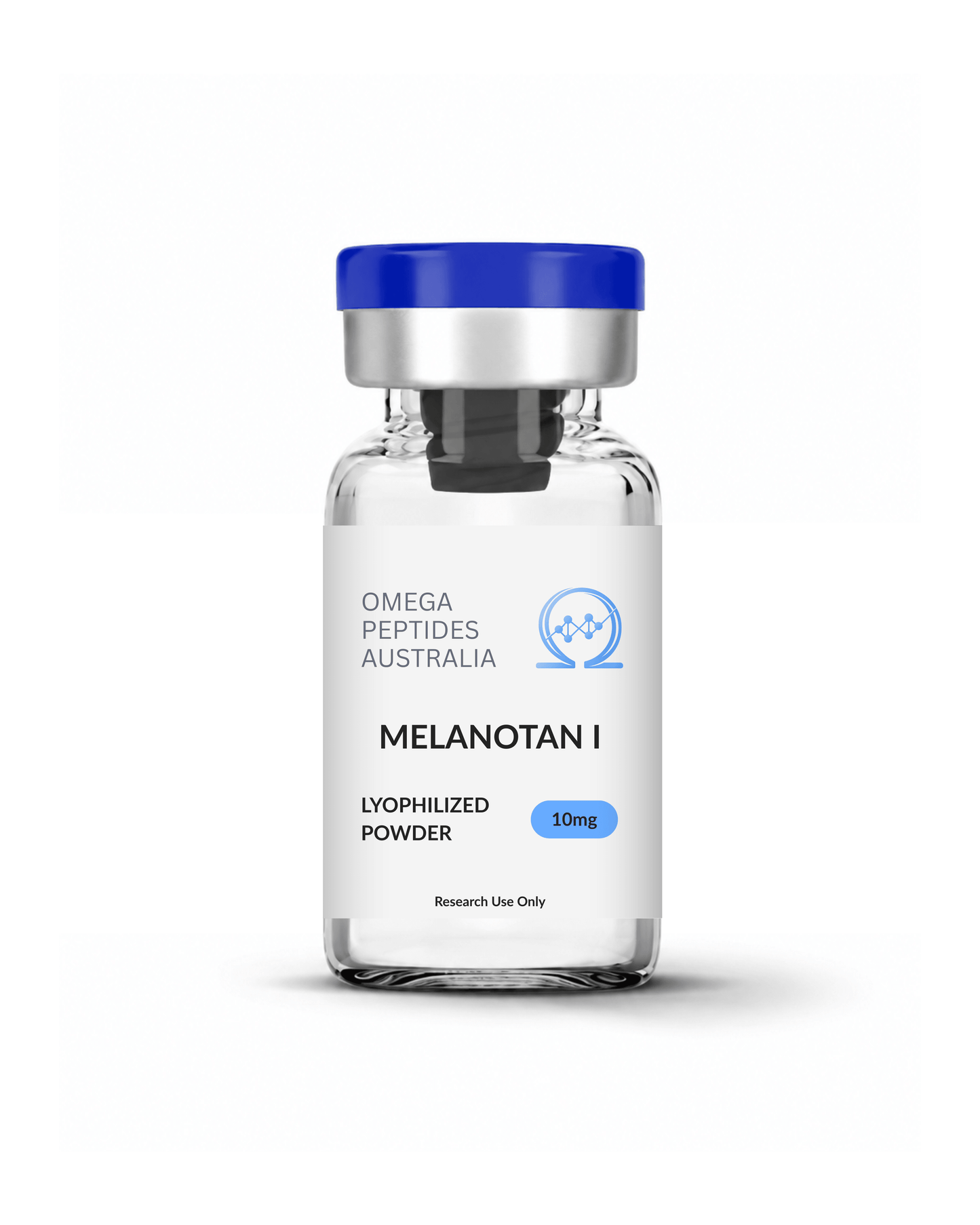
Omega Peptides Australia supplies Melanotan I as a high-purity (≥99% HPLC) COA-verified lyophilised powder in a sealed 10mg vial. Orders placed before 12pm are dispatched the same day from within Australia, and the batch Certificate of Analysis for every lot is published in our COA library so it can be checked before you order.
Key research areas
- Erythropoietic protoporphyria (EPP) The most developed research programme for afamelanotide concerns EPP, a disorder in which accumulated protoporphyrin makes skin acutely painful on light exposure. Clinical trials tested whether increasing eumelanin density could reduce phototoxic reactions and extend pain-free light exposure, and that work led to regulatory approval of a controlled-release implant in the European Union, the United States and Australia.
- Melanogenesis and MC1R pharmacology NDP-α-MSH is the reference ligand for melanocortin-1 receptor studies. In cultured melanocytes it raises cAMP, up-regulates the transcription factor MITF and increases tyrosinase, TYRP1 and DCT expression, shifting melanin output from red-yellow pheomelanin to brown-black eumelanin. Its radio-iodinated form is the standard tracer in melanocortin receptor binding assays.
- Photoprotection and DNA repair Beyond pigment, MC1R signalling has been shown in keratinocyte and melanocyte models to enhance nucleotide-excision repair of UV-induced DNA lesions and to reduce oxidative DNA damage. Melanotan I is used in this research as a stable, potent agonist to probe how MC1R activation contributes to the skin's intrinsic defences independently of tanning.
- Vitiligo repigmentation Clinical investigations have combined afamelanotide with narrowband ultraviolet-B phototherapy to test whether MC1R stimulation accelerates repigmentation of depigmented patches. The proposed mechanism is activation and migration of melanocyte precursors from the hair-follicle reservoir alongside increased melanin synthesis in surviving melanocytes.
- Photodermatoses The compound has been studied in polymorphous light eruption and solar urticaria, conditions in which sunlight triggers abnormal skin reactions. The research question is whether a pre-formed eumelanin shield, and the anti-inflammatory signalling associated with MC1R, can reduce the frequency or severity of provoked episodes in light-challenge models.
- Comparative melanocortin selectivity Because it is linear and MC1R-preferring, Melanotan I is the natural comparator to the cyclic, non-selective analogue Melanotan II. Side-by-side experiments are used to separate peripheral pigmentation effects from the central MC3R and MC4R effects on appetite and sexual function that are seen only with the cyclic compound.
How Melanotan I works
Native α-MSH survives only a few minutes in plasma because proteases cleave it rapidly and its methionine residue oxidises easily. The two substitutions in Melanotan I address both problems. Norleucine at position four is an oxidation-resistant isostere of methionine, and D-phenylalanine at position seven blocks the enzymatic cleavage that normally occurs within the His-Phe-Arg-Trp core, while also stabilising a receptor-preferred turn conformation. The result is an analogue that is far more potent than the parent hormone and considerably more persistent, although its plasma half-life is still only about thirty minutes, which is why the registered medicine is formulated as a slow-release subcutaneous implant rather than a solution.
At MC1R on the melanocyte membrane the peptide activates Gs, raising cyclic AMP and switching on MITF, the master regulator of melanocyte gene expression. MITF in turn induces tyrosinase and related enzymes, so melanin synthesis rises and shifts towards eumelanin. The same cAMP signal supports DNA-repair pathways in the cell. The key distinction from Melanotan II is selectivity: the cyclic analogue activates MC3R and MC4R strongly and therefore produces central effects on appetite and sexual function in research models, whereas Melanotan I is used where a pigmentation-focused, MC1R-centred response is wanted.
Specifications
| Compound | Melanotan I (afamelanotide) |
| Also known as | MT1, MT-1, melanotan 1, NDP-α-MSH, [Nle4, D-Phe7]-α-MSH, Scenesse (pharmaceutical brand), afamelanotide analogue |
| CAS number | 75921-69-6 |
| Molecular formula | C78H111N21O19 |
| Molecular weight | 1646.85 g/mol |
| Sequence | Ac-Ser-Tyr-Ser-Nle-Glu-His-D-Phe-Arg-Trp-Gly-Lys-Pro-Val-NH2 |
| Category | Melanocortin receptor research |
| Purity | ≥99% HPLC, batch COA supplied |
| Form | Lyophilised powder in a sealed sterile vial |
| Vial sizes available | 10mg — $69.99 |
| Storage (lyophilised) | 2–8°C short term or −20°C long term, protect from light and moisture, avoid repeated freeze-thaw |
| Storage (reconstituted) | 2–8°C, use within 28 days |
| Reconstitution | Bacteriostatic water (recommended) |
Available sizes and pricing
Melanotan I is supplied in a single 10mg research vial. Researchers running selectivity comparisons usually order it alongside the cyclic analogue, and the Melanotan II Starter Kit supplies that vial with the bacteriostatic water, syringes and swabs that can be shared across both compounds.
- 10mg vial — $69.99 (about $7.00 per mg)
Quality and COA verification
Every batch of Melanotan I is tested independently by Janoshik Analytical before it is released. HPLC measures purity against the ≥99% specification, and mass spectrometry confirms that the observed molecular mass matches afamelanotide, so the vial contains the linear thirteen-residue peptide and not a cyclic or truncated analogue. A Certificate of Analysis is issued for each batch and published in our COA library, where the batch number printed on the vial can be matched to its report. The peptide is lyophilised to protect it from hydrolysis and oxidation, sealed in a sterile vial under a crimped cap, and cushioned for domestic transit so it arrives intact.
Frequently bought together
- Melanotan II (10mg) — $79.99, the cyclic non-selective analogue for selectivity comparisons
- Melanotan II Starter Kit — $109.99, adds bacteriostatic water, syringes and swabs to the cyclic analogue
- GHK-Cu (50mg) — $89.99, a copper tripeptide studied in parallel skin and pigmentation models
- Bacteriostatic Water (10mL) — $29.99, the recommended diluent for reconstitution
Research guides
- Peptide storage guide: how to store lyophilised peptides properly
- COA testing explained: how research peptides are verified
- Peptide reconstitution calculator
- Certificates of Analysis library
Frequently asked questions
What is MT1?
MT1 is the shorthand for Melanotan I, the linear α-MSH analogue also known as afamelanotide or NDP-α-MSH. It is the first of the two melanotan peptides developed at the University of Arizona and is distinguished from MT2 (Melanotan II) by its full-length linear sequence and its preference for the MC1R pigmentation receptor. In its registered pharmaceutical form it is called Scenesse.
What is Melanotan I?
Melanotan I is a synthetic thirteen-residue analogue of alpha-melanocyte-stimulating hormone carrying norleucine and D-phenylalanine substitutions that make it more potent and longer-lived than the native hormone. It is a potent MC1R agonist studied in melanogenesis, photoprotection, erythropoietic protoporphyria and vitiligo research. Omega Peptides Australia supplies it as a lyophilised 10mg research powder with a batch Certificate of Analysis, strictly for in-vitro laboratory use.
What is Melanotan I also known as?
It is also written as MT1, MT-1, MT-I, melanotan 1 or melanotan one, and appears in the scientific literature as NDP-α-MSH, NDP-MSH or [Nle4, D-Phe7]-α-MSH. Its non-proprietary drug name is afamelanotide, and the registered implant medicine is branded Scenesse. Common misspellings include melanotin 1 and melatonan 1. Its CAS number is 75921-69-6.
How does Melanotan I work?
It binds the melanocortin-1 receptor on melanocytes and activates the Gs-coupled cAMP cascade. Rising cAMP switches on the transcription factor MITF, which induces tyrosinase and related enzymes, so melanin synthesis increases and shifts towards photoprotective eumelanin. The same signal supports DNA-repair pathways. Its norleucine and D-phenylalanine substitutions resist oxidation and enzymatic cleavage, giving far greater potency than α-MSH, although its plasma half-life remains about thirty minutes.
What does the research show about Melanotan I?
In melanocyte cultures and preclinical models Melanotan I consistently increases eumelanin production through MC1R and enhances repair of UV-induced DNA damage. Clinical trials of the afamelanotide implant in erythropoietic protoporphyria reported longer pain-free light exposure and supported regulatory approval in Europe, the United States and Australia. Clinical studies have also examined it with narrowband UVB phototherapy in vitiligo and in light-provocation models of polymorphous light eruption.
Can I buy Melanotan I at Chemist Warehouse or a pharmacy in Australia?
Afamelanotide is TGA-registered in Australia as Scenesse, a prescription-only controlled-release implant for adults with erythropoietic protoporphyria, and it is administered by trained clinicians in specialist settings rather than sold through Chemist Warehouse, Priceline or other retail pharmacies. The research-grade lyophilised Melanotan I supplied here is a different product, a laboratory reagent for in-vitro use, not a medicine.
Can Australian compounding pharmacies supply Melanotan I?
Compounding pharmacies in Australia prepare medicines only for an individual patient on a practitioner's prescription and do not sell peptides to the public. Because a TGA-registered afamelanotide product already exists and is prescribed by specialists, compounding pharmacies do not generally prepare Melanotan I; the compounding exemption applies only to medicines made for an individual patient on prescription where a registered product is unsuitable. Research suppliers such as Omega Peptides Australia supply the lyophilised research compound for laboratory use, which is a separate category from compounded medicines.
How do you reconstitute Melanotan I?
Use bacteriostatic water. Draw the required volume into a sterile syringe, pierce the vial septum and let the water run slowly down the inside wall of the vial rather than directly onto the powder. Swirl gently until the solution is clear; do not shake, because agitation can denature the peptide. Refrigerate the reconstituted vial at 2–8°C and use it within 28 days. Our reconstitution calculator will give you the resulting concentration.
How should Melanotan I be stored?
Store the lyophilised vial at 2–8°C for short-term use or at −20°C for long-term storage, protected from light and moisture, and avoid repeated freeze-thaw cycles. After reconstitution keep the solution refrigerated at 2–8°C and use it within 28 days. Lyophilised Melanotan I tolerates ambient temperatures during domestic transit, so no cold chain is required for delivery.
Where can I buy Melanotan I in Australia?
Omega Peptides Australia holds Melanotan I in domestic stock and ships from within Australia, avoiding international delays and customs uncertainty. Orders placed before 12pm are dispatched the same day, every batch carries an independent Certificate of Analysis, and you can browse the full range in our research peptides collection. We are a research supplier only and do not supply Melanotan I for human use.
What does Melanotan I cost in Australia?
A 10mg vial of Melanotan I costs $69.99, which works out to about $7.00 per mg. It is $10 less than the cyclic analogue Melanotan II at $79.99 per 10mg vial. Prices are in Australian dollars and include the independent Janoshik Analytical testing and the batch Certificate of Analysis.
How do I get Melanotan I online in Australia?
Select the 10mg vial on this page, add it to your cart and check out. Orders placed before 12pm are dispatched the same business day from our Australian facility with tracked domestic shipping. Packaging is plain and discreet, the vial is cushioned for transit, and a tracking number is emailed once the parcel is collected. The batch COA can be checked in the COA library at any time.
Is Melanotan I legal in Australia?
Omega Peptides Australia supplies Melanotan I strictly for lawful in-vitro laboratory research. It is not approved by the TGA for human or veterinary use and is not sold as a medicine or supplement. Purchasers are responsible for ensuring their intended use complies with all applicable laws.
What is the difference between Melanotan I and Melanotan II?
Melanotan I is a linear thirteen-residue peptide that favours MC1R and produces a pigmentation-centred response with a half-life of about thirty minutes. Melanotan II is a cyclic seven-residue peptide that activates MC1R, MC3R, MC4R and MC5R, so in research models it also affects appetite and sexual-function circuits. Choose Melanotan I for MC1R-focused work and Melanotan II when a broad melanocortin agonist is required.
⚠ For in-vitro research and laboratory use only. Not for human or veterinary use.