Omega Peptides Australia
Couldn't load pickup availability
For laboratory research use only. Not for human or veterinary use, consumption, or therapeutic application. Not a drug, food, cosmetic, or dietary supplement. Handling restricted to qualified researchers in an appropriate setting.
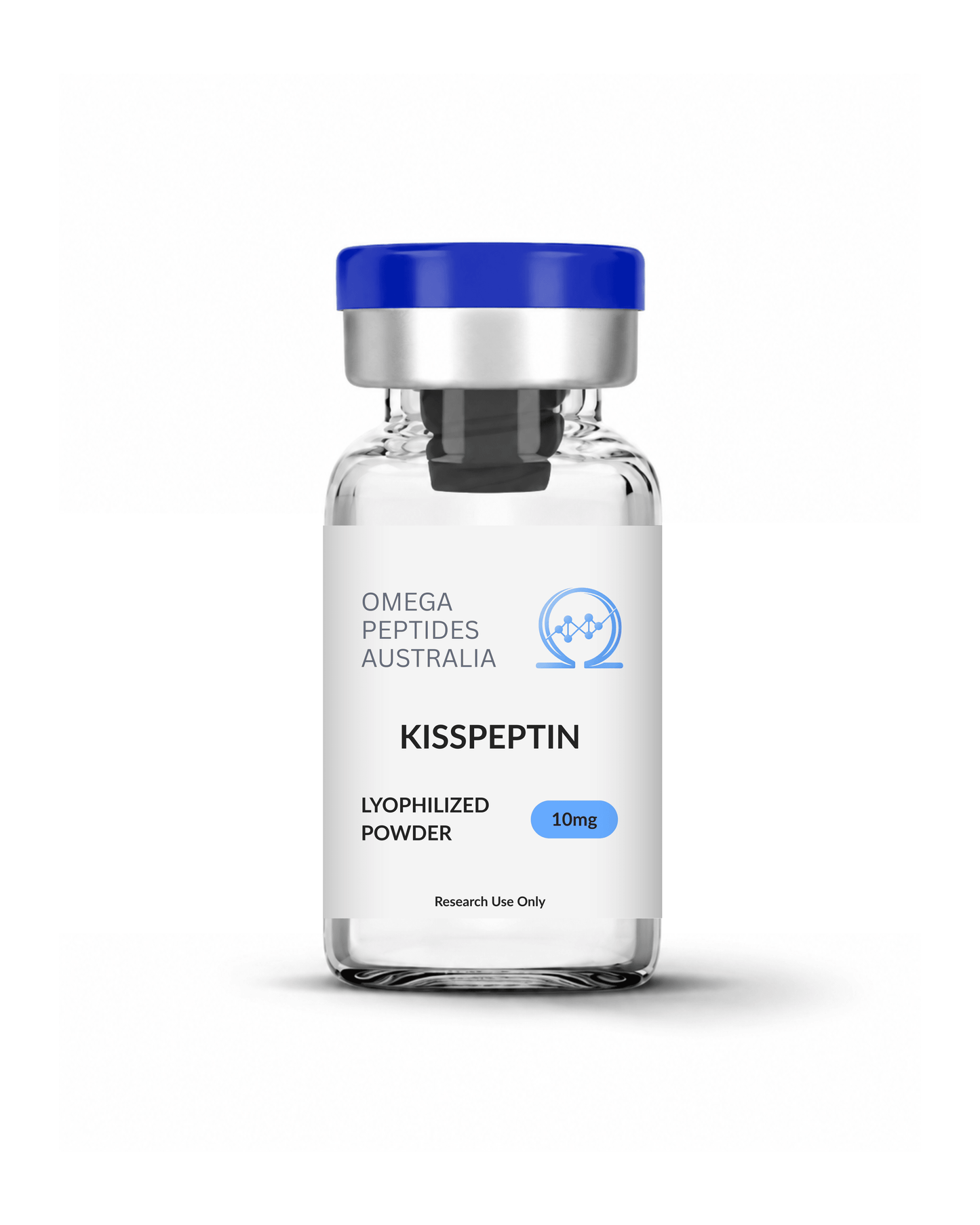
Kisspeptin-10 (10mg) — KISS1 Receptor Agonist Reproductive-Axis Research Peptide
Kisspeptin-10 (10mg) is stocked in Australia by Omega Peptides Australia and dispatched the same business day on orders before 12pm, each batch backed by an independent certificate of analysis. Also searched as kisspeptin 10, metastin, KP-10 or kisspeptin peptide, it is a decapeptide studied for GnRH release and reproductive axis signalling.
Kisspeptin-10 is a ten-residue amidated fragment of kisspeptin, the family of peptides encoded by the KISS1 gene. The gene product is a 145-amino-acid precursor that is cleaved into kisspeptin-54 (also called metastin), and shorter forms of 14, 13 and 10 residues share its C-terminal end. Kisspeptin-10 is that shared C-terminal decapeptide, Tyr-Asn-Trp-Asn-Ser-Phe-Gly-Leu-Arg-Phe-NH2 (YNWNSFGLRF-NH2), and it carries the full receptor-binding activity of the parent. KISS1 was first identified as a metastasis-suppressor gene in melanoma cells in Hershey, Pennsylvania, which is where the name comes from. The peptide is often written as KP-10, KP10, kisspeptin 10 or metastin (45-54), and is sometimes just called the kisspeptin peptide.
Kisspeptin-10 is studied as the master upstream regulator of the hypothalamic-pituitary-gonadal axis, in puberty and reproductive endocrinology research, and in the tumour-metastasis biology from which the gene was first described. It works by activating KISS1R (formerly GPR54), a Gq-coupled receptor on gonadotropin-releasing hormone neurons, triggering phospholipase C, intracellular calcium release and pulsatile GnRH secretion that in turn drives luteinising hormone and follicle-stimulating hormone release from the pituitary.
Omega Peptides Australia supplies Kisspeptin-10 as a high-purity (≥99% HPLC) COA-verified lyophilised powder in a sealed 10mg vial. Orders placed before 12pm are dispatched the same day from within Australia, and the batch Certificate of Analysis for every lot is published in our COA library so it can be checked before you order.
Key research areas
- GnRH pulse generation and the reproductive axis Kisspeptin neurons in the arcuate nucleus and the preoptic area are now understood to be the pacemaker that drives pulsatile GnRH release. Kisspeptin-10 is the standard tool for probing this system: in animal models and in clinical studies in healthy men it produces dose-dependent rises in luteinising hormone, and continuous infusion has been reported to increase LH pulse frequency without the desensitisation seen with GnRH itself.
- Puberty onset and hypogonadotropic hypogonadism Loss-of-function mutations in KISS1R cause failure of puberty, while activating mutations cause precocious puberty, which established kisspeptin signalling as the gatekeeper of reproductive maturation. Research with Kisspeptin-10 examines how the system is switched on, how it integrates nutritional and metabolic cues through leptin-sensitive neurons, and how it responds in hypothalamic amenorrhoea models.
- Reproductive medicine research Because kisspeptin acts upstream of GnRH, it produces a more physiological LH surge than direct GnRH agonists. Clinical research programmes have explored kisspeptin as a trigger for oocyte maturation in assisted-reproduction models, with the aim of reducing ovarian hyperstimulation. Kisspeptin-10 is used in parallel mechanistic work to define receptor kinetics and the duration of the induced surge.
- Metastasis suppression Kisspeptins were originally named metastin because KISS1 expression suppresses metastasis of melanoma and breast cancer cells in xenograft models without affecting primary tumour growth. Kisspeptin-10 activation of KISS1R has been shown in cell models to inhibit chemotaxis, invasion and matrix metalloproteinase activity, and this remains an active line of oncology research.
- Metabolic and energy-balance links Kisspeptin neurons express leptin receptors and are suppressed in negative energy balance, which is thought to explain why fertility is switched off during starvation. Kisspeptin is also produced in the liver and pancreatic islets, and research models are used to test its proposed role in glucose-stimulated insulin secretion and in the crosstalk between metabolism and reproduction.
- Limbic and behavioural neuroscience KISS1R is expressed in the amygdala, hippocampus and other limbic regions, and functional imaging studies in men have examined how kisspeptin administration changes brain activity during emotional and sexual stimuli. Kisspeptin-10 is used in preclinical models to map these non-reproductive circuits.
How Kisspeptin-10 works
Kisspeptin-10 binds KISS1R, a G-protein-coupled receptor that signals mainly through Gq. Receptor activation stimulates phospholipase C, which generates inositol trisphosphate and diacylglycerol, releasing calcium from intracellular stores and activating protein kinase C. In GnRH neurons this calcium signal depolarises the cell and triggers GnRH secretion into the portal circulation, so the pituitary releases LH and FSH. Because the receptor sits upstream of GnRH, kisspeptin does not bypass the normal pulsatile pattern; it drives it. The ten-residue fragment contains the RF-amide motif that the receptor recognises, which is why kisspeptin-10 is as potent as the full-length peptide at the receptor itself.
The main difference between kisspeptin-10 and kisspeptin-54 is pharmacokinetic rather than pharmacological. In human studies the plasma half-life of kisspeptin-10 has been reported at about four minutes, versus roughly twenty-eight minutes for kisspeptin-54, so the short form gives a sharp, rapidly reversible stimulus whereas the long form gives a sustained one. That property makes kisspeptin-10 well suited to pulse-frequency and receptor-kinetic experiments. It is also entirely distinct from melanocortin peptides such as PT-141, which act on MC4R in different hypothalamic circuits; the two are sometimes studied together to separate upstream endocrine signalling from central melanocortin effects.
Specifications
| Compound | Kisspeptin-10 (human) |
| Also known as | KP-10, KP10, kisspeptin 10, metastin (45-54), KISS1-derived peptide, kisspeptin peptide |
| CAS number | 374675-21-5 |
| Molecular formula | C63H83N17O14 |
| Molecular weight | 1302.44 g/mol |
| Sequence | Tyr-Asn-Trp-Asn-Ser-Phe-Gly-Leu-Arg-Phe-NH2 (YNWNSFGLRF-NH2) |
| Category | Reproductive endocrinology research |
| Purity | ≥99% HPLC, batch COA supplied |
| Form | Lyophilised powder in a sealed sterile vial |
| Vial sizes available | 10mg — $79.99 |
| Storage (lyophilised) | 2–8°C short term or −20°C long term, protect from light and moisture, avoid repeated freeze-thaw |
| Storage (reconstituted) | 2–8°C, use within 28 days |
| Reconstitution | Bacteriostatic water (recommended) |
Available sizes and pricing
Kisspeptin-10 is supplied in a single 10mg research vial. Because the peptide is used in short, sharply timed stimuli, one vial supports a large number of in-vitro experiments. It is often ordered alongside PT-141 for laboratories mapping reproductive and central signalling in the same study, and bacteriostatic water is sold separately in 3mL and 10mL vials.
- 10mg vial — $79.99 (about $8.00 per mg)
Quality and COA verification
Every batch of Kisspeptin-10 is tested independently by Janoshik Analytical before release. HPLC measures purity against the ≥99% specification, and mass spectrometry confirms that the observed molecular mass matches the human decapeptide amide, ruling out truncated fragments or the non-amidated acid form. A Certificate of Analysis is issued for each batch and published in our COA library, where the batch number printed on the vial can be matched to its report. The peptide is lyophilised to protect it from hydrolysis and deamidation, sealed in a sterile vial under a crimped cap, and cushioned for domestic transit so it arrives in laboratory condition.
Frequently bought together
- PT-141 (10mg) — $69.99, the melanocortin MC4R agonist for complementary central-signalling research
- Bacteriostatic Water (10mL) — $29.99, the recommended diluent for reconstitution
- Bacteriostatic Water (3mL) — $14.99, a smaller diluent vial for single-peptide work
- GHK-Cu (50mg) — $89.99, a copper tripeptide frequently added to the same order for skin-model work
Research guides
- Peptide storage guide: how to store lyophilised peptides properly
- COA testing explained: how research peptides are verified
- Peptide reconstitution calculator
- Certificates of Analysis library
Frequently asked questions
What is KP-10?
KP-10 is the shorthand for kisspeptin-10, the ten-residue C-terminal fragment of the kisspeptin family of peptides. The number refers to its length, in the same way that KP-54 refers to the full-length 54-residue form. All the kisspeptin fragments share this C-terminal decapeptide, which is the part that binds the KISS1 receptor, so KP-10 is the smallest fully active form of the peptide.
What is Kisspeptin-10?
Kisspeptin-10 is an amidated decapeptide derived from the KISS1 gene product. It is a potent agonist of KISS1R, the receptor on GnRH neurons that governs the reproductive axis, and it is studied in GnRH pulse generation, puberty, reproductive medicine, metastasis suppression and metabolic signalling. Omega Peptides Australia supplies it as a lyophilised 10mg research powder with a batch Certificate of Analysis, strictly for in-vitro laboratory use.
What is Kisspeptin-10 also known as?
It is also written as KP-10, KP10, kisspeptin 10, kisspeptin10 or kiss peptin 10, and in older literature as metastin (45-54) because the parent peptide was named metastin. Common misspellings include kispeptin, kisspeptide and kisseptin. It is sometimes listed as a KISS1-derived peptide or simply the kisspeptin peptide. Its CAS number is 374675-21-5.
How does Kisspeptin-10 work?
It binds KISS1R, a Gq-coupled receptor on GnRH neurons and other cells. Activation stimulates phospholipase C, raises intracellular calcium and triggers pulsatile GnRH release into the portal circulation, which drives LH and FSH secretion from the pituitary. Because it acts upstream of GnRH rather than replacing it, the response preserves the normal pulsatile pattern. Its plasma half-life is only about four minutes, giving a sharp, reversible stimulus.
What does the research show about Kisspeptin-10?
Clinical studies in healthy men have shown dose-dependent LH increases after intravenous kisspeptin-10, and sustained LH elevation with increased pulse frequency during prolonged infusion, without the desensitisation seen with GnRH. Genetic studies link KISS1R mutations to absent or precocious puberty. In cell and xenograft models, KISS1R activation suppresses tumour cell invasion and metastasis. Preclinical work continues on its metabolic and limbic roles.
Can I buy Kisspeptin-10 at Chemist Warehouse or a pharmacy in Australia?
No. There is no kisspeptin product registered on the Australian Register of Therapeutic Goods, so Chemist Warehouse, Priceline and other retail pharmacies do not stock it, and kisspeptin has no approved medicine form anywhere at present; its clinical use has been confined to research trials. The research-grade lyophilised Kisspeptin-10 supplied here is a laboratory reagent for in-vitro use, not a medicine.
Can Australian compounding pharmacies supply Kisspeptin-10?
Compounding pharmacies in Australia prepare medicines only for an individual patient on a practitioner's prescription and do not sell peptides to the public. Kisspeptin-10 is not a standard compounding item in Australia because it has no established clinical indication outside research trials. Compounded medicines are only exempt from registration when prepared for an individual patient on a valid prescription, and the TGA has warned practitioners about their responsibilities when supplying unapproved peptide products. Research suppliers such as Omega Peptides Australia supply the lyophilised research compound for laboratory use, a separate category from compounded medicines.
How do you reconstitute Kisspeptin-10?
Use bacteriostatic water. Draw the required volume into a sterile syringe, pierce the vial septum and let the water run slowly down the inside wall of the vial rather than directly onto the powder. Swirl gently; do not shake. Kisspeptin-10 can be slower to dissolve than some peptides, so allow a few extra minutes of gentle swirling before use. Refrigerate the reconstituted vial at 2–8°C and use it within 28 days.
How should Kisspeptin-10 be stored?
Store the lyophilised vial at 2–8°C for short-term use or at −20°C for long-term storage, protected from light and moisture, and avoid repeated freeze-thaw cycles. After reconstitution keep the solution refrigerated at 2–8°C and use it within 28 days. Lyophilised Kisspeptin-10 tolerates ambient temperatures during domestic transit, so no cold chain is required for delivery.
Where can I buy Kisspeptin-10 in Australia?
Omega Peptides Australia holds Kisspeptin-10 in domestic stock and ships from within Australia, avoiding international delays and customs uncertainty. Orders placed before 12pm are dispatched the same day, every batch carries an independent Certificate of Analysis, and you can browse the full range in our research peptides collection. We are a research supplier only and do not supply Kisspeptin-10 for human use.
What does Kisspeptin-10 cost in Australia?
A 10mg vial of Kisspeptin-10 costs $79.99, which works out to about $8.00 per mg. Prices are in Australian dollars and include the independent Janoshik Analytical testing and the batch Certificate of Analysis. Bacteriostatic water for reconstitution is sold separately at $14.99 for 3mL or $29.99 for 10mL.
How do I get Kisspeptin-10 online in Australia?
Select the 10mg vial on this page, add it to your cart and check out. Orders placed before 12pm are dispatched the same business day from our Australian facility with tracked domestic shipping. Packaging is plain and discreet, the vial is cushioned for transit, and a tracking number is emailed once the parcel is collected. The batch COA can be checked in the COA library at any time.
Is Kisspeptin-10 legal in Australia?
Omega Peptides Australia supplies Kisspeptin-10 strictly for lawful in-vitro laboratory research. It is not approved by the TGA for human or veterinary use and is not sold as a medicine or supplement. Purchasers are responsible for ensuring their intended use complies with all applicable laws.
What is the difference between Kisspeptin-10 and Kisspeptin-54?
Both bind KISS1R with similar potency because they share the same C-terminal decapeptide. Kisspeptin-54 is the full-length 54-residue peptide, also called metastin, and has a plasma half-life of roughly twenty-eight minutes, so it produces a prolonged stimulus and is the form used in assisted-reproduction research. Kisspeptin-10 is cleared in about four minutes, giving a brief, sharply defined pulse that suits receptor-kinetic and pulse-frequency experiments.
⚠ For in-vitro research and laboratory use only. Not for human or veterinary use.
Share