Omega Peptides Australia
Couldn't load pickup availability
For laboratory research use only. Not for human or veterinary use, consumption, or therapeutic application. Not a drug, food, cosmetic, or dietary supplement. Handling restricted to qualified researchers in an appropriate setting.
IGF-1 LR3 (1mg) — Long-Acting IGF-1 Analogue Growth Factor Research Compound
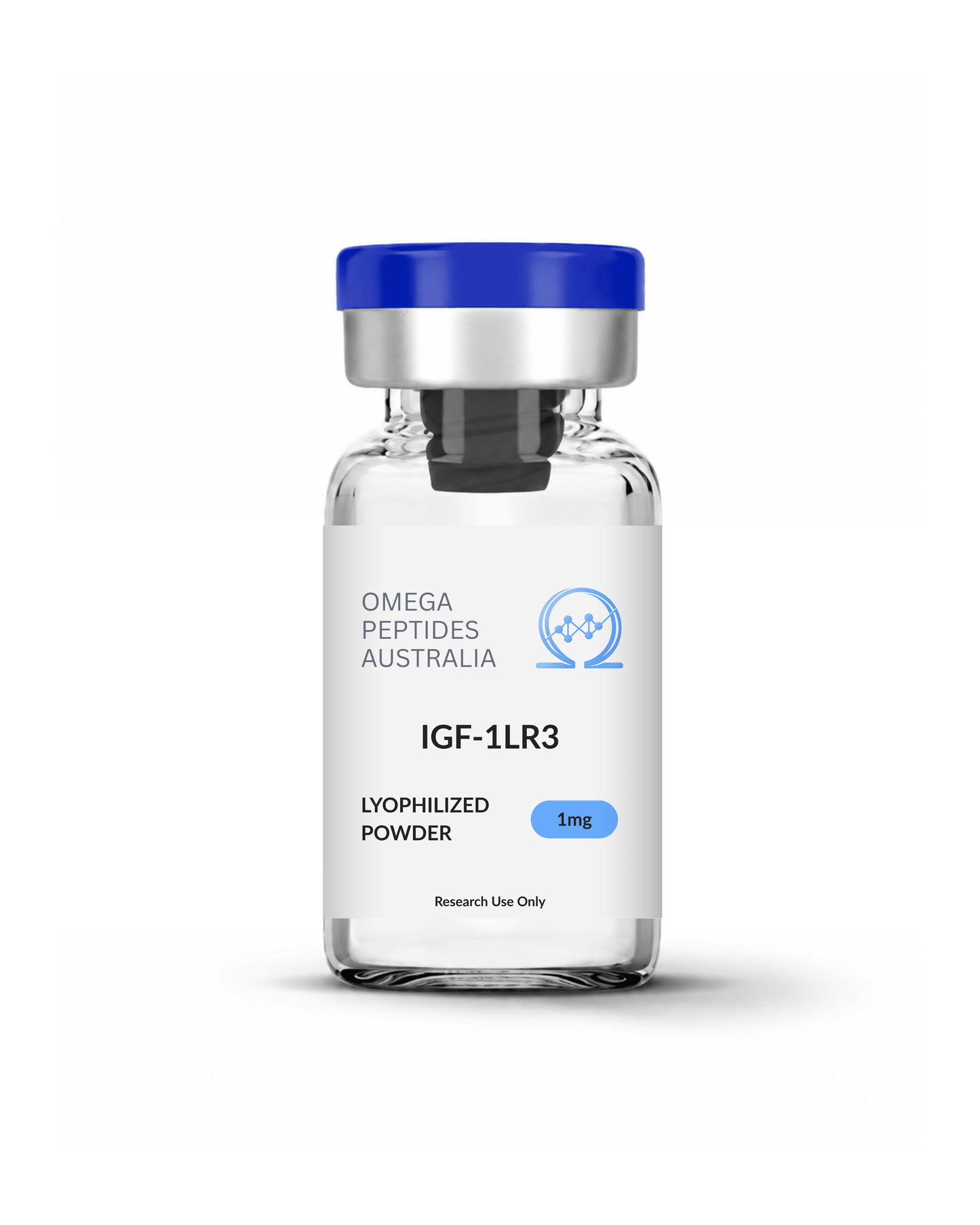
IGF-1 LR3 (1mg) is stocked in Australia by Omega Peptides Australia and dispatched the same business day on orders before 12pm, each batch backed by an independent certificate of analysis. Also searched as Long R3 IGF-1, IGF1 LR3, IGF-1LR3 or LR3 IGF-1, it is an extended insulin-like growth factor analogue with reduced binding-protein affinity.
IGF-1 LR3 is a recombinant analogue of human insulin-like growth factor-1, the 70-amino-acid signalling protein that mediates most of the growth-promoting actions of growth hormone. The analogue is 83 amino acids long: it keeps the native IGF-1 sequence but substitutes an arginine for the glutamic acid at position 3 (the "R3") and adds a 13-residue extension to the N-terminus (the "Long"). It was engineered in Australia in the 1990s as a cell-culture growth factor and is produced by recombinant expression rather than chemical synthesis. It is written as IGF-1 LR3, IGF1 LR3, LR3-IGF-1, Long R3 IGF-1 or simply igf lr3.
IGF-1 LR3 is studied in three main directions: as a potent IGF-1 receptor agonist in cell proliferation, differentiation and survival models, as a serum-free culture supplement that replaces insulin in recombinant protein production, and as a comparator to native IGF-1 in studies of how binding proteins regulate growth factor availability. At the receptor level it binds the type 1 IGF receptor, a receptor tyrosine kinase, and activates the PI3K-Akt and MAPK signalling cascades; its two modifications reduce its affinity for the IGF binding proteins by more than a thousandfold, so far more of it remains free to reach the receptor.
Omega Peptides Australia supplies IGF-1 LR3 as a high-purity (≥99% HPLC) COA-verified lyophilised powder in a sealed 1mg vial. Orders placed before 12pm are dispatched the same day from stock held within Australia, and the batch Certificate of Analysis for every lot is published in our COA library so the purity and identity of the vial you receive can be checked against the batch number on the label.
Key research areas
- Cell proliferation and survival signalling. IGF-1 LR3 is a standard tool for activating the IGF-1 receptor in cultured cells. Through PI3K-Akt it suppresses apoptosis and promotes protein synthesis, and through the Ras-MAPK pathway it drives cell-cycle progression. Its high free-ligand availability makes it a more reliable stimulus than native IGF-1 in binding-protein-containing media.
- Serum-free cell-culture media. The analogue was developed as an insulin replacement for industrial cell culture, where it supports growth and viability of mammalian production lines such as CHO cells.
- Muscle cell and satellite-cell models. IGF-1 signalling is central to myoblast proliferation, differentiation and fusion. IGF-1 LR3 is used in C2C12 and primary myoblast cultures and in rodent models to study hypertrophy pathways and mTOR activation.
- IGF binding protein biology. Because IGF-1 LR3 barely binds IGFBP-1 to IGFBP-6, it lets researchers separate the receptor-mediated actions of IGF-1 from the modulating effects of the binding proteins.
- Neuronal survival and neurotrophic signalling. IGF-1 receptors are expressed throughout the nervous system, and the analogue is used in neuronal culture and injury models to study growth-factor-dependent survival and neurite outgrowth.
- Metabolic and insulin-receptor cross-talk. IGF-1 LR3 has weak affinity for the insulin receptor and for hybrid insulin-IGF-1 receptors. It is used in glucose-uptake, adipocyte and hepatocyte models to map the overlap between insulin and IGF-1 signalling.
How IGF-1 LR3 works
IGF-1 LR3 binds the type 1 IGF receptor (IGF-1R), a transmembrane receptor tyrosine kinase that dimerises and autophosphorylates on ligand binding. The activated receptor recruits the insulin receptor substrate proteins and Shc, which launch two main cascades: the PI3K-Akt-mTOR pathway, which promotes protein synthesis, glucose uptake and cell survival, and the Ras-Raf-MEK-ERK pathway, which drives proliferation and differentiation. Native IGF-1 circulates almost entirely bound to IGF binding proteins, particularly IGFBP-3, which extends its half-life but limits how much is free to reach the receptor.
The two modifications in IGF-1 LR3 change that balance. The arginine at position 3 sits in the region of IGF-1 that contacts the binding proteins, and the 13-residue N-terminal extension adds steric bulk at the same site, so the analogue's affinity for the binding proteins falls by more than a thousandfold while its receptor affinity is largely preserved. The result is a much higher free fraction and a longer effective duration of action in culture and animal models. Against native IGF-1 or the registered medicine mecasermin, which is unmodified recombinant IGF-1, LR3 is the binding-protein-resistant research analogue; against secretagogues such as ipamorelin or CJC-1295, which act upstream by raising growth hormone, it acts directly at the growth-factor receptor.
Specifications
| Compound | IGF-1 LR3 (Long R3 insulin-like growth factor-1) |
| Also known as | IGF1 LR3, LR3-IGF-1, Long R3 IGF-1, IGF-1LR3, igf lr3, LR3 IGF-1 |
| CAS number | 946870-92-4 |
| Molecular formula | C400H625N111O115S9 |
| Molecular weight | Approximately 9,111 Da (about 9.1 kDa) |
| Sequence | 83 residues: human IGF-1 with Glu3 replaced by Arg and a 13-amino-acid N-terminal extension; three disulfide bonds |
| Category | Growth factor research |
| Purity | ≥99% HPLC, batch COA supplied |
| Form | Lyophilised powder in a sealed sterile vial |
| Vial sizes available | 1mg — $129.99 |
| Storage (lyophilised) | 2–8°C short term or −20°C long term, protect from light and moisture, avoid repeated freeze-thaw |
| Storage (reconstituted) | 2–8°C, use within 28 days |
| Reconstitution | Bacteriostatic water (recommended) |
Available sizes and pricing
IGF-1 LR3 is supplied in a single 1mg vial. Because it is a recombinant protein active at nanogram-per-millilitre concentrations in culture, 1mg is a substantial quantity for research purposes. The price is per vial, with the per-milligram figure shown for comparison. Laboratories that need reconstitution supplies can add the Research Starter Kit, which bundles bacteriostatic water, syringes and alcohol swabs.
- 1mg vial — $129.99 (about $129.99 per mg)
Quality and COA verification
Every batch of IGF-1 LR3 is tested independently by Janoshik Analytical before it is released. The HPLC purity assay quantifies the intact 83-residue protein against any truncated, aggregated or misfolded species, and mass spectrometry confirms the measured mass matches the full analogue. A Certificate of Analysis is issued for every lot and published in our COA library, where it can be matched to the batch number on the vial label. The protein is lyophilised for stability, sealed in a sterile glass vial with a crimped cap, and packed with cushioning for domestic transit so the powder arrives dry and intact. Keeping the vial lyophilised and cold until use is the most important handling step for a folded protein.
Frequently bought together
- Bacteriostatic Water (10mL) — $29.99, the recommended diluent for reconstituting lyophilised IGF-1 LR3.
- Ipamorelin (10mg) — $89.99, a selective growth hormone secretagogue for studying the upstream GH axis alongside direct IGF-1 receptor activation.
- CJC-1295 No DAC + Ipamorelin Blend (10mg) — $139.99, a combined GHRH analogue and secretagogue for full GH-IGF axis research models.
Research guides
- CJC-1295 and Ipamorelin research guide
- Peptide storage guide
- COA testing explained
- Peptide reconstitution calculator
- Certificates of Analysis library
Frequently asked questions
What is IGF-1 LR3?
IGF-1 LR3 is an 83-amino-acid recombinant analogue of human insulin-like growth factor-1. It carries an arginine in place of glutamic acid at position 3 and a 13-residue N-terminal extension, changes that reduce its binding to IGF binding proteins more than a thousandfold and make it a longer-acting, more available IGF-1 receptor agonist. It is supplied here as a lyophilised, COA-verified powder for in-vitro laboratory research only.
What is IGF-1 LR3 also known as?
It is also written as IGF1 LR3, IGF-1LR3, LR3-IGF-1, LR3 IGF-1 or igf lr3, and its full name is Long R3 insulin-like growth factor-1, which is where the LR3 abbreviation comes from. In cell-culture catalogues it appears as Long R3 IGF-I with a Roman numeral. Misspellings such as igf1 lr3 peptide, igf lr 3 and lr3 igf all refer to the same recombinant protein.
How does IGF-1 LR3 work?
IGF-1 LR3 binds and activates the type 1 IGF receptor, a receptor tyrosine kinase on the surface of most cell types. Activation switches on the PI3K-Akt-mTOR pathway, which drives protein synthesis and cell survival, and the Ras-MAPK pathway, which drives proliferation. Because the analogue is not captured by IGF binding proteins, a far larger share of it is free to reach the receptor than is the case for native IGF-1.
What does the research show about IGF-1 LR3?
Cell-culture studies show that IGF-1 LR3 is a more potent stimulus of proliferation and survival than native IGF-1 in binding-protein-containing media, which is why it became a standard serum-free supplement. Rodent and cell models have used it to study muscle cell differentiation, neuronal survival and the overlap between insulin and IGF-1 signalling. All of this describes laboratory and preclinical research and does not relate to any use outside that setting.
Can I buy IGF-1 LR3 at Chemist Warehouse or a pharmacy in Australia?
No. IGF-1 LR3 is not registered as a medicine and is not stocked by Chemist Warehouse, Priceline or any other retail pharmacy. It is a different molecule, dispensed only on prescription. The research-grade lyophilised IGF-1 LR3 sold here is a laboratory reagent, not a pharmacy product.
Can Australian compounding pharmacies supply IGF-1 LR3?
Compounding pharmacies may only prepare a medicine for a named patient on a practitioner's prescription and cannot sell peptides or proteins to the public. Research suppliers such as Omega Peptides Australia supply the lyophilised research compound for in-vitro laboratory use, on a separate pathway from any pharmacy product.
How do you reconstitute IGF-1 LR3?
Use bacteriostatic water. Draw the required volume into a sterile syringe and add it slowly down the inside wall of the vial so the stream does not strike the lyophilised cake. Swirl gently until the solution is clear and never shake, because shear can unfold a disulfide-bonded protein. Refrigerate the reconstituted vial at 2–8°C and use it within 28 days. Our reconstitution calculator will convert vial size and diluent volume into a working concentration.
How should IGF-1 LR3 be stored?
Keep the unopened lyophilised vial at 2–8°C for short-term storage or at −20°C for long-term storage, protected from light and moisture and away from repeated freeze-thaw cycles. After reconstitution, store the solution at 2–8°C and use it within 28 days. Because IGF-1 LR3 is a folded protein rather than a short peptide, it is more sensitive to heat, shear and freeze-thaw damage, so aliquoting a reconstituted vial into single-use volumes is good practice.
Where can I buy IGF-1 LR3 in Australia?
Omega Peptides Australia holds IGF-1 LR3 in domestic stock and dispatches orders placed before 12pm on the same business day with tracked shipping within Australia. Each batch is backed by an independent Certificate of Analysis that you can review in the COA library before ordering. IGF-1 LR3 is listed alongside the growth hormone secretagogues and GHRH analogues in our research peptides range.
What does IGF-1 LR3 cost in Australia?
IGF-1 LR3 is supplied in a 1mg vial at $129.99, which is $129.99 per milligram. The higher per-milligram cost compared with synthetic hexapeptides reflects recombinant production, but because the protein is active at nanogram concentrations a single 1mg vial covers a large number of assays. There is currently no larger vial or bundle for this compound. Bacteriostatic water is sold separately at $29.99 for 10mL or $14.99 for 3mL.
How do I get IGF-1 LR3 online in Australia?
Open the IGF-1 LR3 product page, select the 1mg vial, add it to the cart and complete checkout. Orders placed before 12pm are dispatched the same business day from our Australian stock and later orders leave on the next business day. Parcels travel by tracked domestic courier in plain, discreet packaging with no product description on the outside, and a tracking number is emailed as soon as the order ships.
Is IGF-1 LR3 legal in Australia?
Omega Peptides Australia supplies IGF-1 LR3 strictly for lawful in-vitro laboratory research. It is not approved by the TGA for human or veterinary use and is not sold as a medicine or supplement. Purchasers are responsible for ensuring their intended use complies with all applicable laws, including any state or territory requirements that apply to research chemicals.
What does LR3 mean and how does it differ from native IGF-1?
LR3 stands for Long Arg3. "Long" refers to the 13-amino-acid extension added to the N-terminus, and "R3" to the arginine that replaces glutamic acid at position 3 of the IGF-1 sequence. Native IGF-1 is 70 residues and circulates almost entirely bound to IGF binding proteins; the LR3 analogue is 83 residues and binds those proteins over a thousand times more weakly, so it stays free and active far longer in culture and animal models.
⚠ For in-vitro research and laboratory use only. Not for human or veterinary use.
Share