Omega Peptides Australia
Couldn't load pickup availability
For laboratory research use only. Not for human or veterinary use, consumption, or therapeutic application. Not a drug, food, cosmetic, or dietary supplement. Handling restricted to qualified researchers in an appropriate setting.
Certificates of Analysis
Independent third-party testing for this product. Tap a report to view the data.


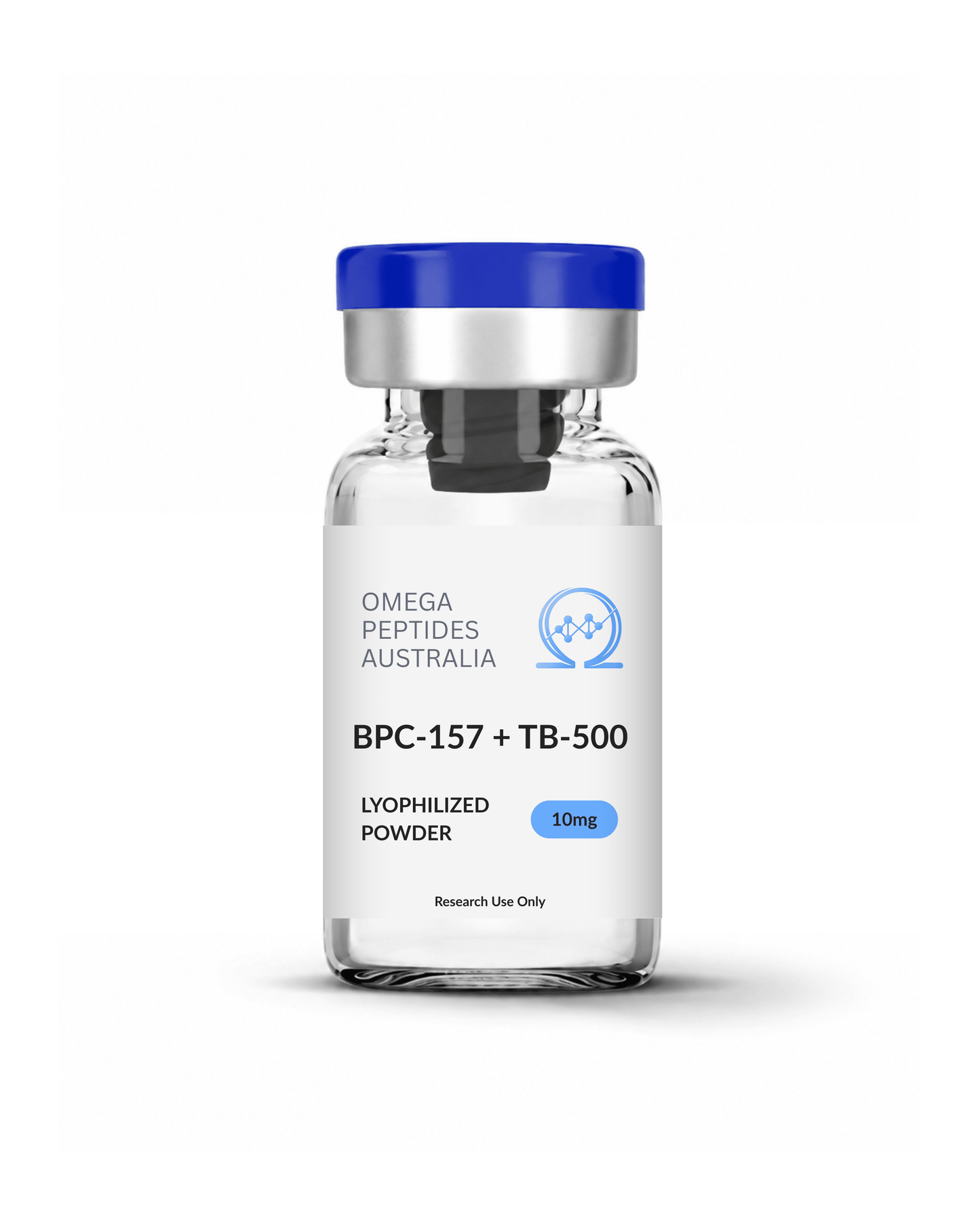
BPC-157 + TB-500 Blend (10mg) — Dual-Mechanism Tissue-Repair Research Blend
Omega Peptides Australia supplies BPC-157 + TB-500 Blend (10mg) in Australia from domestic stock, dispatching same day on orders placed before 12pm with a certificate of analysis published for every batch. Often written BPC157 TB500, BPC 157 TB 500, BPC-157 and TB-500 or TB500 BPC157, it is a pre-blended tissue-repair stack combining a pentadecapeptide with a thymosin beta-4 fragment.
The BPC-157 + TB-500 blend combines two of the most widely studied repair peptides in a single lyophilised vial, with 5mg of BPC-157 and 5mg of TB-500 per 10mg vial. BPC-157 is a synthetic pentadecapeptide (Gly-Glu-Pro-Pro-Pro-Gly-Lys-Pro-Ala-Asp-Asp-Ala-Gly-Leu-Val) derived from a protective protein in human gastric juice, while TB-500 is a synthetic peptide based on the actin-binding region of thymosin beta-4, a 43-amino-acid protein found in almost all mammalian cells. The blend is often written as BPC-157 TB-500 blend, BPC TB blend or bpc tb500, and is informally nicknamed the Wolverine blend in online discussion.
The two peptides are studied together because they act on different stages of tissue repair: BPC-157 is investigated for growth-factor and nitric-oxide signalling that drives angiogenesis and collagen production, and TB-500 for its regulation of the actin cytoskeleton, which governs how cells migrate into an injury site. The main research directions are tendon and ligament repair, muscle recovery and wound healing, with gastrointestinal and vascular models forming a secondary line.
Omega Peptides Australia supplies the blend as a high-purity (≥99% HPLC) COA-verified lyophilised powder in a sealed sterile vial. Orders placed before 12pm are dispatched the same day from within Australia, and the batch Certificate of Analysis is published in our COA library. Researchers looking to buy the BPC-157 TB-500 blend in Australia get verified material, transparent documentation and domestic stock with no customs delays.
Key research areas
- Tendon and ligament repair Both peptides have been studied individually in rodent models of transected tendon and ligament injury. BPC-157 is proposed to increase fibroblast outgrowth and collagen deposition through FAK-paxillin signalling, while TB-500 is proposed to speed the migration of repair cells into the lesion by regulating actin polymerisation, which is the rationale for studying them together.
- Muscle recovery Crush, transection and contusion models are used to investigate muscle-fibre regeneration and functional recovery. Research designs typically look at fibrosis, new vessel formation and the rate at which inflammatory cells clear from the injury, with the two peptides expected to contribute through complementary pathways.
- Wound and dermal healing Full-length thymosin beta-4 has progressed through Phase 2 clinical programmes for chronic dermal wounds, and BPC-157 has been studied in rodent skin-wound and burn models. Proposed mechanisms include faster keratinocyte migration, re-epithelialisation and granulation-tissue formation.
- Angiogenesis and blood flow Both peptides are studied for new blood-vessel formation. BPC-157 activates VEGFR2 and nitric-oxide signalling in endothelial cells, and thymosin beta-4 promotes endothelial cell motility and tube formation, so the combination is used in models of vessel occlusion and ischaemic tissue.
- Inflammation Preclinical research has examined the modulation of inflammatory signalling by each compound. Thymosin beta-4 has been reported to reduce NF-κB activation and inflammatory cytokine levels, and BPC-157 has been studied for its effect on inflammatory markers in gastrointestinal and musculoskeletal injury models.
- Gastrointestinal protection BPC-157 was originally characterised as a gastroprotective peptide, and its stability in gastric juice makes it a frequent subject of ulcer, fistula and colitis models. Combining it with TB-500 lets researchers compare a gut-derived cytoprotective peptide with a cytoskeletal regulator in the same model.
BPC-157 + TB-500 Blend in Australia
BPC-157 + TB-500 Blend is supplied in Australia strictly as a research-grade lyophilised vial; it is not a registered medicine and is not available through Chemist Warehouse, Priceline or compounding pharmacies. Omega Peptides Australia holds it in domestic stock, dispatches same day on orders before 12pm, and ships on tracked delivery within Australia, so there is no international transit or customs hold. Each batch carries an independent certificate in the COA library matched to the number printed on the vial.
The blend is supplied in Australia as one 10mg vial containing 5mg of each peptide. Researchers who prefer to titrate the two separately can source BPC-157 and TB-500 individually from the same domestic stock.
How BPC-157 + TB-500 Blend works
BPC-157 does not act through a single receptor. In vitro and rodent studies show that it activates VEGFR2 and the Akt-eNOS pathway in endothelial cells, increasing nitric-oxide production and angiogenesis, and that it stimulates the FAK-paxillin pathway in fibroblasts, increasing their migration and collagen output. It also upregulates early growth response genes involved in cytokine regulation. The peptide is unusually stable, remaining intact in human gastric juice for more than 24 hours, though detailed human pharmacokinetic data are limited. TB-500, by contrast, reproduces the Leu-Lys-Lys-Thr-Glu-Thr-Gln motif of thymosin beta-4 that binds monomeric G-actin. By regulating how much free actin is available for polymerisation, it influences the cytoskeletal remodelling that cells need in order to move, divide and re-organise damaged tissue.
Because the two mechanisms are distinct, the blend is used where a study wants to observe a growth-factor-driven and a cytoskeleton-driven repair signal at the same time, without preparing two separate solutions. The fixed 1:1 ratio (5mg of each) keeps the preparation consistent between vials and between batches. Laboratories that need a different ratio, or want to study one compound in isolation, can use the individual BPC-157 and TB-500 vials instead. Our BPC-157 vs TB-500 guide compares the two peptides in more detail.
Specifications
| Compound | BPC-157 + TB-500 blend (5mg BPC-157 and 5mg TB-500 per vial) |
| Also known as | BPC-157 TB-500 blend, BPC TB blend, bpc tb500, Wolverine blend (informal), BPC157 TB500, BPC 157 TB 500, BPC-157 and TB-500, TB500 BPC157 |
| CAS number | BPC-157 137525-51-0; TB-500 885340-08-9 (Ac-LKKTETQ fragment) or 77591-33-4 (full-length thymosin beta-4) |
| Molecular formula | BPC-157 C62H98N16O22; TB-500 fragment C38H68N10O14 |
| Molecular weight | BPC-157 1419.6 g/mol; TB-500 fragment 889.0 g/mol (full-length thymosin beta-4 4963.5 g/mol) |
| Sequence | BPC-157 GEPPPGKPADDAGLV; TB-500 Ac-LKKTETQ |
| Category | Tissue-repair research |
| Purity | ≥99% HPLC, batch COA supplied |
| Form | Lyophilised powder in a sealed sterile vial |
| Vial sizes available | 10mg (5mg + 5mg) — $119.99 |
| Storage (lyophilised) | 2–8°C short term or −20°C long term, protect from light and moisture, avoid repeated freeze-thaw |
| Storage (reconstituted) | 2–8°C, use within 28 days |
| Reconstitution | Bacteriostatic water (recommended) |
Available sizes and pricing
The blend is supplied in a single 10mg vial containing 5mg of BPC-157 and 5mg of TB-500. Each vial carries its batch number so the contents can be matched to the Certificate of Analysis. For larger quantities of each peptide, the individual 10mg vials of BPC-157 and TB-500 are sold separately, and the GLOW Peptide Bundle pairs both with GHK-Cu as separate vials.
- 10mg vial (5mg BPC-157 + 5mg TB-500) — $119.99 (about $12.00 per mg)
Quality and COA verification
Every batch of the BPC-157 + TB-500 blend is independently tested by Janoshik Analytical. HPLC confirms purity, and mass spectrometry confirms the identity of each peptide in the vial by matching its measured mass to the expected molecular weight. A Certificate of Analysis is issued for every batch and published in our COA library, where the batch number printed on your vial can be checked against the report. The blend is lyophilised for long-term stability, sealed in a sterile vial and packed in protective packaging for domestic transit. Because our stock is held in Australia, vials are not exposed to extended international shipping or customs holds before they reach your laboratory.
Frequently bought together
- BPC-157 (10mg) — $99.99, the single-compound vial for studies that need more BPC-157 or a different ratio
- TB-500 (10mg) — $99.99, the single-compound vial for actin-binding studies
- GLOW Peptide Bundle — $189.99, GHK-Cu, BPC-157 and TB-500 supplied as separate vials
- Bacteriostatic Water (10mL) — $29.99, for reconstituting the lyophilised blend
Research guides
- BPC-157 vs TB-500
- BPC-157 research guide
- How to store lyophilised peptides
- COA testing explained
- Peptide reconstitution calculator
- Certificates of Analysis library
Frequently asked questions
What is BPC-157 + TB-500 Blend?
It is a single lyophilised vial containing 5mg of BPC-157 and 5mg of TB-500, a total of 10mg of peptide. BPC-157 is a fifteen-amino-acid peptide derived from a gastric protective protein, and TB-500 is a synthetic peptide based on the actin-binding region of thymosin beta-4. The two are supplied together because they are the most frequently paired compounds in preclinical tissue-repair research.
What is BPC-157 + TB-500 Blend also known as?
It is also written as BPC-157 TB-500 blend, BPC TB blend, bpc tb500 and BPC/TB-500. The component names are often misspelled as bcp 157, bpc157, TB500 or TB 500, and the combination is informally called the Wolverine blend or Wolverine stack in online discussion. TB-500 itself is also described as a thymosin beta-4 fragment or Tβ4 fragment.
How does BPC-157 + TB-500 Blend work?
The two peptides act through different pathways. BPC-157 activates VEGFR2 and nitric-oxide signalling in endothelial cells and the FAK-paxillin pathway in fibroblasts, promoting angiogenesis, cell migration and collagen production. TB-500 binds G-actin through the LKKTETQ motif of thymosin beta-4, regulating cytoskeletal remodelling so that cells can migrate into injured tissue. Together they are studied as a growth-factor signal and a cytoskeletal signal acting in parallel.
What does the research show about BPC-157 + TB-500 Blend?
The blend itself has not been studied as a fixed combination in published trials; the evidence comes from research on each peptide. Rodent studies of BPC-157 report faster tendon, ligament, muscle and gastrointestinal healing, and studies of thymosin beta-4 report faster wound closure, increased angiogenesis and reduced inflammation, with full-length thymosin beta-4 reaching Phase 2 clinical programmes. Both remain investigational research compounds.
Can I buy BPC-157 + TB-500 Blend at Chemist Warehouse or a pharmacy in Australia?
No. Neither BPC-157 nor TB-500 is registered on the Australian Register of Therapeutic Goods, so Chemist Warehouse, Priceline and other retail pharmacies do not stock them, individually or as a blend. The research-grade lyophilised blend supplied here is a laboratory reagent, not a pharmacy medicine.
Can Australian compounding pharmacies supply BPC-157 + TB-500 Blend?
Compounding pharmacies in Australia prepare medicines only for an individual patient on a practitioner's prescription and do not sell peptides to the public. Omega Peptides Australia is not a pharmacy. We supply the lyophilised research blend with a batch COA, strictly for in-vitro laboratory use.
How do you reconstitute BPC-157 + TB-500 Blend?
Use bacteriostatic water. Swab the stopper, then add the chosen volume of water slowly down the inside wall of the vial so it runs onto the powder rather than jetting into it. Swirl gently until the solution is clear, do not shake, because agitation can fragment the peptides. Label the vial with the date and concentration, refrigerate at 2–8°C and use within 28 days. Remember that the concentration you calculate is total peptide, split equally between the two compounds.
How should BPC-157 + TB-500 Blend be stored?
Keep the lyophilised vial sealed and protected from light and moisture. Short-term storage at 2–8°C is fine; for long-term storage keep it at −20°C and avoid repeated freeze-thaw cycles. After reconstitution, store the solution refrigerated at 2–8°C and use it within 28 days. Do not freeze the reconstituted solution, and let a cold vial reach room temperature before opening it to prevent condensation.
Where can I buy BPC-157 + TB-500 Blend in Australia?
Directly from Omega Peptides Australia. Stock is held domestically, orders placed before 12pm are dispatched the same day, and every batch is tested by Janoshik Analytical with the certificate published in our COA library. The blend can be ordered on this page or browsed alongside our full range of research peptides in Australia, including the individual BPC-157 and TB-500 vials and the GLOW and KLOW multi-peptide blends.
What does BPC-157 + TB-500 Blend cost in Australia?
The 10mg blend vial is $119.99, which works out to about $12.00 per mg of total peptide. For comparison, BPC-157 10mg and TB-500 10mg are $99.99 each, so the blend suits laboratories that want both compounds without buying two full vials. The GLOW Peptide Bundle, which adds GHK-Cu as a separate vial, is $189.99. Bacteriostatic water is sold separately at $29.99 for 10mL or $14.99 for 3mL.
How do I get BPC-157 + TB-500 Blend online in Australia?
Add the 10mg vial to your cart, add bacteriostatic water if required, and complete checkout. Orders ship from within Australia with tracked domestic delivery and discreet, unbranded packaging. Orders placed before 12pm on a business day are dispatched the same day, and later orders leave the next business day. A tracking number is emailed as soon as the parcel is scanned by the carrier.
Is BPC-157 + TB-500 Blend legal in Australia?
Omega Peptides Australia supplies the BPC-157 + TB-500 blend strictly for lawful in-vitro laboratory research. It is not approved by the TGA for human or veterinary use and is not sold as a medicine or supplement. Purchasers are responsible for ensuring their intended use complies with all applicable laws.
What is in the blend and what is the ratio?
Each vial contains 10mg of total peptide made up of 5mg BPC-157 and 5mg TB-500, a fixed 1:1 ratio by mass. Because BPC-157 (about 1419.6 g/mol) is heavier than the TB-500 fragment (about 889 g/mol), the molar ratio is not exactly 1:1, which is worth noting when calculating concentrations. The batch COA reports the identity and purity of both components. If your study calls for a different ratio, use the individual vials.
Is the BPC-157 TB-500 blend available in Australia?
Yes, as a research-grade pre-blended lyophilised vial from domestic suppliers. Omega Peptides Australia holds the BPC-157 + TB-500 blend in Australian stock, COA verified, with same-day dispatch before 12pm.
Where can I buy BPC-157 and TB-500 in Australia?
From an Australian research peptide supplier holding domestic stock. Omega Peptides Australia ships the blend and both individual peptides from within Australia on tracked delivery.
⚠ For in-vitro research and laboratory use only. Not for human or veterinary use.