Pure Peptides Australia
Couldn't load pickup availability
For laboratory research use only. Not for human or veterinary use, consumption, or therapeutic application. Not a drug, food, cosmetic, or dietary supplement. Handling restricted to qualified researchers in an appropriate setting.
ARA-290 (10mg) — Innate Repair Receptor Agonist Research Peptide
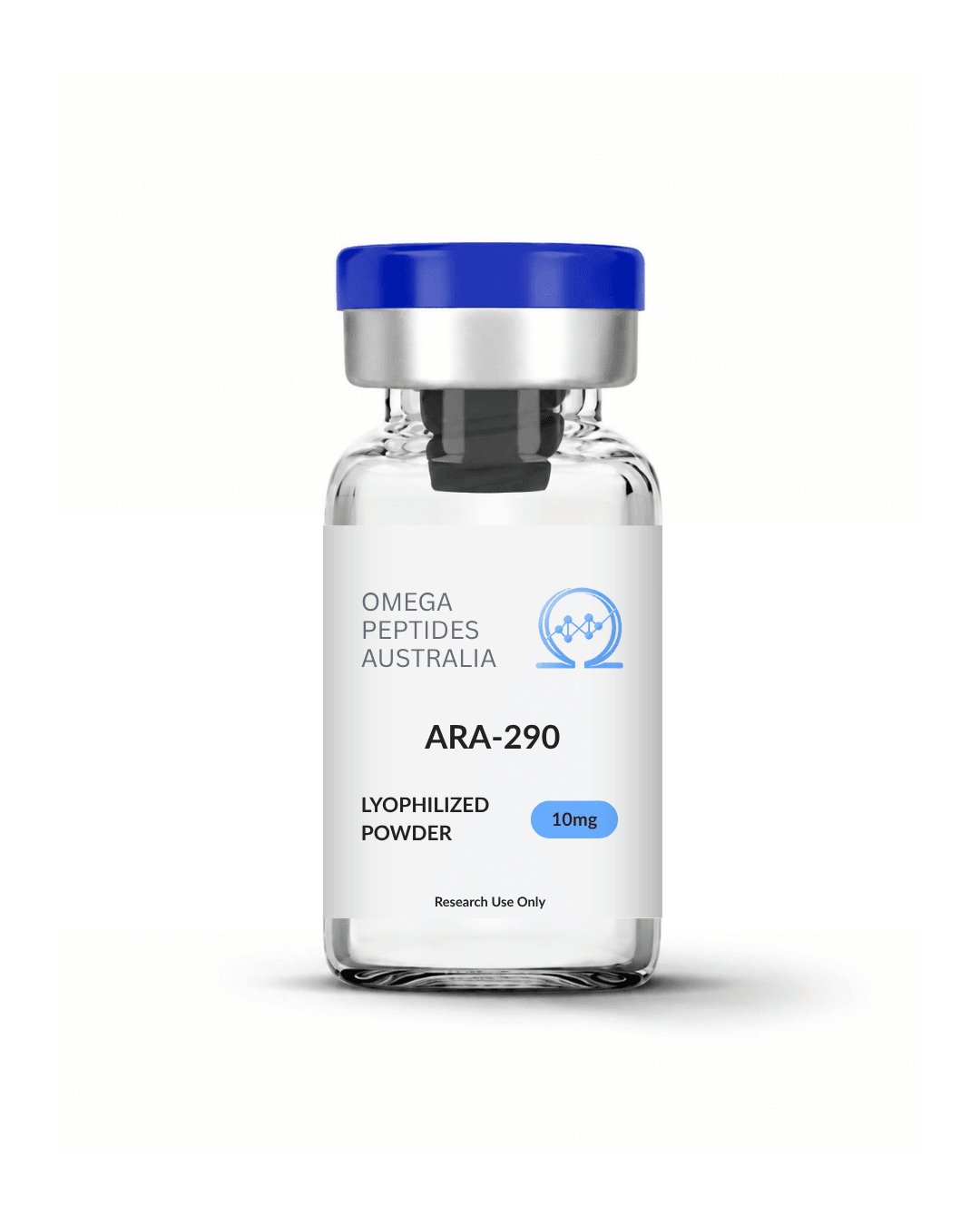
ARA-290 (10mg) is supplied in Australia by Omega Peptides Australia from domestic stock, with same-day dispatch on orders placed before 12pm and an independent certificate of analysis for every batch. Commonly written as ARA 290, cibinetide, ARA290 or innate repair receptor agonist, it is an erythropoietin-derived undecapeptide studied for innate repair receptor signalling.
ARA-290 is a synthetic 11-amino-acid peptide engineered from the three-dimensional structure of erythropoietin (EPO). It reproduces the surface of EPO's helix B, the region that contacts the tissue-protective receptor, while leaving out the parts of the hormone that stimulate red blood cell production, which is why it is described as a non-erythropoietic EPO derivative or helix B surface peptide. The sequence begins with a pyroglutamate residue and is written pGlu-Glu-Gln-Leu-Glu-Arg-Ala-Leu-Asn-Ser-Ser, giving a molecular weight of about 1,257 daltons. Its international non-proprietary name is cibinetide, and it is often written as ARA 290, ARA290 or ara290 peptide and sometimes called an innate repair receptor agonist.
ARA-290 is studied mainly in three areas: small fibre neuropathy and neuropathic pain, metabolic and microvascular complications of diabetes, and tissue protection after ischaemic or inflammatory injury in the kidney, heart and nervous system. It works by selectively activating the innate repair receptor, a heteromer formed by the erythropoietin receptor and the beta-common receptor (CD131), which is expressed on stressed cells and triggers anti-apoptotic, anti-inflammatory and repair-promoting signalling without engaging the EPO receptor homodimer that drives erythropoiesis.
Omega Peptides Australia supplies ARA-290 as a high-purity (≥99% HPLC) COA-verified lyophilised powder in a sealed sterile 10mg vial. Orders placed before 12pm are dispatched the same day from within Australia, and the batch Certificate of Analysis for every lot is published in our COA library.
Key research areas
- Small fibre neuropathy The best-known clinical research on cibinetide is a series of Phase 2 studies in sarcoidosis-associated small fibre neuropathy, where investigators measured neuropathic symptoms and used corneal confocal microscopy to count small nerve fibres. Increased corneal nerve fibre density after treatment is the finding most often cited, and it supported orphan drug and fast track designations in the United States for this indication.
- Diabetic neuropathy and metabolic markers Phase 2 work in type 2 diabetes with small fibre neuropathy examined nerve fibre regeneration in skin and cornea alongside metabolic end points such as HbA1c and lipid measures. The proposed mechanism is protection of Schwann cells and small sensory neurons from metabolic stress via innate repair receptor signalling.
- Ischaemia-reperfusion injury Preclinical rodent models of kidney, heart and brain ischaemia have used ARA-290 and its parent helix B peptide to test whether activating the innate repair receptor reduces infarct size and apoptosis. Because the peptide does not raise haematocrit, it avoids the thrombotic concerns that limited EPO itself in these models.
- Kidney transplantation and renal protection Clinical research has explored cibinetide as a means of limiting delayed graft function after kidney transplantation, building on animal work showing reduced tubular injury and inflammation. This remains an investigational use with mixed results across studies.
- Inflammation and macrophage polarisation In cell and animal models ARA-290 shifts macrophages away from a pro-inflammatory state and reduces cytokine release, which is why it is studied in inflammatory pain, wound and autoimmune models. The innate repair receptor is expressed on immune cells as well as on injured tissue.
- Neuroprotection and cognition Because EPO-derived signalling supports neuronal survival, ARA-290 has been examined in models of traumatic and metabolic nerve injury and in early work on mood and cognitive end points. Development for depressive disorders was discontinued, but the neuroprotective rationale continues to drive preclinical interest.
ARA-290 in Australia
ARA-290 is not registered on the Australian Register of Therapeutic Goods, so it is not stocked by Chemist Warehouse, Priceline or other pharmacies. In Australia it is supplied as a research-grade lyophilised vial by domestic research suppliers. Omega Peptides Australia holds ARA-290 in stock within Australia and dispatches orders placed before 12pm the same business day on tracked domestic delivery, so material arrives in days rather than waiting on an international shipment and customs. Every batch is tested independently and its certificate is published in the COA library before the vial ships.
ARA-290 is stocked in Australia as a 10mg vial in the tissue-repair range alongside BPC-157 and TB-500.
How ARA-290 works
Erythropoietin signals through two different receptor assemblies. The classical EPO receptor homodimer, found on erythroid progenitors, drives red blood cell production and is activated at picomolar concentrations of circulating EPO. A second assembly, the innate repair receptor, pairs one EPO receptor subunit with the beta-common receptor CD131 shared by the GM-CSF, IL-3 and IL-5 receptors. This heteromer has lower affinity for EPO, appears mainly on cells exposed to injury or metabolic stress, and triggers pathways such as JAK2-STAT, PI3K-Akt and NF-kB inhibition that reduce apoptosis, dampen inflammation and promote repair. ARA-290 was designed to mimic only the helix B face of EPO that contacts this heteromer, so it activates innate repair signalling without binding the homodimer or stimulating erythropoiesis.
ARA-290 has a very short plasma half-life, reported in the order of minutes in preclinical pharmacokinetic work, yet its biological effects persist far longer because receptor activation sets off downstream gene expression changes that continue after the peptide has cleared. This decoupling of exposure from effect is a distinctive feature of the compound. It differs from BPC-157 and TB-500, whose tissue-repair research centres on angiogenesis, growth factor expression and actin dynamics rather than on a defined receptor, and from GLP-1 class peptides, with which it shares nothing beyond peptide chemistry.
Specifications
| Compound | ARA-290 (cibinetide) |
| Also known as | Cibinetide, ARA 290, ARA290, ara290 peptide, pyroglutamate helix B surface peptide (pHBSP), innate repair receptor agonist |
| CAS number | 1208243-50-8 |
| Molecular formula | C51H84N16O21 |
| Molecular weight | 1257.3 g/mol |
| Sequence | pGlu-Glu-Gln-Leu-Glu-Arg-Ala-Leu-Asn-Ser-Ser (11 residues, N-terminal pyroglutamate) |
| Category | Tissue-repair research |
| Purity | ≥99% HPLC, batch COA supplied |
| Form | Lyophilised powder in a sealed sterile vial |
| Vial sizes available | 10mg — $129.99 |
| Storage (lyophilised) | 2–8°C short term or −20°C long term, protect from light and moisture, avoid repeated freeze-thaw |
| Storage (reconstituted) | 2–8°C, use within 28 days |
| Reconstitution | Bacteriostatic water (recommended) |
Available sizes and pricing
ARA-290 is offered in a single 10mg vial. Pricing is per vial, with the equivalent per-milligram figure shown so it can be compared with other tissue-repair research peptides in the range.
- 10mg vial — $129.99 (about $13.00 per mg)
There is no dedicated kit for ARA-290. A 10mL vial of bacteriostatic water is the usual companion purchase and will reconstitute several vials.
Quality and COA verification
Every batch of ARA-290 sold by Omega Peptides Australia is independently tested by Janoshik Analytical. HPLC confirms purity of ≥99%, and mass spectrometry confirms that the measured mass matches the expected 1,257 daltons of cibinetide, including the N-terminal pyroglutamate that distinguishes it from the open-chain glutamine form. A Certificate of Analysis is issued for every batch and published in our COA library, where the batch number on your vial can be matched to its report. The peptide is supplied lyophilised in a sealed sterile vial because the freeze-dried form is stable for months in the cold, whereas solutions degrade over weeks. Vials are packed in protective outer packaging for domestic transit.
Frequently bought together
- Bacteriostatic Water (10mL) — $29.99, the diluent used to reconstitute lyophilised ARA-290.
- BPC-157 (10mg) — $99.99, the pentadecapeptide most often compared with ARA-290 in tissue-repair research.
- TB-500 (10mg) — $99.99, the thymosin beta-4 fragment studied in cell migration and repair models.
- LL-37 (5mg) — $119.99, the antimicrobial peptide studied in wound and innate immunity models.
Research guides
- Peptide storage guide: how to store lyophilised peptides properly
- COA testing explained for research peptides in Australia
- BPC-157 vs TB-500 comparison
- Peptide reconstitution calculator
- Certificates of Analysis library
Frequently asked questions
What is ARA-290?
ARA-290 is a synthetic 11-amino-acid peptide derived from the helix B region of erythropoietin, designed to activate the tissue-protective innate repair receptor without stimulating red blood cell production. Its international non-proprietary name is cibinetide and its molecular weight is about 1,257 daltons. Omega Peptides Australia supplies it as a lyophilised research-grade powder in 10mg vials for in-vitro laboratory use, with an independent Certificate of Analysis for every batch.
What is ARA-290 also known as?
It is also written as ARA 290, ARA290 or ara290 peptide, and its generic name is cibinetide. In the scientific literature it is described as pyroglutamate helix B surface peptide (pHBSP), a non-erythropoietic EPO derivative or an innate repair receptor agonist. All of these names refer to the same 11-residue peptide with CAS number 1208243-50-8.
How does ARA-290 work?
In research models ARA-290 binds the innate repair receptor, a complex of the erythropoietin receptor and the beta-common receptor CD131 that appears on cells under stress. Activation triggers JAK2-STAT and PI3K-Akt signalling and inhibits NF-kB, which reduces apoptosis, limits inflammatory cytokine release and promotes repair. Because it cannot engage the EPO receptor homodimer, it does not raise haematocrit, which separates it from erythropoietin itself.
What does the research show about ARA-290?
Phase 2 clinical programs in sarcoidosis-associated and diabetic small fibre neuropathy reported improved neuropathic symptoms and increased corneal and skin nerve fibre density. Preclinical rodent models report protection in kidney, heart and brain ischaemia and reduced inflammation in wound and pain models. Development did not proceed to Phase 3, so cibinetide remains an investigational compound and the clinical evidence is limited to small studies.
Can I buy ARA-290 at Chemist Warehouse or a pharmacy in Australia?
No. ARA-290 is not a registered medicine in Australia or anywhere else, and it is not stocked by Chemist Warehouse, Priceline or other retail pharmacies. Cibinetide never advanced beyond Phase 2 trials and has no approved pharmaceutical form. The lyophilised research-grade compound sold here is supplied strictly for laboratory use and is not a pharmacy product.
Can Australian compounding pharmacies supply ARA-290?
ARA-290 is not a compound that Australian compounding pharmacies routinely prepare, and any compounded peptide product would require an individual prescription under a pathway the TGA has placed under close scrutiny in its 2026 guidance on unapproved peptide products. Omega Peptides Australia is a research supplier: we supply the lyophilised compound for laboratory use and do not compound, prescribe or dispense medicines.
How do you reconstitute ARA-290?
Swab the stopper and add bacteriostatic water slowly down the inside wall of the vial so the stream does not hit the powder directly. Swirl gently until the solution is clear; do not shake. Label the vial with the date and concentration, refrigerate at 2–8°C and use within 28 days. ARA-290 dissolves readily in water, and our reconstitution calculator gives the concentration for any diluent volume.
How should ARA-290 be stored?
Keep the lyophilised vial at 2–8°C for short-term use or at −20°C for long-term storage, protected from light and moisture. The freeze-dried powder is stable for many months under these conditions. Once reconstituted, store the solution at 2–8°C and use it within 28 days, and avoid repeated freeze-thaw cycles, which accelerate hydrolysis of the peptide bonds and deamidation of the asparagine and glutamine residues.
Where can I buy ARA-290 in Australia?
Omega Peptides Australia holds ARA-290 in domestic stock, so orders placed before 12pm are dispatched the same day without international shipping delays or customs uncertainty. Every batch carries an independent Certificate of Analysis, and the compound sits within our research peptides collection alongside BPC-157, TB-500 and other tissue-repair research peptides.
What does ARA-290 cost in Australia?
A 10mg vial of ARA-290 costs $129.99 from Omega Peptides Australia, which is about $13.00 per mg. There is no bundle for this compound at present, and bacteriostatic water is available separately in 3mL and 10mL sizes for reconstitution. Pricing is expressed per vial and per milligram only, as the product is supplied for laboratory use.
How do I get ARA-290 online in Australia?
Select the 10mg vial on this product page, add any bacteriostatic water or syringes you need, and complete checkout. Orders placed before 12pm are dispatched the same day from within Australia with tracked domestic shipping in plain, discreet packaging. A tracking number is emailed when the parcel is lodged, and most metropolitan addresses receive their order within a few business days.
Is ARA-290 legal in Australia?
Omega Peptides Australia supplies ARA-290 strictly for lawful in-vitro laboratory research. It is not approved by the TGA for human or veterinary use and is not sold as a medicine or supplement. Purchasers are responsible for ensuring their intended use complies with all applicable laws, including any state or territory requirements that apply to their laboratory.
How do ARA-290 and BPC-157 differ in tissue-repair research?
ARA-290 acts through a defined receptor, the innate repair receptor, and its research centres on nerve fibre regeneration, neuropathic pain and protection from ischaemic injury. BPC-157 is a 15-residue gastric peptide with no single identified receptor whose research centres on tendon, ligament, muscle and gut repair through angiogenesis and growth factor expression. They are studied for different questions, and ARA-290 is the more expensive compound per milligram because of its clinical development history.
Is ARA-290 available in Australia?
Yes, as a research-grade lyophilised peptide from domestic suppliers. Omega Peptides Australia holds ARA-290 10mg in Australian stock, COA verified, with same-day dispatch before 12pm.
Where can I buy ARA 290 in Australia?
From an Australian research peptide supplier holding domestic stock. Omega Peptides Australia dispatches ARA-290 from within Australia on tracked delivery.
⚠ For in-vitro research and laboratory use only. Not for human or veterinary use.
Share