Omega Peptides Australia
Couldn't load pickup availability
For laboratory research use only. Not for human or veterinary use, consumption, or therapeutic application. Not a drug, food, cosmetic, or dietary supplement. Handling restricted to qualified researchers in an appropriate setting.
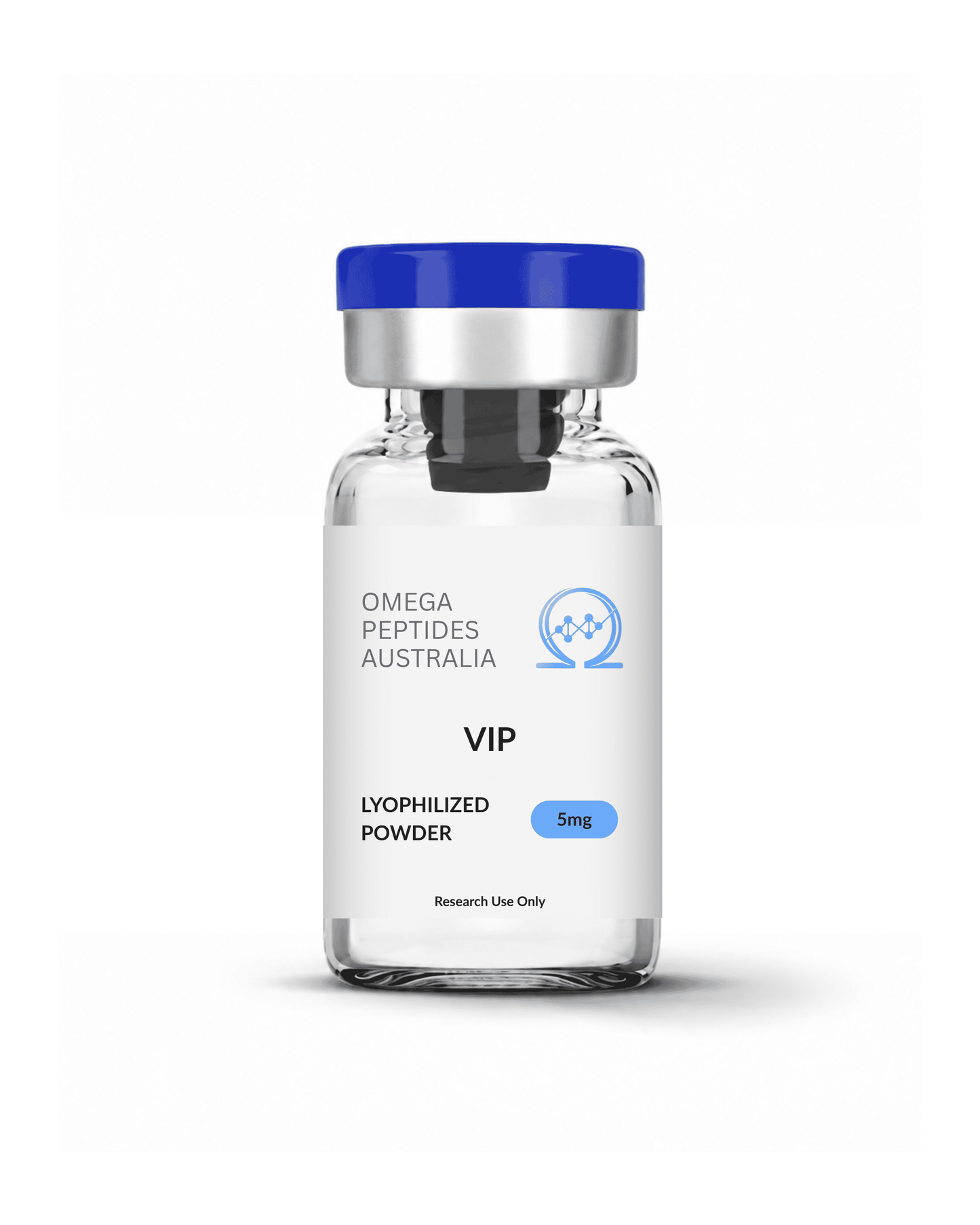
VIP (5mg) — Vasoactive Intestinal Neuropeptide Research Compound
VIP, or Vasoactive Intestinal Peptide, is a 28-amino-acid neuropeptide first isolated in 1970 from porcine small intestine by Sami Said and Viktor Mutt, who named it for its ability to dilate blood vessels. It belongs to the glucagon/secretin superfamily alongside secretin, PACAP, GHRH and GLP-1, and its sequence, His-Ser-Asp-Ala-Val-Phe-Thr-Asp-Asn-Tyr-Thr-Arg-Leu-Arg-Lys-Gln-Met-Ala-Val-Lys-Lys-Tyr-Leu-Asn-Ser-Ile-Leu-Asn, is identical in humans, pigs and rats and ends in a C-terminal amide in the native form. It is often written as VIP peptide, vasoactive intestinal polypeptide or vip 5mg, and the synthetic pharmaceutical form carries the international non-proprietary name aviptadil.
VIP is studied in three main directions: immune regulation and inflammation, where it shifts cytokine balance and induces regulatory T cells; neuroprotection and circadian biology, including its role as a core signalling molecule of the suprachiasmatic nucleus; and smooth-muscle and vascular physiology in the gut and lung. It acts through two G-protein-coupled receptors, VPAC1 and VPAC2, which couple to Gs and raise intracellular cyclic AMP, with lower-affinity activity at the PAC1 receptor shared with PACAP.
Omega Peptides Australia supplies VIP as a high-purity (≥99% HPLC) COA-verified lyophilised powder in a sealed sterile 5mg vial. Orders placed before 12pm are dispatched the same day from within Australia, and the batch Certificate of Analysis for every lot is published in our COA library.
Key research areas
- Immune modulation and inflammation VIP is one of the most studied neuropeptides in immunology. In cell and rodent models it reduces production of TNF-alpha, IL-6 and IL-12 by macrophages, shifts T-cell responses away from Th1 and Th17 profiles and promotes regulatory T cells, which is why it has been examined in models of rheumatoid arthritis, inflammatory bowel disease and septic shock.
- Pulmonary research VIP is abundant in airway nerves and is a potent relaxant of bronchial and pulmonary vascular smooth muscle. Aviptadil, the synthetic form, has been taken into clinical trials for pulmonary arterial hypertension and for acute respiratory distress syndrome, where the rationale is protection of alveolar type II cells and suppression of cytokine release in the lung.
- Circadian rhythm and the suprachiasmatic nucleus VIP-expressing neurons in the suprachiasmatic nucleus synchronise the individual cellular clocks that make up the master circadian pacemaker. Mice lacking VIP or VPAC2 show fragmented rhythms, making VIP signalling a central model for research on entrainment and shift-work biology.
- Neuroprotection VIP promotes neuronal survival in models of excitotoxic, ischaemic and inflammatory brain injury, partly through direct receptor signalling on neurons and partly by inducing glial cells to release neurotrophic factors such as activity-dependent neurotrophic factor. It is also studied for maintenance of blood-brain barrier integrity.
- Gastrointestinal physiology As a neurotransmitter of the enteric nervous system VIP mediates relaxation of gut smooth muscle, stimulates water and electrolyte secretion by the intestinal epithelium and regulates sphincter tone. Research ranges from motility disorders to the secretory effects of VIP-producing tumours.
- Mucosal inflammation and local delivery VIP is examined in models of persistent airway and nasal inflammation, where its short half-life has driven interest in intranasal and inhaled delivery formats, since it acts on both immune and epithelial cells in these tissues.
How VIP works
VIP binds two class B G-protein-coupled receptors, VPAC1 and VPAC2, with roughly equal nanomolar affinity, and binds the PAC1 receptor with much lower affinity. All three couple primarily to Gs, activating adenylyl cyclase and raising intracellular cyclic AMP, which in turn activates protein kinase A and the transcription factor CREB. In smooth muscle this cascade produces relaxation and vasodilation; in immune cells it suppresses NF-kB-driven inflammatory gene expression and promotes anti-inflammatory cytokines such as IL-10; and in neurons it supports survival signalling and clock gene expression. VPAC1 is broadly expressed on epithelia, macrophages and resting T cells, while VPAC2 is inducible on activated T cells and prominent in the suprachiasmatic nucleus.
VIP has a very short plasma half-life, reported at around one to two minutes, because it is rapidly cleaved by peptidases and cleared from the circulation, so research on the peptide often involves continuous infusion, local delivery or protected analogues. Compared with PACAP, which shares the same receptors, VIP is far weaker at PAC1, making it the more selective tool for studying VPAC-mediated effects. Compared with KPV, a three-residue melanocortin fragment, VIP is a full-length receptor ligand with a much broader range of actions.
Specifications
| Compound | VIP (Vasoactive Intestinal Peptide) |
| Also known as | Vasoactive intestinal polypeptide, VIP peptide, vip 5mg, aviptadil (INN of the synthetic form) |
| CAS number | 37221-79-7 |
| Molecular formula | C147H237N43O43S (free acid form as listed in chemical databases; the native C-terminal amide is C147H238N44O42S) |
| Molecular weight | 3326.8 g/mol (free acid); 3325.8 g/mol (C-terminal amide) |
| Sequence | HSDAVFTDNYTRLRKQMAVKKYLNSILN (28 residues) |
| Category | Immune research |
| Purity | ≥99% HPLC, batch COA supplied |
| Form | Lyophilised powder in a sealed sterile vial |
| Vial sizes available | 5mg — $89.99 |
| Storage (lyophilised) | 2–8°C short term or −20°C long term, protect from light and moisture, avoid repeated freeze-thaw |
| Storage (reconstituted) | 2–8°C, use within 28 days |
| Reconstitution | Bacteriostatic water (recommended) |
Available sizes and pricing
VIP is offered in a single 5mg vial. Pricing is per vial, with the per-milligram figure shown for comparison with other immune research peptides.
- 5mg vial — $89.99 (about $18.00 per mg)
There is no dedicated kit for VIP. A vial of bacteriostatic water is the usual companion purchase for reconstitution.
Quality and COA verification
Every batch of VIP sold by Omega Peptides Australia is independently tested by Janoshik Analytical. HPLC confirms purity of ≥99%, and mass spectrometry confirms that the measured mass matches the expected molecular weight of the full 28-residue sequence, which excludes truncated chains and oxidised methionine variants. A Certificate of Analysis is issued for every batch and published in our COA library, where the batch number on your vial can be matched to its report. The peptide is supplied lyophilised in a sealed sterile vial because VIP is unstable in solution, with its methionine residue prone to oxidation, whereas the freeze-dried powder is stable for months in the cold. Vials are packed in protective outer packaging for domestic transit.
Frequently bought together
- Bacteriostatic Water (10mL) — $29.99, the diluent used to reconstitute lyophilised VIP.
- KPV (10mg) — $79.99, the alpha-MSH tripeptide most often compared with VIP in inflammation research.
- LL-37 (5mg) — $119.99, the antimicrobial peptide studied in innate immunity and mucosal defence.
- Thymosin Alpha-1 (10mg) — $89.99, the thymic peptide studied in adaptive immune regulation.
Research guides
- Peptide storage guide: how to store lyophilised peptides properly
- COA testing explained for research peptides in Australia
- Peptide reconstitution calculator
- Certificates of Analysis library
Frequently asked questions
What is VIP?
In peptide research VIP stands for Vasoactive Intestinal Peptide, a 28-amino-acid neuropeptide found in the gut, airways, brain and immune system. The name comes from its discovery in intestinal extracts and its strong effect on blood vessel dilation. VIP is not a growth hormone secretagogue or a tissue-repair peptide; it is a signalling molecule of the nervous and immune systems studied for its regulatory effects.
What is Vasoactive Intestinal Peptide?
Vasoactive Intestinal Peptide is a member of the glucagon/secretin peptide superfamily with a molecular weight of about 3,326 daltons and a sequence that is identical across humans, pigs and rats. It acts as a neurotransmitter, a neuroendocrine hormone and an immune regulator. Omega Peptides Australia supplies it as a lyophilised research-grade powder in 5mg vials for in-vitro laboratory use, with an independent Certificate of Analysis for every batch.
What is VIP also known as?
It is also written as VIP peptide, vasoactive intestinal polypeptide or vip 5mg, and its synthetic pharmaceutical form is named aviptadil. Older literature occasionally groups it with PHM-27 and PHI-27, which are related peptides cut from the same precursor protein rather than alternative names for VIP itself. It should not be confused with PACAP, a close relative that shares its receptors.
How does VIP work?
In research models VIP binds the VPAC1 and VPAC2 receptors, and to a lesser extent PAC1, activating adenylyl cyclase and raising cyclic AMP. This relaxes smooth muscle, suppresses inflammatory cytokine production in macrophages and T cells, promotes regulatory T cells, supports neuronal survival and synchronises clock neurons in the suprachiasmatic nucleus. Its actions are broad because its receptors are expressed on immune, neural, epithelial and vascular cells.
What does the research show about VIP?
Preclinical models report reduced inflammation in arthritis, colitis and sepsis models, protection of neurons in injury models and a central role in circadian timing. Clinical programs with aviptadil have examined pulmonary hypertension and acute respiratory distress syndrome, with mixed results across trials. Its very short half-life limits systemic work, so much of the research involves local delivery or protected analogues, and VIP remains investigational outside a small number of specialist uses overseas.
Can I buy VIP at Chemist Warehouse or a pharmacy in Australia?
No. VIP is not a registered medicine in Australia and is not stocked by Chemist Warehouse, Priceline or other retail pharmacies. The synthetic form aviptadil has been used in clinical trials and is included in a small number of specialist injectable products overseas, but none is available through Australian retail pharmacies. The lyophilised research-grade compound sold here is supplied strictly for laboratory use and is not a pharmacy product.
Can Australian compounding pharmacies supply VIP?
A small number of compounding pharmacies overseas prepare VIP nasal sprays on prescription, and any such product in Australia would require an individual prescription under an unapproved-medicine pathway that the TGA has placed under close scrutiny in its 2026 guidance on compounded peptide products. Omega Peptides Australia is a research supplier: we supply the lyophilised compound for laboratory use and do not compound, prescribe or dispense medicines.
How do you reconstitute VIP?
Swab the stopper and add bacteriostatic water slowly down the inside wall of the vial so the stream does not hit the powder directly. Swirl gently until the solution is clear; do not shake, because VIP is sensitive to agitation and oxidation. Label the vial with the date and concentration, refrigerate at 2–8°C and use within 28 days. Our reconstitution calculator gives the concentration for any diluent volume.
How should VIP be stored?
Keep the lyophilised vial at 2–8°C for short-term use or at −20°C for long-term storage, protected from light and moisture. The freeze-dried powder is stable for many months under these conditions. Once reconstituted, store the solution at 2–8°C and use it within 28 days, and avoid repeated freeze-thaw cycles, which accelerate oxidation of the methionine residue and hydrolysis of the peptide chain.
Where can I buy VIP in Australia?
Omega Peptides Australia holds VIP in domestic stock, so orders placed before 12pm are dispatched the same day without international shipping delays or customs uncertainty. Every batch carries an independent Certificate of Analysis, and the compound sits within our research peptides collection alongside KPV, LL-37, Thymosin Alpha-1 and other immune research peptides.
What does VIP cost in Australia?
A 5mg vial of VIP costs $89.99 from Omega Peptides Australia, which is about $18.00 per mg. There is no bundle for this compound at present, and bacteriostatic water is available separately in 3mL and 10mL sizes for reconstitution. Pricing is expressed per vial and per milligram only, as the product is supplied for laboratory use.
How do I get VIP online in Australia?
Select the 5mg vial on this product page, add any bacteriostatic water or syringes you need, and complete checkout. Orders placed before 12pm are dispatched the same day from within Australia with tracked domestic shipping in plain, discreet packaging. A tracking number is emailed when the parcel is lodged, and most metropolitan addresses receive their order within a few business days.
Is VIP legal in Australia?
Omega Peptides Australia supplies VIP strictly for lawful in-vitro laboratory research. It is not approved by the TGA for human or veterinary use and is not sold as a medicine or supplement. Purchasers are responsible for ensuring their intended use complies with all applicable laws, including any state or territory requirements that apply to their laboratory.
How do VIP and KPV compare in inflammation research?
VIP is a 28-residue neuropeptide that acts through the VPAC1 and VPAC2 receptors to raise cyclic AMP, with effects across immune, neural, vascular and smooth-muscle tissue. KPV is a three-residue fragment of alpha-MSH studied for anti-inflammatory signalling through melanocortin pathways and inhibition of NF-kB, with a narrower profile focused on gut and skin inflammation. VIP is far more potent at its receptors but far less stable, so the choice depends on the pathway and delivery format under study.
⚠ For in-vitro research and laboratory use only. Not for human or veterinary use.
Share