Omega Peptides Australia
Couldn't load pickup availability
For laboratory research use only. Not for human or veterinary use, consumption, or therapeutic application. Not a drug, food, cosmetic, or dietary supplement. Handling restricted to qualified researchers in an appropriate setting.
Certificates of Analysis
Independent third-party testing for this product. Tap a report to view the data.


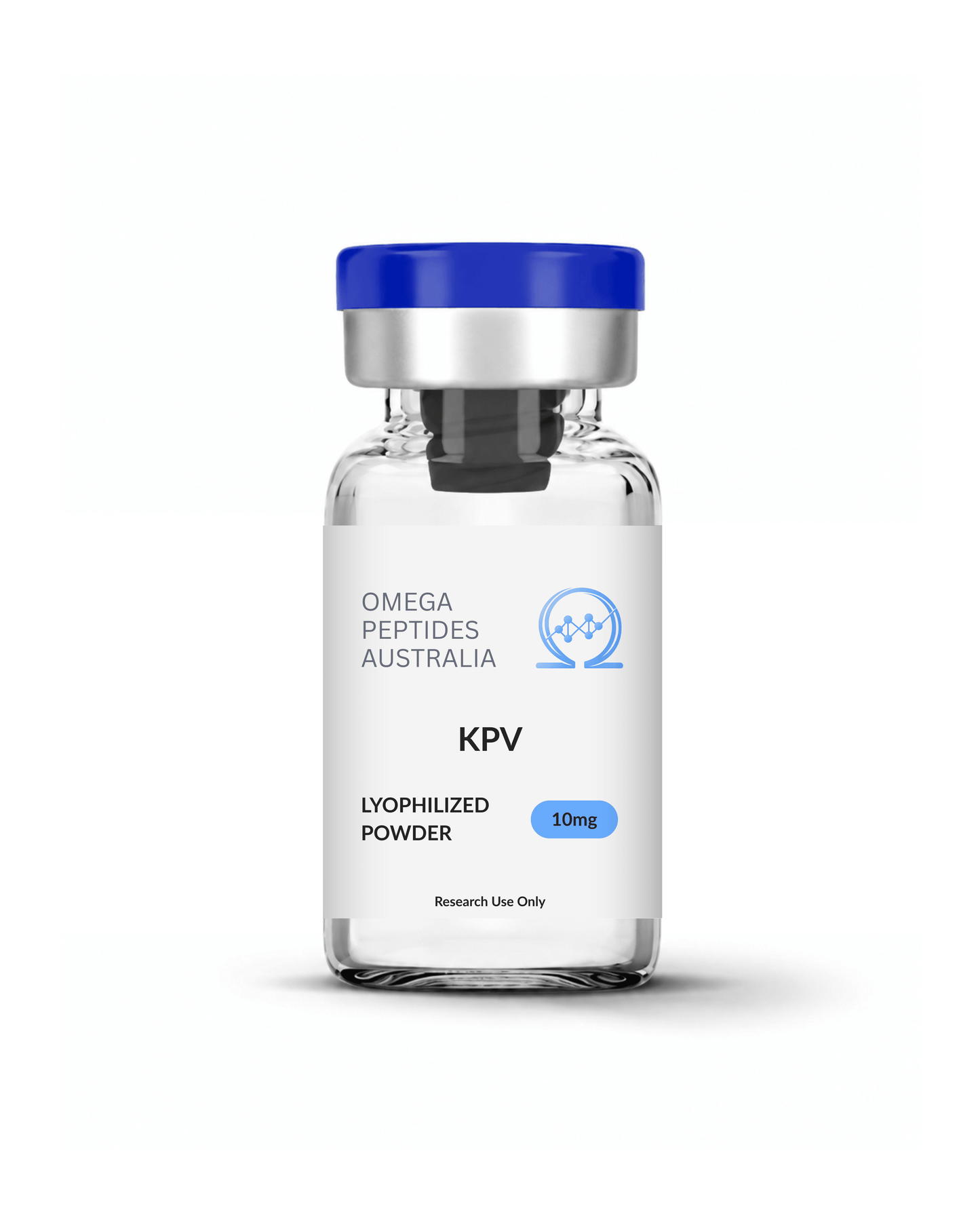
KPV (10mg) — Alpha-MSH Fragment Anti-Inflammatory Research Peptide
KPV (10mg) is stocked in Australia by Omega Peptides Australia and dispatched the same business day on orders before 12pm, each batch backed by an independent certificate of analysis. Also searched as KPV peptide, Lys-Pro-Val or alpha-MSH 11-13, it is the C-terminal tripeptide fragment of alpha-MSH studied for anti-inflammatory signalling.
KPV is a tripeptide made up of lysine, proline and valine (Lys-Pro-Val). It is the C-terminal fragment of alpha-melanocyte-stimulating hormone (alpha-MSH), corresponding to residues 11 to 13 of that thirteen-amino-acid melanocortin, and it is the smallest piece of alpha-MSH that retains the parent hormone's anti-inflammatory activity in laboratory models. It is written as KPV, KPV peptide or kpv tripeptide, and is sometimes referred to by its sequence, Lys-Pro-Val, or as alpha-MSH 11-13.
KPV is studied mainly for inflammation of the gut, skin and mucosal surfaces, for wound and barrier-repair models, and for its reported antimicrobial activity. Unlike full-length alpha-MSH, KPV lacks the His-Phe-Arg-Trp core that melanocortin receptors recognise, so it is not thought to act primarily through the MC1 receptor. Instead it is taken up into intestinal epithelial and immune cells by the peptide transporter PepT1 and, once inside, inhibits activation of the transcription factor NF-kB, which lowers production of inflammatory cytokines such as IL-6, IL-8 and TNF-alpha.
Omega Peptides Australia supplies KPV as a high-purity (≥99% HPLC) COA-verified lyophilised powder in a 10mg vial, dispatched same day from within Australia on orders placed before 12pm. Every batch is independently tested and the certificate for your vial can be reviewed in our COA library before you order.
Key research areas
- Intestinal inflammation research KPV has been examined in rodent colitis models, including chemically induced colitis, where oral and nanoparticle-delivered forms were used to study reductions in inflammatory markers, tissue damage and body-weight loss. The proposed mechanism is PepT1-mediated uptake into colonic epithelial cells and macrophages followed by suppression of NF-kB signalling.
- Skin and keratinocyte research The peptide has been studied in keratinocyte cultures exposed to inflammatory stimuli and to fine particulate matter, where it was investigated for its ability to limit oxidative stress and cytokine release, and in models of inflammatory skin conditions where alpha-MSH fragments are of long-standing interest.
- Wound and barrier-repair research Because inflammation and epithelial repair are closely linked, KPV has been investigated in wound-closure and barrier-integrity models, often alongside tissue-repair peptides, to see whether dampening the inflammatory phase changes the pace of re-epithelialisation.
- Antimicrobial research Alpha-MSH and its C-terminal tripeptide have been reported to reduce the viability of organisms such as Staphylococcus aureus and Candida albicans in vitro, and KPV is used as a model peptide for studying antimicrobial activity that does not depend on classical melanocortin receptor signalling.
- Mast-cell and allergic inflammation research KPV has been studied in models of mast-cell activation and allergic inflammation, where alpha-MSH-derived peptides are examined for effects on cytokine and mediator release.
- Delivery and formulation research Its small size and stability have made KPV a common test compound for oral delivery systems, hydrogels and nanoparticle carriers designed to target inflamed tissue, which is an active area of pharmaceutical research in its own right.
KPV in Australia
Because KPV is not listed on the Australian Register of Therapeutic Goods, it cannot be bought from a pharmacy in Australia; retail chains do not carry it. The route in Australia is a domestic research supplier holding the compound as a research-grade lyophilised vial. Omega Peptides Australia keeps KPV in Australian stock and ships it the same business day for orders before 12pm, on tracked delivery, which removes the transit and customs delay of ordering from overseas. The batch certificate is published in the COA library so identity and purity can be checked before the order is placed.
KPV is stocked in Australia as a 10mg vial and is also the anti-inflammatory component of the four-peptide KLOW blend.
How KPV works
Full-length alpha-MSH signals through the melanocortin receptors MC1R to MC5R, and its anti-inflammatory action was originally assumed to run through MC1R on immune cells. Structure-activity work showed that the C-terminal Lys-Pro-Val tripeptide retained much of that anti-inflammatory activity even though it lacks the central His-Phe-Arg-Trp pharmacophore needed for high-affinity receptor binding. This led to the current model in which KPV crosses the cell membrane through the oligopeptide transporter PepT1, which is expressed on intestinal epithelium and upregulated on immune cells during inflammation. Inside the cell, KPV interferes with the phosphorylation and degradation of IkB-alpha, preventing NF-kB from moving into the nucleus and switching on inflammatory genes. It has also been reported to reduce signalling through the MAPK pathway and to lower oxidative stress in cell models.
KPV is a very short peptide with a low molecular weight of about 342 g/mol, which gives it a short circulating half-life and rapid clearance but also makes it unusually stable in solution and suitable for oral and topical formulation research. It differs from the larger tissue-repair peptides it is often compared with: BPC-157 is a fifteen-amino-acid gastric peptide studied for angiogenic and nitric-oxide pathways, and TB-500 is a fragment of thymosin beta-4 studied for actin regulation and cell migration, whereas KPV is specifically an anti-inflammatory signalling fragment.
Specifications
| Compound | KPV (alpha-MSH 11-13) |
| Also known as | Lys-Pro-Val, KPV peptide, kpv tripeptide, alpha-MSH C-terminal tripeptide, alpha-MSH 11-13 |
| CAS number | 67727-97-3 |
| Molecular formula | C16H30N4O4 |
| Molecular weight | ~342.4 g/mol |
| Sequence | Lys-Pro-Val (KPV) |
| Category | Immune research |
| Purity | ≥99% HPLC, batch COA supplied |
| Form | Lyophilised powder in a sealed sterile vial |
| Vial sizes available | 10mg — $79.99 |
| Storage (lyophilised) | 2–8°C short term or −20°C long term, protect from light and moisture, avoid repeated freeze-thaw |
| Storage (reconstituted) | 2–8°C, use within 28 days |
| Reconstitution | Bacteriostatic water (recommended) |
Available sizes and pricing
KPV is supplied in a single 10mg vial. Because the tripeptide is so light, 10mg represents a large molar quantity, roughly 29 micromoles, which is enough for extended cell-culture or small-animal work. Researchers who want KPV alongside its most common partner peptides can also find 10mg of KPV inside the KLOW blend, which combines it with GHK-Cu, BPC-157 and TB-500 in one 80mg vial.
- 10mg vial — $79.99 (about $8.00 per mg)
Quality and COA verification
Every batch of KPV is independently tested by Janoshik Analytical. HPLC is used to confirm purity at or above 99% and mass spectrometry is used to confirm that the material has the correct molecular mass for Lys-Pro-Val, which matters for a tripeptide because closely related sequences are hard to tell apart by purity testing alone. A Certificate of Analysis is issued for every batch and published in our COA library, so the result for the vial you receive can be matched to its batch number. The peptide is supplied as a lyophilised powder in a sealed sterile vial for stability in storage and transit, and each order is packed securely and discreetly for domestic delivery within Australia.
Frequently bought together
- KLOW (80mg) — $149.99, a four-peptide blend containing KPV, GHK-Cu, BPC-157 and TB-500 for combined inflammation and repair models
- BPC-157 (10mg) — $99.99, the tissue-repair pentadecapeptide most often studied alongside KPV in gut and wound models
- Bacteriostatic Water (10mL) — $29.99, the recommended diluent for reconstituting lyophilised peptides
- Bacteriostatic Water (3mL) — $14.99, a smaller vial for single-compound work
Research guides
- KLOW research guide (includes KPV)
- How to store lyophilised peptides
- COA testing explained
- Peptide reconstitution calculator
Frequently asked questions
What does KPV stand for?
KPV is the single-letter amino-acid code for its sequence: K is lysine, P is proline and V is valine. The name is used interchangeably with Lys-Pro-Val and with alpha-MSH 11-13, which describes where the tripeptide sits within the parent hormone. All of these names refer to the same compound supplied here as a lyophilised research peptide.
What is KPV?
KPV is a synthetic tripeptide identical to the last three amino acids of alpha-melanocyte-stimulating hormone. It is the shortest fragment of alpha-MSH that keeps the parent hormone's anti-inflammatory activity in laboratory models, and it is studied for gut inflammation, skin inflammation, barrier repair and antimicrobial activity. Omega Peptides Australia supplies it as a COA-verified lyophilised powder in a 10mg vial for in-vitro research.
What is KPV also known as?
KPV is also written as KPV peptide, kpv tripeptide, Lys-Pro-Val or alpha-MSH 11-13, and some papers describe it as the alpha-MSH C-terminal tripeptide. Its CAS number is 67727-97-3. It should not be confused with KLOW, which is a four-peptide blend that contains KPV together with GHK-Cu, BPC-157 and TB-500.
How does KPV work?
KPV does not rely on the melanocortin receptors used by full-length alpha-MSH. It is carried into epithelial and immune cells by the peptide transporter PepT1, and inside the cell it blocks activation of NF-kB, the transcription factor that switches on inflammatory genes. This lowers production of cytokines such as IL-6, IL-8 and TNF-alpha, and it has also been reported to reduce MAPK signalling and oxidative stress in cell models.
What does the research show about KPV?
Rodent colitis models report reduced inflammatory markers and tissue damage with oral or nanoparticle-delivered KPV. Keratinocyte studies have looked at protection against particulate-induced inflammation and oxidative stress, and in-vitro work has reported activity against Staphylococcus aureus and Candida albicans. KPV is also a common test peptide in delivery-system research. These findings come from preclinical and cell-culture studies rather than human trials.
Can I buy KPV at Chemist Warehouse or a pharmacy in Australia?
No. KPV is not a registered medicine in Australia and is not stocked by Chemist Warehouse, Priceline or other retail pharmacies. The KPV supplied here is a research-grade lyophilised compound intended for laboratory use, and it is sold with an independent batch Certificate of Analysis rather than as a pharmacy product.
Can Australian compounding pharmacies supply KPV?
Australian compounding pharmacies may only prepare a product for an individual patient on a valid prescription from a registered prescriber, within Pharmacy Board and TGA requirements, and the TGA has been increasing its scrutiny of unapproved peptide products. Omega Peptides Australia is not a pharmacy and does not compound. We supply the lyophilised research-grade compound with a batch COA for in-vitro laboratory work only.
How do you reconstitute KPV?
Use bacteriostatic water. Allow the vial to reach room temperature, then add the water slowly down the inside wall of the vial so it runs onto the powder gently. Swirl until the powder dissolves, do not shake. KPV dissolves readily and gives a clear solution. Store the reconstituted vial at 2 to 8°C and use it within 28 days. Our reconstitution calculator will help you work out concentrations.
How should KPV be stored?
Store sealed lyophilised vials at 2 to 8°C for short-term use or at minus 20°C for long-term storage, away from light and moisture, and avoid repeated freeze-thaw cycles. As a dry powder KPV is stable for extended periods under these conditions. Once reconstituted, keep the solution refrigerated at 2 to 8°C and use within 28 days.
Where can I buy KPV in Australia?
KPV can be ordered directly from Omega Peptides Australia. We hold stock domestically, dispatch orders placed before 12pm the same day with tracked shipping, and publish an independent Janoshik COA for every batch. If you are setting up a broader inflammation or repair study you can browse our full range of research peptides in Australia and order everything in one shipment.
What does KPV cost in Australia?
KPV is $79.99 for a 10mg vial, which works out at about $8.00 per mg. Because the tripeptide is so light, 10mg is a large molar quantity for a compound of this size. If you also need GHK-Cu, BPC-157 and TB-500, the KLOW blend at $149.99 includes 10mg of KPV alongside those three peptides in a single 80mg vial.
How do I get KPV online in Australia?
Select the 10mg vial on this page, add it to your cart and complete checkout. Orders are shipped from our Australian stock with tracked domestic delivery in discreet packaging, and orders placed before 12pm on a business day leave the same day. Shipping from within Australia means there is no customs clearance or import paperwork and delivery times are short.
Is KPV legal in Australia?
Omega Peptides Australia supplies KPV strictly for lawful in-vitro laboratory research. It is not approved by the TGA for human or veterinary use and is not sold as a medicine or supplement. Purchasers are responsible for ensuring their intended use complies with all applicable laws.
When is standalone KPV used versus the KLOW blend?
Standalone KPV suits studies that isolate the anti-inflammatory mechanism, such as NF-kB reporter assays, colitis models or antimicrobial testing, where a single defined compound is needed. The KLOW blend supplies KPV together with GHK-Cu, BPC-157 and TB-500 in fixed proportions, which suits combined inflammation and tissue-repair models where all four peptides are studied together and separate vials would be less convenient.
Is KPV peptide available in Australia?
Yes, as a research-grade lyophilised tripeptide from domestic suppliers. Omega Peptides Australia holds KPV 10mg in Australian stock, COA verified, with same-day dispatch before 12pm.
Can you get KPV in Australia?
Yes, from an Australian research peptide supplier holding domestic stock. Omega Peptides Australia dispatches KPV from within Australia on tracked delivery.
⚠ For in-vitro research and laboratory use only. Not for human or veterinary use.