Omega Peptides Australia
Couldn't load pickup availability
For laboratory research use only. Not for human or veterinary use, consumption, or therapeutic application. Not a drug, food, cosmetic, or dietary supplement. Handling restricted to qualified researchers in an appropriate setting.
Certificates of Analysis
Independent third-party testing for this product. Tap a report to view the data.


Glutathione (600mg) — Tripeptide Antioxidant Research Compound
Glutathione (600mg) is supplied in Australia by Omega Peptides Australia from domestic stock, with same-day dispatch on orders placed before 12pm and an independent certificate of analysis for every batch. Commonly written as GSH, reduced glutathione, glutathione peptide or L-glutathione, it is the tripeptide antioxidant central to cellular redox balance. The current batch (#199769) was tested by Janoshik Analytical on 9 July 2026 and the report can be verified by batch number.
Glutathione is a tripeptide made of glutamate, cysteine and glycine, joined by an unusual gamma-glutamyl bond that makes it resistant to ordinary peptidases. It is the most abundant low-molecular-weight thiol in animal cells, present at millimolar concentrations, and it exists in a reduced form (GSH) with a free sulfhydryl group and an oxidised disulfide form (GSSG). It was named by Frederick Gowland Hopkins in 1921 and its structure was settled in 1935. It is often written as L-glutathione, reduced glutathione, GSH or glutathion, and searches for glutathione 600mg refer to the reduced form supplied here.
Glutathione is studied in three main directions: oxidative stress and redox signalling, where the GSH to GSSG ratio is the principal measure of a cell's redox state; detoxification, where it conjugates reactive electrophiles and drug metabolites for excretion; and models of neurodegeneration, liver injury and ageing in which glutathione depletion is a consistent finding. It works by donating electrons through its cysteine thiol, either directly to reactive oxygen species or as the substrate for glutathione peroxidase and glutathione S-transferase enzymes, and it is then recycled from GSSG by glutathione reductase using NADPH.
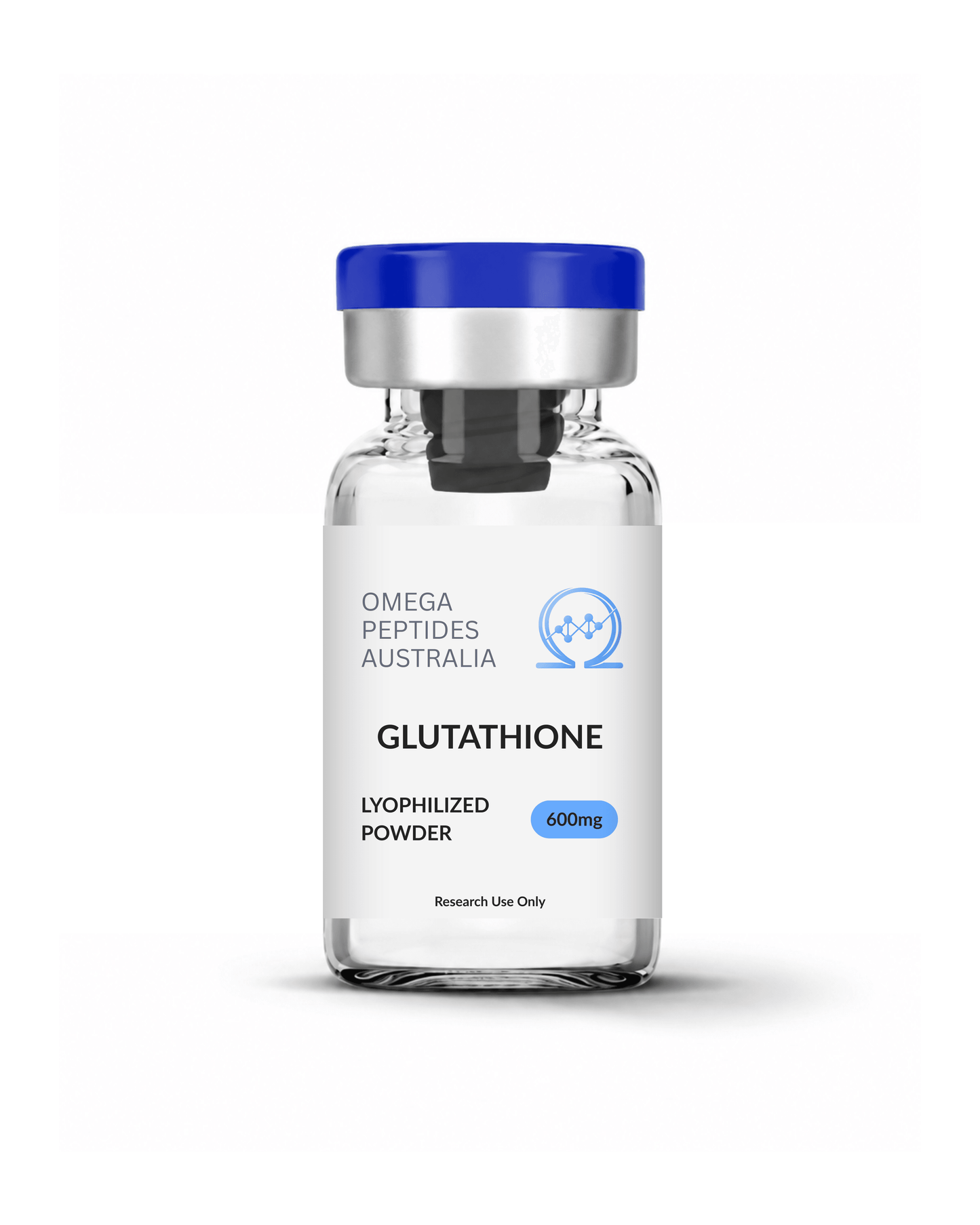
Omega Peptides Australia supplies Glutathione as a high-purity (≥99% HPLC) COA-verified lyophilised powder in a sealed sterile 600mg vial. Orders placed before 12pm are dispatched the same day from within Australia, and the batch Certificate of Analysis for every lot is published in our COA library.
Key research areas
- Oxidative stress and redox biology Glutathione is the reference molecule for studying cellular redox balance. Research measures the GSH to GSSG ratio, normally well above 100 to 1 in healthy cells, as a readout of oxidative stress in models of inflammation, ischaemia, radiation exposure and toxic injury. Its thiol group neutralises peroxides and free radicals, directly or through the selenium-dependent glutathione peroxidases.
- Detoxification and xenobiotic metabolism Glutathione S-transferases attach glutathione to electrophilic drugs, carcinogens and heavy metals, producing water-soluble conjugates that are exported from the cell and excreted. The classic model is paracetamol toxicity, where the reactive metabolite NAPQI depletes hepatic glutathione before it damages liver cells, which is why glutathione precursors are studied as hepatoprotective agents.
- Neurodegeneration models Glutathione levels are reduced in the substantia nigra in Parkinson's disease and in other neurodegenerative conditions, and loss of glutathione precedes cell death in several models. Research examines whether restoring neuronal glutathione, directly or through precursors, protects dopaminergic neurons from oxidative and mitochondrial damage.
- Skin pigmentation and melanogenesis Glutathione shifts melanin synthesis from dark eumelanin towards lighter pheomelanin by interacting with tyrosinase and by quenching the reactive intermediates of melanogenesis. This mechanism underlies a large body of dermatological research, although controlled evidence for the many consumer skin products remains limited.
- Immune function and inflammation Lymphocyte activation and proliferation depend on adequate intracellular glutathione, and glutathione depletion is associated with impaired T-cell responses and increased inflammatory signalling through NF-kB. Research spans infection models, immune ageing and the link between redox state and cytokine production.
- Ageing and mitochondrial research Mitochondrial glutathione protects the electron transport chain from the superoxide it generates, and its decline with age is studied as a driver of mitochondrial dysfunction. Glutathione is frequently examined alongside NAD+ in ageing research because glutathione reductase depends on NADPH, linking the two redox systems.
Glutathione in Australia
Glutathione is not registered on the Australian Register of Therapeutic Goods, so it is not stocked by Chemist Warehouse, Priceline or other pharmacies. In Australia it is supplied as a research-grade lyophilised vial by domestic research suppliers. Omega Peptides Australia holds Glutathione in stock within Australia and dispatches orders placed before 12pm the same business day on tracked domestic delivery, so material arrives in days rather than waiting on an international shipment and customs. Every batch is tested independently and its certificate is published in the COA library before the vial ships. Browse the full range of research peptides in Australia on our homepage.
Glutathione is stocked in Australia as a 600mg research-grade vial. It is often run alongside NAD+ in cellular-ageing and redox designs, also held domestically.
How Glutathione works
Glutathione is synthesised inside cells in two ATP-dependent steps: glutamate-cysteine ligase joins glutamate and cysteine through the gamma-carboxyl group, which is the rate-limiting step and depends on cysteine availability, and glutathione synthetase then adds glycine. The reduced form acts as an electron donor. Its cysteine thiol reacts with reactive oxygen and nitrogen species and with electrophiles, and glutathione peroxidases use it to reduce hydrogen peroxide and lipid hydroperoxides to water and alcohols. Two molecules of oxidised glutathione are joined by a disulfide bond as GSSG, and glutathione reductase regenerates GSH using NADPH from the pentose phosphate pathway, so the system is effectively a rechargeable redox buffer. Glutathione also reversibly modifies protein cysteine residues (S-glutathionylation), acting as a signalling switch, and stores nitric oxide as S-nitrosoglutathione.
Outside the cell glutathione is broken down at the membrane by gamma-glutamyl transpeptidase, which is why orally ingested glutathione has limited bioavailability in pharmacokinetic studies and why much research uses precursors such as N-acetylcysteine or delivery formats that bypass the gut. In laboratory work the reduced form supplied here is the active species; the oxidised GSSG form, glutathione ethyl ester and liposomal preparations are different research tools with different properties. Unlike the receptor-targeting peptides elsewhere in this range, glutathione has no hormone-like signalling activity.
Specifications
| Compound | Glutathione, reduced (L-glutathione) |
| Also known as | GSH, reduced glutathione, L-glutathione, glutathion, gamma-L-glutamyl-L-cysteinylglycine, glutathione 600mg, glutathione peptide |
| CAS number | 70-18-8 |
| Molecular formula | C10H17N3O6S |
| Molecular weight | 307.32 g/mol |
| Sequence | γ-Glu-Cys-Gly (gamma-glutamyl linkage) |
| Category | Antioxidant and redox research |
| Purity | ≥99% HPLC · content 650.23 mg · Janoshik Analytical batch #199769 (9 July 2026) · verify report |
| Form | Lyophilised powder in a sealed sterile vial |
| Vial sizes available | 600mg — $149.99 |
| Storage (lyophilised) | 2–8°C short term or −20°C long term, protect from light and moisture, avoid repeated freeze-thaw |
| Storage (reconstituted) | 2–8°C, use within 28 days |
| Reconstitution | Bacteriostatic water (recommended) |
Available sizes and pricing
Glutathione is supplied in a single 600mg vial, a much larger quantity than the milligram-scale peptides in the range because redox research uses it at far higher concentrations. Pricing is per vial, with the per-milligram figure shown for comparison.
- 600mg vial — $149.99 (about $0.25 per mg)
Multi-vial pricing (600mg): 2 vials $269.98 (10% off, $134.99 each), 3 vials $393.72 (12.5% off, $131.24 each), 4 vials $509.97 (15% off, $127.49 each). The discount is applied automatically in the cart.
There is no dedicated kit for Glutathione. A 10mL vial of bacteriostatic water is the usual companion purchase.
Quality and COA verification
Every batch of Glutathione sold by Omega Peptides Australia is independently tested by Janoshik Analytical. HPLC confirms purity of ≥99% and distinguishes reduced glutathione from its oxidised disulfide form, which matters because GSH converts to GSSG on exposure to air and moisture, and mass spectrometry confirms that the measured mass matches the expected 307.3 daltons. A Certificate of Analysis is issued for every batch and published in our COA library, where the batch number on your vial can be matched to its report. The compound is supplied lyophilised in a sealed sterile vial because the dry powder is far more stable than a solution, and vials are packed in protective outer packaging for domestic transit.
Frequently bought together
- Bacteriostatic Water (10mL) — $29.99, the diluent used to reconstitute the lyophilised powder.
- NAD+ (500mg) — $139.99, the coenzyme studied alongside glutathione in redox and ageing research.
- GHK-Cu (50mg) — $89.99, the copper tripeptide studied in skin and collagen research.
Research guides
- Peptide storage guide: how to store lyophilised peptides properly
- COA testing explained for research peptides in Australia
- Peptide reconstitution calculator
- Certificates of Analysis library
Frequently asked questions
What is GSH?
GSH is the standard abbreviation for reduced glutathione, the form of the tripeptide that carries a free thiol group on its cysteine residue and can donate electrons. The oxidised form, in which two molecules are linked by a disulfide bond, is abbreviated GSSG. The ratio of GSH to GSSG is the most widely used laboratory measure of cellular redox status, and it is the reduced GSH form that is supplied in this vial.
What is Glutathione?
Glutathione is a tripeptide of glutamate, cysteine and glycine with a molecular weight of 307.32 daltons, found in almost every cell of the body at concentrations of one to ten millimolar. It functions as the cell's principal antioxidant and detoxification substrate. Omega Peptides Australia supplies reduced L-glutathione as a lyophilised research-grade powder in 600mg vials for in-vitro laboratory use, with an independent Certificate of Analysis for every batch.
What is Glutathione also known as?
It is also written as L-glutathione, reduced glutathione, GSH or glutathion, and its systematic name is gamma-L-glutamyl-L-cysteinylglycine. Searches for glutathione 600mg, glutathione powder or glutathione vial refer to the same reduced form. It should not be confused with GSSG (oxidised glutathione), glutathione ethyl ester or S-acetyl glutathione, which are chemically distinct derivatives used in different research settings.
How does Glutathione work?
In research models glutathione donates electrons from its cysteine thiol to neutralise reactive oxygen species, serves as the substrate for glutathione peroxidases that remove hydrogen peroxide and lipid peroxides, and is attached to electrophilic toxins by glutathione S-transferases so they can be excreted. After oxidation to GSSG it is regenerated by glutathione reductase using NADPH. It also reversibly modifies protein thiols and stores nitric oxide as S-nitrosoglutathione.
What does the research show about Glutathione?
Glutathione depletion is a consistent finding in models of liver injury, neurodegeneration, ageing and chronic inflammation, and restoring it protects cells in many in-vitro and animal studies. Pharmacokinetic research shows that oral glutathione is largely broken down in the gut, which is why precursors and alternative delivery formats are studied. Clinical evidence for the many consumer glutathione products remains limited, and the compound is best regarded as a research tool for redox biology.
Can I buy Glutathione at Chemist Warehouse or a pharmacy in Australia?
Yes, in other forms. Chemist Warehouse, Priceline and other pharmacies sell oral glutathione capsules, liposomal liquids and sublingual tablets as listed complementary medicines, and some clinics offer glutathione infusions prepared by compounding pharmacies on prescription. The lyophilised 600mg research-grade vial sold here is a different product: it is a laboratory reagent supplied for in-vitro use only and is not a supplement or a medicine.
Can Australian compounding pharmacies supply Glutathione?
Yes. Glutathione is one of the compounds that Australian compounding pharmacies do prepare, typically as an injectable or infusion for use in clinics under an individual prescription, and it is not a scheduled poison in its own right. That prescription pathway is separate from research supply. Omega Peptides Australia supplies the lyophilised research-grade compound for laboratory use and does not compound, prescribe or dispense medicines.
How do you reconstitute Glutathione?
Swab the stopper and add bacteriostatic water slowly down the inside wall of the vial so the stream does not hit the powder directly. Swirl gently until the solution is clear; do not shake, because agitation introduces air and speeds oxidation of the thiol group. Label the vial with the date and concentration, refrigerate at 2–8°C and use within 28 days. Glutathione is freely soluble in water, and our reconstitution calculator gives the concentration for any diluent volume.
How should Glutathione be stored?
Keep the lyophilised vial at 2–8°C for short-term use or at −20°C for long-term storage, protected from light and moisture. Reduced glutathione oxidises to GSSG on contact with air, so keep the seal intact until use and minimise headspace exposure after opening. Once reconstituted, store the solution at 2–8°C and use it within 28 days, and avoid repeated freeze-thaw cycles.
Where can I buy Glutathione in Australia?
Omega Peptides Australia holds Glutathione in domestic stock, so orders placed before 12pm are dispatched the same day without international shipping delays or customs uncertainty. Every batch carries an independent Certificate of Analysis, and the compound sits within our research peptides collection alongside NAD+, GHK-Cu and other redox and skin research compounds.
What does Glutathione cost in Australia?
A 600mg vial of reduced Glutathione costs $149.99 from Omega Peptides Australia, which is about $0.25 per mg. There is no bundle for this compound at present, and bacteriostatic water is available separately in 3mL and 10mL sizes. Pricing is expressed per vial and per milligram only.
How do I get Glutathione online in Australia?
Select the 600mg vial on this product page, add any bacteriostatic water or syringes you need, and complete checkout. Orders placed before 12pm are dispatched the same day from within Australia with tracked domestic shipping in plain, discreet packaging. A tracking number is emailed when the parcel is lodged, and most metropolitan addresses receive their order within a few business days.
Is Glutathione legal in Australia?
Omega Peptides Australia supplies Glutathione strictly for lawful in-vitro laboratory research. It is not approved by the TGA for human or veterinary use and is not sold as a medicine or supplement. Purchasers are responsible for ensuring their intended use complies with all applicable laws, including any state or territory requirements that apply to their laboratory.
How does lyophilised glutathione 600mg differ from glutathione capsules and IV clinic products?
Capsules, liposomal liquids and sublingual tablets are listed complementary medicines formulated for oral use, and clinic infusions are prescription products compounded for an individual patient. The 600mg vial sold here is a lyophilised laboratory reagent: reduced glutathione of ≥99% purity with a batch Certificate of Analysis, packaged for reconstitution and in-vitro research. It is not formulated, labelled or supplied for any of those consumer or clinical uses.
Is Glutathione available in Australia as a research compound?
Yes. Omega Peptides Australia holds research-grade Glutathione 600mg in Australian stock as a lyophilised vial, COA verified, with same-day dispatch before 12pm.
Where can I buy Glutathione peptide in Australia?
From an Australian research supplier holding domestic stock. Omega Peptides Australia ships Glutathione from within Australia on tracked delivery.
What is the tested purity of Glutathione?
The current batch (#199769) was tested by Janoshik Analytical on 9 July 2026 by HPLC and mass spectrometry, with 650.23 mg content per vial. The full report can be checked on Janoshik's verification portal using the batch number, and the certificate is published in our COA library.
⚠ For in-vitro research and laboratory use only. Not for human or veterinary use.