Omega Peptides Australia
Couldn't load pickup availability
For laboratory research use only. Not for human or veterinary use, consumption, or therapeutic application. Not a drug, food, cosmetic, or dietary supplement. Handling restricted to qualified researchers in an appropriate setting.
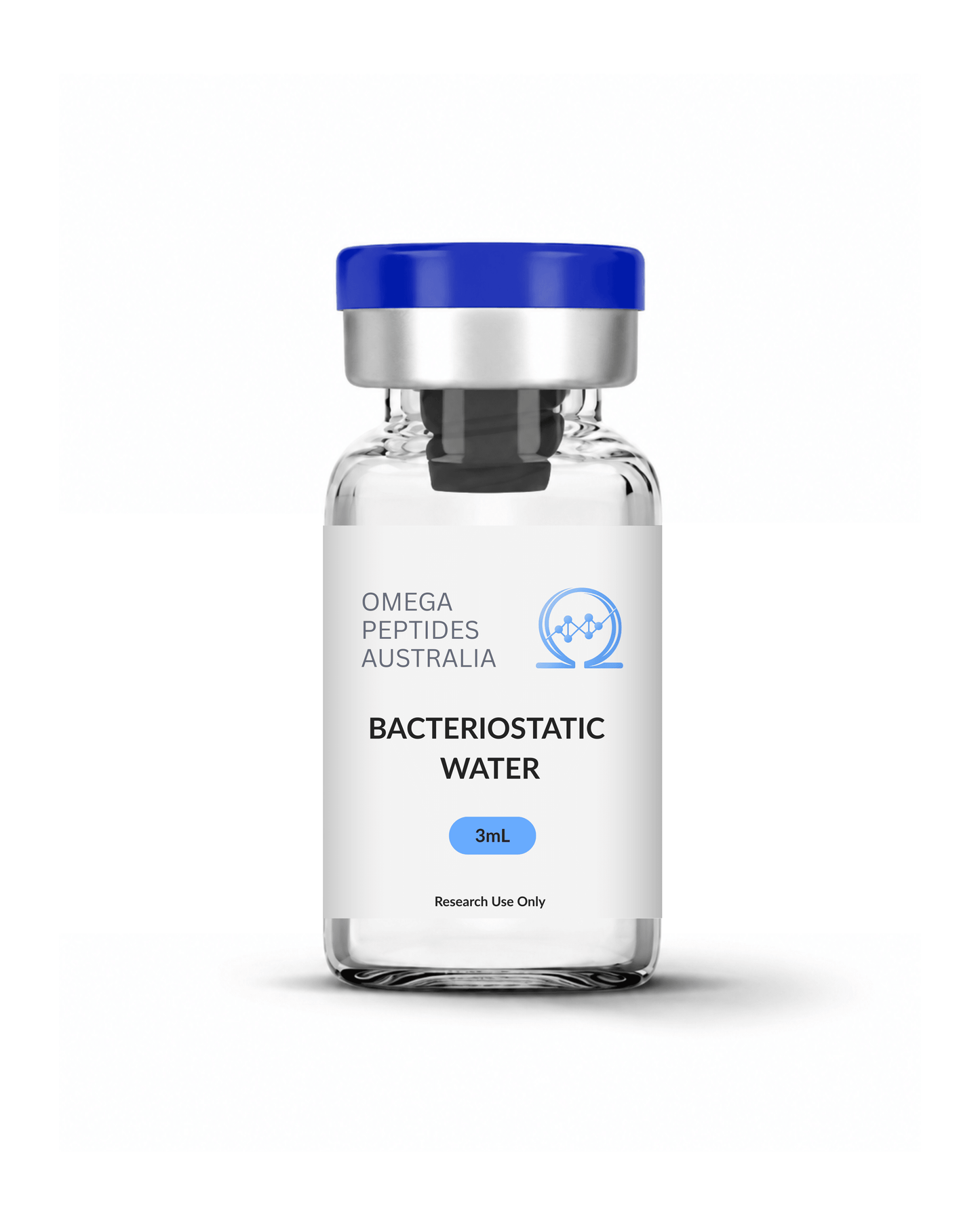
Bacteriostatic Water 3mL — 0.9% Benzyl Alcohol Sterile Laboratory Diluent
Bacteriostatic water is sterile, purified water to which 0.9% benzyl alcohol has been added as a preservative. It is the standard multi-draw diluent used in peptide laboratories to dissolve lyophilised powders into a working solution, and the diluent recommended on every research peptide page at Omega Peptides Australia. It is often shortened to bac water or BAC water, appears on labels as bacteriostatic water for injection, and is sometimes confused with bacteriostatic saline, a different product that also contains 0.9% sodium chloride.
This page is the 3mL vial, a compact size that suits reconstituting one or two peptide vials, or keeping a small backup on hand without committing to a larger volume. If you're running several peptides at once or a dilution series, the 10mL vial brings the per-mL cost down by about 40%.
In research settings it does three main jobs: reconstituting lyophilised peptides, preparing serial dilutions and working stocks, and keeping an opened vial usable across repeated draws. The benzyl alcohol does the preservative work. At 0.9% it disrupts bacterial cell membranes and inhibits replication, so any organism introduced during a needle entry cannot multiply inside the vial. The effect is bacteriostatic rather than sterilising, which is why an opened multi-draw vial is limited to 28 days.
Omega Peptides Australia supplies this 3mL bacteriostatic water vial as the companion diluent to its high-purity (≥99% HPLC), COA-verified lyophilised research peptides. Orders are dispatched same day from within Australia when placed before 12pm, and the batch Certificates of Analysis for the peptides it is paired with are published in the COA library.
Key research areas
- Peptide reconstitution Lyophilised peptides arrive as a dry cake that must be returned to solution before any in-vitro work. Bacteriostatic water is the default solvent for water-soluble peptides such as BPC-157, TB-500, GHK-Cu and Ipamorelin because it dissolves the cake cleanly and adds no salts or buffers that could interfere with assays.
- Multi-draw vial stability A reconstituted research vial is rarely used in one sitting. Benzyl alcohol keeps the solution bacteriostatic between draws, which is why preserved water is preferred over sterile water whenever a vial will be entered repeatedly over several weeks.
- Serial dilution and working stocks Concentration studies need a stock solution diluted stepwise. Because bacteriostatic water contains nothing beyond the preservative, it gives a clean, reproducible baseline for dilution series planned with the reconstitution calculator.
- Diluent compatibility research Not every peptide behaves identically in preserved water. Some hydrophobic or highly charged sequences dissolve more readily in dilute acetic acid first, and comparing solubility, clarity and HPLC purity across diluents is routine formulation work.
- Preservative efficacy studies Laboratory work has examined how long benzyl alcohol stays above its effective preservative floor after a vial is opened. The 28-day convention comes from multi-dose container guidance rather than chemical breakdown.
How Bacteriostatic Water works
The active component is benzyl alcohol, an aromatic alcohol with the formula C7H8O, present at 0.9% weight per volume, about 9mg per millilitre. Benzyl alcohol partitions into microbial cell membranes, increases their permeability and denatures membrane-bound proteins. At this concentration it does not sterilise a contaminated solution; it stops the few organisms that may enter through a needle puncture from growing to a meaningful population. That is the distinction between bacteriostatic, meaning growth-inhibiting, and bactericidal, meaning killing. Because the water is sterile-filled and the septum reseals after each draw, the preservative only has to hold the line against incidental contamination.
Bacteriostatic water is unbuffered and slightly acidic, typically around pH 5.7 within an accepted range of 4.5 to 7.0, so it is a solvent rather than a physiological buffer. It is also hypotonic, containing no dissolved salts, which separates it from bacteriostatic saline. Sterile water for injection is the unpreserved sibling, intended for single entry, and dilute acetic acid serves the few peptides that resist dissolving at near-neutral pH.
Specifications
| Compound | Bacteriostatic Water (sterile water with 0.9% benzyl alcohol) |
| Also known as | Bac water, BAC water, bacteriostatic water for injection, benzyl alcohol 0.9% water |
| CAS number | Benzyl alcohol 100-51-6; water 7732-18-5 |
| Molecular formula | Benzyl alcohol C7H8O; water H2O |
| Molecular weight | Benzyl alcohol 108.14 g/mol; water 18.02 g/mol |
| Category | Lab supplies (reconstitution diluent) |
| Preservative | Benzyl alcohol 0.9% w/v (about 9mg per mL) |
| Form | Clear, colourless sterile solution in a sealed vial with a resealable septum |
| This vial | 3mL — $14.99 (also available as a 10mL vial — $29.99) |
| Storage (unopened) | Room temperature, 20–25°C, protect from light, do not freeze |
| Storage (after first puncture) | Use within 28 days; keep the septum clean and the vial capped |
3mL vial: pricing and who it suits
The 3mL vial is $14.99, about $5.00 per mL. It's the right size for reconstituting one or two peptide vials, for a compact bench kit, or if you just want to try a peptide before committing to a larger diluent stock. It's the same sterile-filled, benzyl alcohol-preserved solution as the 10mL vial; only the volume differs, so purity and preservative concentration are identical. It's also the size bundled into the Starter Kit with syringes and swabs.
If you're running several peptides at once or planning a dilution series over a few weeks, the 10mL vial brings the per-mL cost down by about 40%.
Quality and COA verification
Every research peptide supplied by Omega Peptides Australia is independently tested by Janoshik Analytical, with HPLC purity and mass spectrometry identity reported on a Certificate of Analysis for each batch. Those documents are published in the COA library and are the reference for any peptide reconstituted with this diluent. The bacteriostatic water itself is sterile-filled, sealed with a tamper-evident cap over a resealable septum, and supplied as a clear, colourless solution that should be discarded if it ever appears cloudy. Vials are packed for domestic transit, and because the solution is stable at room temperature no cold chain is required.
Frequently bought together
- 1mL Insulin Needles (5 Pack), $15.99, sterile single-use syringes for drawing water and withdrawing aliquots.
- Starter Kit, $39.99, this 3mL bacteriostatic water vial, five syringes and two alcohol swabs in one order.
- BPC-157 (10mg), $99.99, a water-soluble pentadecapeptide that reconstitutes cleanly in bacteriostatic water.
- GHK-Cu (50mg), $89.99, a copper tripeptide often reconstituted with the larger 10mL diluent.
Research guides
- Peptide storage guide: how to store lyophilised peptides properly
- COA testing explained for research peptides in Australia
- Peptide reconstitution calculator
- Certificate of Analysis library
Frequently asked questions
What is bac water?
Bac water is the everyday short form of bacteriostatic water: sterile water containing 0.9% benzyl alcohol, supplied in a sealed vial with a resealable septum so measured volumes can be drawn out over several weeks. In peptide laboratories it is the diluent used to turn a lyophilised powder back into solution.
What is Bacteriostatic Water?
Bacteriostatic water is purified, sterile-filled water with benzyl alcohol added at 0.9% as a preservative. It contains no salts, buffers or active ingredients, is clear and colourless, and is slightly acidic at around pH 5.7. Omega Peptides Australia supplies this 3mL vial, and a larger 10mL vial, as laboratory reconstitution diluents.
What is Bacteriostatic Water also known as?
It is written as bac water, BAC water or bacteriostatic water for injection, and is sometimes described simply as benzyl alcohol 0.9% water. It should not be confused with bacteriostatic saline, which adds 0.9% sodium chloride to the same preservative, or with sterile water for injection, which has no preservative.
How does Bacteriostatic Water work?
The benzyl alcohol preservative partitions into microbial cell membranes, increasing their permeability and denaturing membrane proteins, which stops bacteria from replicating. At 0.9% the effect is growth-inhibiting rather than sterilising, so the solution relies on being sterile-filled to begin with, with the preservative holding incidental contamination from each needle entry in check.
How long does Bacteriostatic Water last once opened?
The laboratory convention, drawn from multi-dose container guidance in USP General Chapter 797, is to discard an opened vial 28 days after the first puncture. Studies indicate benzyl alcohol typically stays above its effective concentration well beyond that window, so the limit reflects sterility assurance rather than chemical breakdown. Unopened vials are used before the printed expiry.
Should I choose the 3mL or 10mL vial?
The 3mL vial suits reconstituting one or two peptide vials, a compact bench kit, or trying a peptide before committing to a larger volume. The 10mL vial is the better value per mL if you're running several peptides at once or a longer dilution series. Both are the same sterile, benzyl alcohol-preserved solution; only the volume differs.
Can I buy Bacteriostatic Water at Chemist Warehouse or a pharmacy in Australia?
Generally no. Chemist Warehouse, Priceline and other retail pharmacies do not routinely stock bacteriostatic water for injection as a retail line; it is a laboratory and clinical consumable that is ordered through specialist suppliers. Omega Peptides Australia supplies it as a laboratory diluent for research use, a different supply channel from a pharmacy product intended for a patient.
Can Australian compounding pharmacies supply Bacteriostatic Water?
Some compounding pharmacies prepare preserved diluents for their own prescription work through a clinical channel governed by pharmacy regulation. Research suppliers such as Omega Peptides Australia supply sealed bacteriostatic water vials for laboratory reconstitution of research peptides, which is a separate purpose and not interchangeable with a pharmacy-dispensed product.
How do you reconstitute a peptide with Bacteriostatic Water?
Swab both septa, draw the planned volume of bacteriostatic water into a sterile syringe, then add it slowly down the inside wall of the peptide vial rather than spraying it onto the powder. Swirl gently until clear; never shake, because shear can damage the peptide. Label the vial, refrigerate at 2–8°C and use within 28 days.
How should Bacteriostatic Water be stored?
Store unopened vials at room temperature, ideally 20–25°C, away from direct light, and do not freeze them. After the first puncture keep the cap on, swab the septum before every draw and use the contents within 28 days. Reconstituted peptide solutions made with it are kept at 2–8°C.
Where can I buy Bacteriostatic Water in Australia?
Omega Peptides Australia holds domestic stock of this 3mL vial and the 10mL vial, and dispatches same day on orders placed before 12pm, with tracked delivery Australia-wide. It is stocked to pair with the COA-verified lyophilised peptides in the research peptides collection, so diluent and peptide arrive together.
What does this 3mL vial of Bacteriostatic Water cost in Australia?
This 3mL vial is $14.99, about $5.00 per mL. The 10mL vial is $29.99, about $3.00 per mL, so it gives the best value per millilitre if you need more volume. This 3mL size is also bundled in the Starter Kit for $39.99 with five 1mL syringes and two alcohol swabs.
How do I get Bacteriostatic Water online in Australia?
Add this 3mL vial to the cart with any peptides or syringes you need, and check out. Orders placed before 12pm are dispatched the same business day from within Australia in discreet packaging, with a tracking number emailed once the parcel is lodged.
Is Bacteriostatic Water legal in Australia?
Omega Peptides Australia supplies Bacteriostatic Water strictly for lawful in-vitro laboratory research. It is not approved by the TGA for human or veterinary use and is not sold as a medicine or supplement. Purchasers are responsible for ensuring their intended use complies with all applicable laws.
Bacteriostatic water, sterile water or acetic acid: which diluent for which peptide?
Bacteriostatic water is the default for water-soluble research peptides that will be drawn from more than once, which covers most of the catalogue. Sterile water without preservative suits single-use preparations used immediately. Dilute acetic acid, typically 0.1%, is reserved for peptides that dissolve poorly at near-neutral pH, often diluted further with bacteriostatic water afterwards.
⚠ For in-vitro research and laboratory use only. Not for human or veterinary use.
Share