Omega Peptides Australia
Couldn't load pickup availability
For laboratory research use only. Not for human or veterinary use, consumption, or therapeutic application. Not a drug, food, cosmetic, or dietary supplement. Handling restricted to qualified researchers in an appropriate setting.
Certificates of Analysis
Independent third-party testing for this product. Tap a report to view the data.


GHK-Cu (50mg) — Copper Tripeptide Research Compound
GHK-Cu is a naturally occurring copper-binding tripeptide made up of glycine, L-histidine and L-lysine (Gly-His-Lys) complexed with a single copper(II) ion. It was first isolated from human plasma albumin in 1973 by the biochemist Loren Pickart, and it is also found in saliva and urine, with circulating levels reported to fall substantially between early adulthood and older age. It is often written as GHK Cu, GHKCu or ghk-cu, and is commonly called copper peptide, copper tripeptide-1 (its cosmetic ingredient name), GHK copper or prezatide copper.
GHK-Cu is studied for skin and collagen remodelling, wound-healing and tissue-repair models, and hair-follicle biology, with a growing body of work on its effects on gene expression. At the cellular level it acts as a high-affinity copper carrier that delivers the ion to and from cells, and in fibroblast and keratinocyte models it has been reported to stimulate collagen, elastin and glycosaminoglycan synthesis while modulating matrix metalloproteinases and their tissue inhibitors, which together regulate extracellular-matrix turnover.
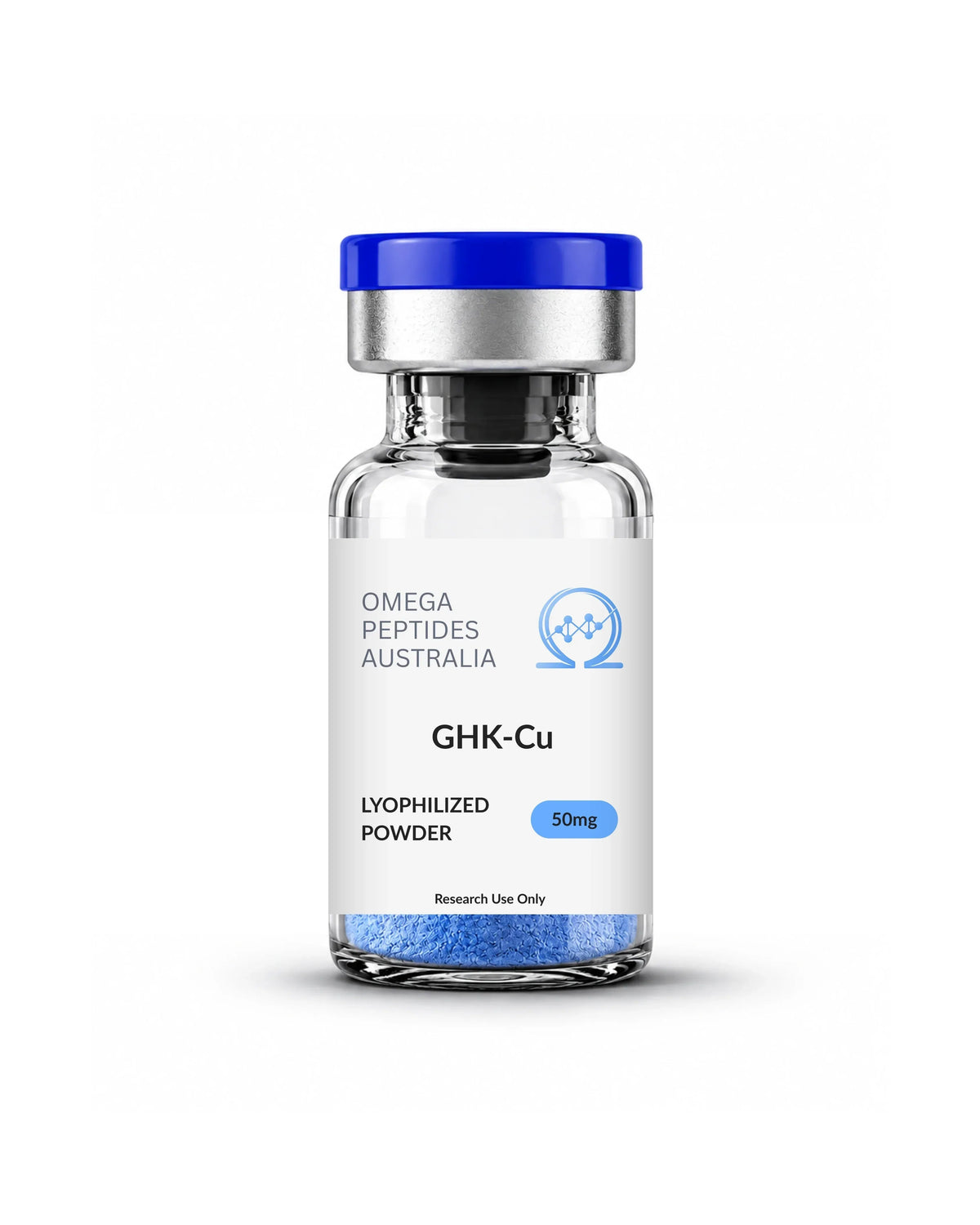
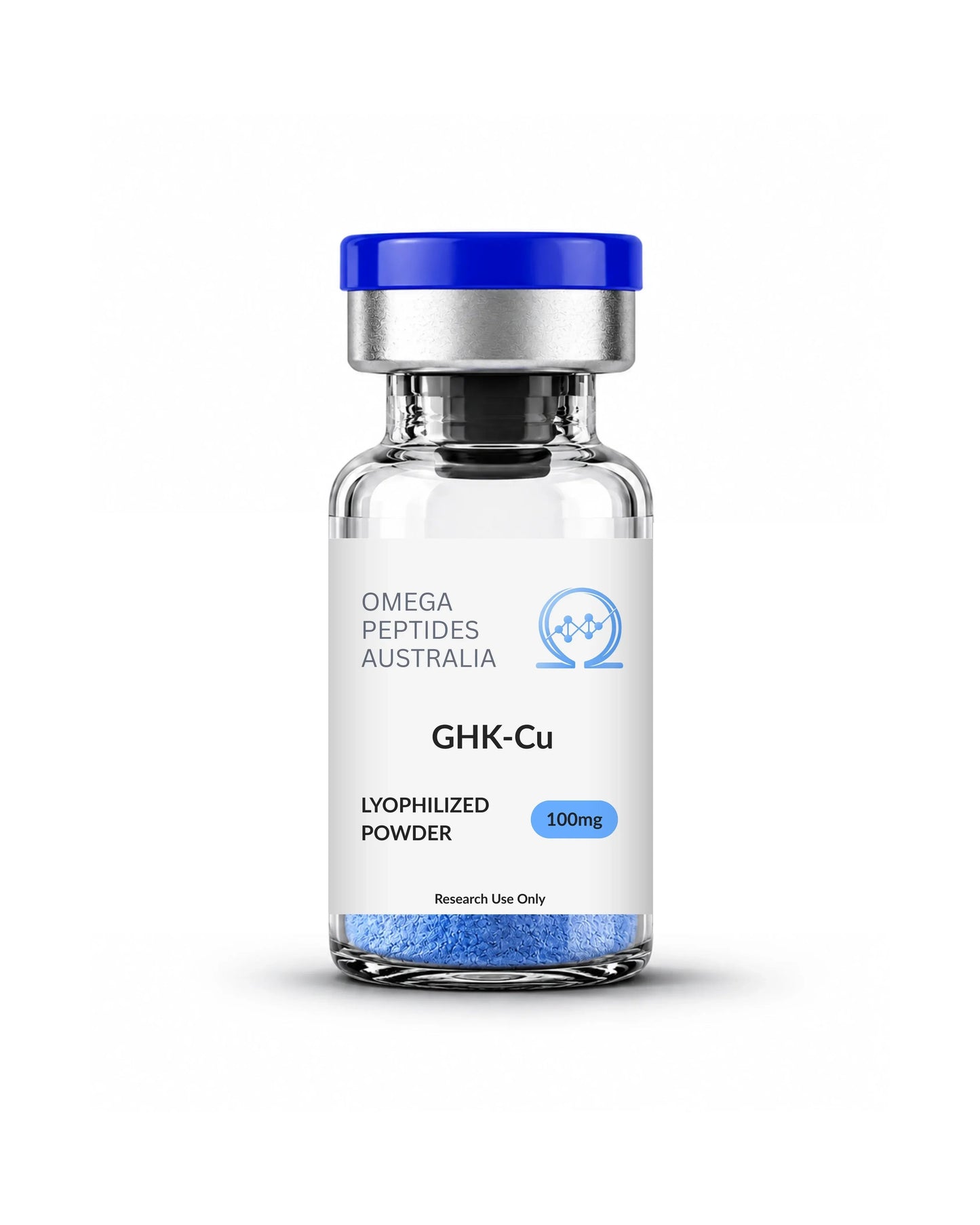
Omega Peptides Australia supplies GHK-Cu as a high-purity (≥99% HPLC) COA-verified lyophilised powder. This 50mg vial is our standard starter size, dispatched same day from within Australia on orders placed before 12pm. For labs running larger or repeated studies, GHK-Cu is also supplied as a 100mg vial at a lower cost per mg. Every batch is independently tested, and the certificate for your vial can be checked in our COA library before you order.
Key research areas
- Skin and collagen research GHK-Cu is one of the most extensively studied peptides in dermal biology. In cultured human fibroblasts it has been reported to increase synthesis of type I collagen, elastin, decorin and glycosaminoglycans, and in animal and ex-vivo skin models it has been examined for dermal thickness, elasticity and the remodelling of photo-damaged tissue.
- Wound healing and tissue repair Rodent wound models have been used to study GHK-Cu for wound closure, granulation-tissue formation and angiogenesis. The proposed mechanism combines copper delivery to copper-dependent enzymes such as lysyl oxidase with the recruitment of fibroblasts, immune cells and endothelial cells into the wound bed.
- Hair-follicle research GHK-Cu has been investigated in dermal-papilla cell cultures and animal models for follicle size and the transition of follicles into the growth phase, with the copper complex proposed to support follicle blood supply and matrix synthesis.
- Anti-inflammatory and antioxidant research In cell models the peptide has been reported to reduce secretion of inflammatory cytokines such as TNF-alpha and IL-6, to suppress NF-kB signalling and to limit iron release from ferritin, which reduces the pool of free iron available to drive oxidative damage.
- Gene-expression research Large-scale gene-expression profiling has been used to examine how GHK-Cu alters the activity of human genes involved in tissue repair, DNA repair, antioxidant defence and inflammation, and these data sets have prompted further investigation in lung, nerve and bone models.
- Copper transport research GHK binds copper(II) with very high affinity and can exchange the ion with albumin, so the complex is used as a model of physiological copper delivery to cuproenzymes such as superoxide dismutase and cytochrome c oxidase.
How GHK-Cu works
The activity of GHK-Cu depends on the way the tripeptide holds copper. The imidazole ring of the histidine residue, the free amino group of glycine and the backbone amide nitrogen together form a square-planar binding site that chelates copper(II) with an affinity comparable to that of albumin, so the peptide can accept copper from, and hand copper back to, the body's main copper-transport protein. This exchange is thought to be why free GHK and GHK-Cu behave differently in research: the copper-loaded form delivers a bioavailable ion to cells, supports copper-dependent enzymes involved in collagen cross-linking and antioxidant defence, and signals through cell-surface interactions that the free tripeptide does not fully reproduce.
GHK-Cu is a short peptide and is cleared quickly in the circulation, which is why most research uses local or repeated administration models rather than single systemic exposures. It is distinct from tissue-repair peptides such as BPC-157, a gastric-derived pentadecapeptide studied for angiogenic and nitric-oxide pathways, and from AHK-Cu, a related copper tripeptide used mainly in hair research. The reconstituted solution of GHK-Cu is a characteristic blue-violet colour, which comes from the copper complex and is a normal property of the compound rather than a sign of degradation.
Specifications
| Compound | GHK-Cu (copper tripeptide-1) |
| Also known as | GHK Cu, GHKCu, copper peptide, copper tripeptide-1, GHK copper, prezatide copper |
| CAS number | 89030-95-5 (copper complex); 49557-75-7 (free GHK tripeptide) |
| Molecular formula | C14H22CuN6O4 (copper complex) |
| Molecular weight | ~401.9 g/mol (copper complex); free GHK ~340.4 g/mol |
| Sequence | Gly-His-Lys (GHK), complexed with copper(II) |
| Category | Skin & collagen research |
| Purity | ≥99% HPLC, batch COA supplied |
| Form | Lyophilised powder in a sealed sterile vial |
| This vial | 50mg — $89.99 (about $1.80 per mg) |
| Also available | 100mg vial — $119.99 (about $1.20 per mg) |
| Storage (lyophilised) | 2–8°C short term or −20°C long term, protect from light and moisture, avoid repeated freeze-thaw |
| Storage (reconstituted) | 2–8°C, use within 28 days |
| Reconstitution | Bacteriostatic water (recommended) |
Available sizes and pricing
This page is the 50mg vial, GHK-Cu's standard starter size and the right choice for a single study or a first order. If your research needs a larger quantity or repeated administration across a longer study, the 100mg vial brings the cost per mg down by a third. GHK-Cu is also included in the GLOW Peptide Bundle alongside a BPC-157 and TB-500 blend for tissue-repair comparisons.
- 50mg vial (this page) — $89.99 (about $1.80 per mg)
- 100mg vial — $119.99 (about $1.20 per mg)
Quality and COA verification
Every batch of GHK-Cu is independently tested by Janoshik Analytical, with HPLC used to confirm purity at or above 99% and mass spectrometry used to confirm the identity of the copper tripeptide. A Certificate of Analysis is issued for every batch and published in our COA library, so the exact result for the vial you receive can be checked against its batch number. The peptide is supplied as a lyophilised powder in a sealed sterile vial, which keeps the copper complex stable in storage and during transit, and each order is packed in protective, discreet packaging for domestic delivery within Australia.
Frequently bought together
- KLOW (80mg) — $149.99, a multi-peptide blend that combines GHK-Cu with KPV, BPC-157 and TB-500 for combined repair models
- GLOW Peptide Bundle — $189.99, GHK-Cu paired with a BPC-157 and TB-500 blend at a bundle price
- BPC-157 (10mg) — $99.99, the tissue-repair pentadecapeptide most often run alongside GHK-Cu in wound models
- Bacteriostatic Water (10mL) — $29.99, the recommended diluent for reconstituting lyophilised peptides
Research guides
- GHK-Cu research guide
- What is GHK-Cu? Copper peptide research overview
- GHK-Cu vs BPC-157
- Best place to buy GHK-Cu in Australia
- How to store lyophilised peptides
- COA testing explained
- Peptide reconstitution calculator
Frequently asked questions
What is GHKCu?
GHKCu is simply GHK-Cu written without the hyphen. The letters are the single-letter codes for its three amino acids, glycine (G), histidine (H) and lysine (K), and Cu is the chemical symbol for copper. Whether it is spelled GHKCu, GHK Cu or ghk-cu, it refers to the same copper-bound tripeptide, supplied here as a 50mg lyophilised research vial.
What is GHK-Cu?
GHK-Cu is a copper complex of the tripeptide glycyl-L-histidyl-L-lysine. It occurs naturally in human plasma, saliva and urine and was isolated from plasma albumin in 1973. It is one of the most studied peptides in skin, collagen, wound-healing and hair-follicle research, and Omega Peptides Australia supplies it strictly for in-vitro laboratory use as a COA-verified lyophilised powder.
What is GHK-Cu also known as?
It is also written as GHK Cu, GHKCu or ghk-cu, and is often called copper peptide, copper tripeptide-1, GHK copper or ghkcu peptide. The cosmetic ingredient name is copper tripeptide-1 and the name prezatide copper appears in some chemical databases. The copper-free tripeptide is referred to simply as GHK and has its own CAS number, 49557-75-7.
How does GHK-Cu work?
GHK binds copper(II) with very high affinity through its histidine imidazole ring and glycine amino group, which lets it accept copper from albumin and deliver it to cells. In research models the copper-loaded peptide supports copper-dependent enzymes such as lysyl oxidase, stimulates fibroblast production of collagen, elastin and glycosaminoglycans, modulates matrix metalloproteinases, and dampens inflammatory signalling through the NF-kB pathway.
What does the research show about GHK-Cu?
Cell-culture work reports increased collagen and elastin synthesis in fibroblasts, while rodent wound models have examined faster closure and improved granulation tissue. Animal and ex-vivo skin models have been used to study dermal thickness and elasticity, dermal-papilla cultures have explored follicle growth, and gene-expression profiling suggests the peptide alters the activity of many genes tied to repair and antioxidant defence. These remain preclinical research findings.
Can I buy GHK-Cu at Chemist Warehouse or a pharmacy in Australia?
Not in this form. Retail pharmacies and beauty retailers such as Priceline do stock cosmetic serums that contain copper peptides at low concentrations, typically around 1%, blended into a topical formula. GHK-Cu as a pure lyophilised powder is not a registered medicine and is not sold by Chemist Warehouse, Priceline or other retail pharmacies. The research-grade compound supplied here is a different product intended for laboratory use.
Can Australian compounding pharmacies supply GHK-Cu?
Compounding pharmacies in Australia prepare medicines only for an individual patient on a practitioner's prescription and do not sell peptides to the public. Omega Peptides Australia is not a pharmacy. We supply the lyophilised research-grade compound with a batch COA for in-vitro laboratory work only.
How do you reconstitute GHK-Cu?
Use bacteriostatic water. Let the vial reach room temperature, then add the water slowly down the inside wall so it runs onto the powder rather than splashing it. Swirl gently until fully dissolved, do not shake, as agitation can damage the peptide. The solution will take on a blue-violet colour from the copper complex. Refrigerate at 2 to 8°C and use within 28 days. Our reconstitution calculator can help with concentrations.
How should GHK-Cu be stored?
Keep lyophilised vials sealed at 2 to 8°C for short-term storage or at minus 20°C for long-term storage, protected from light and moisture, and avoid repeated freeze-thaw cycles. The copper complex is stable as a dry powder for extended periods under these conditions. Once reconstituted, store the solution in the refrigerator at 2 to 8°C and use within 28 days.
Where can I buy GHK-Cu in Australia?
GHK-Cu can be ordered directly from Omega Peptides Australia. Stock is held domestically, orders placed before 12pm are dispatched the same day with tracked shipping, and every batch has an independent Janoshik COA available in our library. You can browse the full range of research peptides in Australia if you are ordering several compounds for the same study.
What does GHK-Cu cost in Australia?
This 50mg vial is $89.99, about $1.80 per mg. A 100mg vial is also available at $119.99, about $1.20 per mg, a lower cost per mg for labs that use the peptide regularly. GHK-Cu is also available at a bundle price in the GLOW Peptide Bundle at $189.99, which includes a BPC-157 and TB-500 blend.
How do I get GHK-Cu online in Australia?
Add this 50mg vial to your cart and check out, or switch to the 100mg vial first if you need the larger size. Orders are shipped with tracked domestic delivery in discreet packaging from our Australian stock, and orders placed before 12pm on a business day are dispatched the same day. Because we ship from within Australia there are no customs delays or import paperwork to deal with.
Is GHK-Cu legal in Australia?
Omega Peptides Australia supplies GHK-Cu strictly for lawful in-vitro laboratory research. It is not approved by the TGA for human or veterinary use and is not sold as a medicine, cosmetic or supplement. Purchasers are responsible for ensuring their intended use complies with all applicable laws.
Should I choose the 50mg or 100mg vial?
The 50mg vial on this page is the standard choice for a first order or a single study, since it matches the quantities used in most published cell-culture and small-animal protocols without tying up capital in unused powder. Labs running a longer study, a larger cohort, or several concurrent experiments typically move to the 100mg vial, which lowers the cost per mg by about a third for the same purity and COA verification.
⚠ For in-vitro research and laboratory use only. Not for human or veterinary use.